
Executive Summary
Enterprise connectivity in 2026 is no longer a single-technology decision. IT leaders are navigating a landscape where private 5G, CBRS, and Wi-Fi 7 are all maturing simultaneously and where AI is reshaping how networks are managed, optimized, and planned. Choosing the right architecture requires understanding what each technology actually delivers, where it falls short, and how AI-managed converged networks are changing the calculus.
By 2026, the average enterprise network supports over 50 connected devices per employee, according to Cisco’s Annual Internet Report, and most of those networks were designed for a fraction of that load.
The warehouse manager notices it first. Inventory scanners dropping connection mid-count. Autonomous guided vehicles pausing in the aisle, waiting for a signal that should already be there. On the factory floor two buildings over, a machine vision system meant to catch defects in real time is buffering. In the hospital wing across town, a nurse is walking back to a fixed terminal to pull up patient data because the mobile device lost its connection somewhere between the elevator and the ward.
The applications have changed. The devices have multiplied. The expectations placed on enterprise wireless have been rewritten entirely. The infrastructure, in most cases, has not kept pace.
The Enterprise Connectivity Problem Has Changed
Five years ago, the enterprise connectivity decision was relatively contained. Today it is about whether the network can support applications that will not tolerate failure, devices that number in the thousands per campus, and AI workloads that demand real-time data movement at a scale no one was designing for in 2020. The enterprise WLAN market totaled $10.5 billion in full-year 2025, growing 11.4% annually, according to IDC’s Worldwide Quarterly WLAN Tracker published in March 2026. IDC is explicit: in the AI era, connectivity is no longer just infrastructure. It is a strategic foundation for digital business. When wireless underpins autonomous guided vehicles, machine vision systems, real-time AI inference, and clinical telemetry, a dropped connection is an operational failure. The stakes have risen accordingly.
The Technology Options on the Table
Enterprise IT leaders in 2026 are assembling a connectivity architecture from maturing options, each with a distinct performance profile, cost structure, and operational overhead. The honest answer to which technology is right is almost always: more than one.
Private 5G: Control, Performance, and the Spectrum Question
Private 5G delivers dedicated spectrum, deterministic sub-10ms latency, network slicing with guaranteed QoS, and deep indoor and outdoor coverage. Private LTE/5G networks reached 6,500 deployments globally in 2025, according to Computer Weekly, driven increasingly by organic enterprise demand. The platform’s own deployment coverage, spanning manufacturing, ports, logistics, and mining, documents what these networks look like in operational environments. Deploying a private 5G network typically costs between $250,000 and $1 million depending on site size, according to PatentPC, and requires specialized expertise most enterprise IT teams do not have in-house. Dell’Oro Group is clear: private cellular adoption will remain concentrated in use cases where performance requirements genuinely justify the cost and complexity.
CBRS: The Unlicensed Path to Private Cellular
CBRS operates across 150 MHz of mid-band spectrum in the 3.5 GHz band, managed through a cloud-based Spectrum Access System. Most enterprise deployments use the General Authorized Access tier, building a private cellular network without FCC auction participation or ongoing licensing fees. The OnGo Alliance confirmed CBRS 2.0 as fully proven in 2025 and has shifted its focus to broad commercial adoption. The platform’s dedicated CBRS section covers the technology, spectrum framework, and deployment landscape in depth.
Wi-Fi 7: Still the Default, Now With More to Prove
Enterprise-class Wi-Fi 7 will become mainstream in 2026, tracking three times faster than Wi-Fi 6E at the same lifecycle stage, according to Dell’Oro Group. It earns its place in high-density indoor environments, for employee IT connectivity, and wherever broad device compatibility and familiar operational tooling matter. Its limits appear in deterministic performance under interference and outdoor coverage. Dell’Oro is forecasting double-digit growth for enterprise WLAN in 2026, with Research Director Siân Morgan stating this is the year enterprises can genuinely prove ROI on AI-powered network operations. Wi-Fi 7 is not losing ground to private cellular. It is maturing alongside it.
The AI-Managed Network: A Layer Across All Three
AI is not a fourth connectivity technology. It is a management and optimization layer that sits across all three. At Mobile World Congress in March 2026, T-Mobile demonstrated concurrent AI and RAN processing on NVIDIA’s AI-RAN platform, while SoftBank’s AITRAS live field trial achieved an industry-first 16-layer massive MIMO using fully software-defined 5G. The AI-RAN Alliance now counts over 130 participating companies. The platform’s analysis of why Nvidia’s AI-RAN bet matters beyond the carrier world documents what this shift means for enterprise wireless operators. For enterprise IT leaders, AI-managed networks are becoming the standard management approach for any multi-technology wireless environment.
PRO TIP — Map Your Traffic Before You Choose Your Technology
Before any RFP or vendor conversation, classify your enterprise traffic by latency tolerance, mobility requirement, and criticality. Build a simple matrix: list your top 10 application types, assign each a latency tolerance (under 10ms, under 50ms, best-effort), a mobility pattern (fixed, zone-roaming, site-roaming), and a failure impact rating (production-critical, business-impacting, recoverable). AI workloads, OT sensor data, and employee Wi-Fi have fundamentally different requirements. Mixing them on a single network architecture without that classification exercise is where most enterprise connectivity projects run into trouble.
Technology Comparison
| Licensed Private 5G | CBRS-Based Private 5G | Wi-Fi 7 | |
| Spectrum | Licensed / dedicated | Shared (GAA/PAL, 3.5 GHz) | Unlicensed (2.4 / 5 / 6 GHz) |
| Typical deployment cost | $250K to $1M+ | Lower than licensed private 5G | Lowest of the three |
| Indoor coverage | Excellent | Excellent | Excellent (needs more APs) |
| Outdoor / large site coverage | Excellent | Excellent | Limited |
| OT / industrial suitability | High | High | Moderate |
| Device ecosystem maturity | Growing | Growing | Mature |
| In-house IT manageability | Requires specialist skill | Moderate complexity | Familiar to IT teams |
| AI management support | Native in modern platforms | Native in modern platforms | Supported, vendor-dependent |
Three Questions Before You Choose
Enterprise connectivity decisions fail not because organizations chose the wrong technology, but because they chose before answering the questions that should have come first. The platform’s wireless self-audit tool walks through these dimensions in a guided format.
Question 1: What are the latency and reliability requirements of your most demanding applications?
If your most demanding applications are video collaboration, file access, and SaaS tools, Wi-Fi 7 will serve them well. If they include autonomous guided vehicles, real-time machine vision, or edge AI inference requiring sub-10ms latency, private 5G or CBRS belongs in your architecture. The question becomes where, not whether.
Question 2: What does your coverage environment require?
Pure indoor environments: Wi-Fi 7 is capable and cost-effective. Large indoor sites with industrial RF characteristics: private cellular is likely necessary in some zones. Mixed indoor-outdoor large sites: private cellular is almost certainly required. Underground or harsh environments: private cellular is the only practical option.
Question 3: What is your genuine in-house capability to manage a new technology stack?
Private 5G and CBRS introduce a technology stack that most enterprise IT teams have no prior experience managing. If you lack RF engineering capability or 5G core management experience, a managed private wireless service model is likely more appropriate. Private 5G-as-a-Service offerings are expanding specifically for mid-market enterprises that need private cellular performance without the in-house expertise to run it.
When to Layer Rather Than Choose
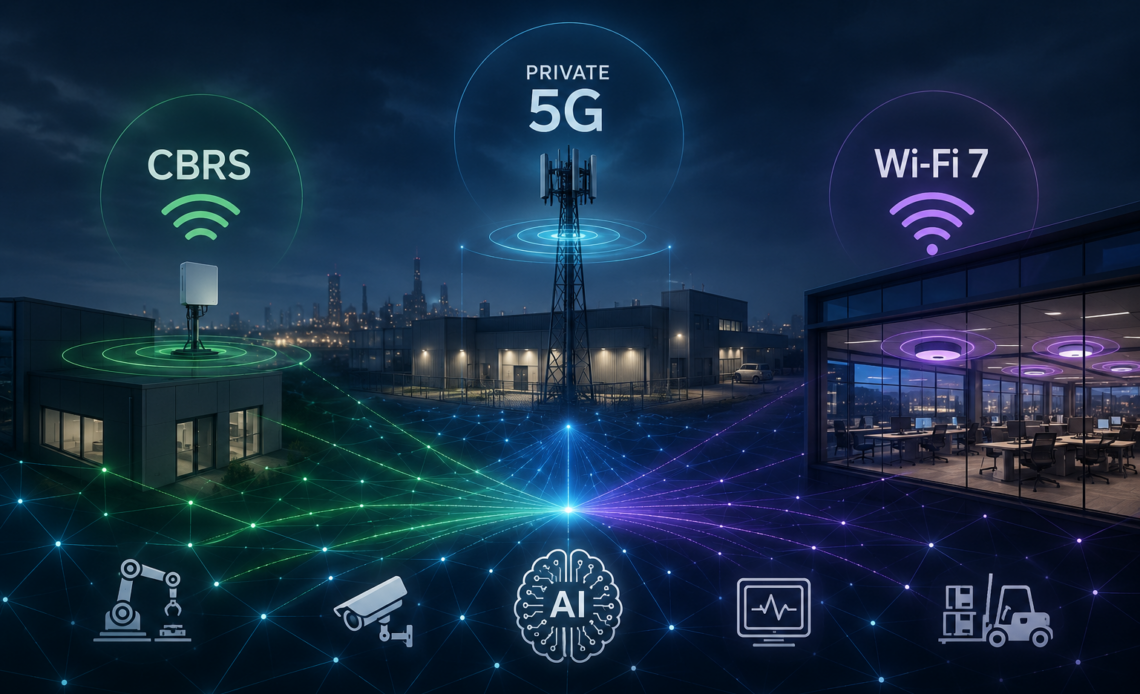
The framing of private 5G versus Wi-Fi as a competitive choice is increasingly outdated, according to Dell’Oro Group’s December 2025 enterprise networking market predictions. The converged architecture that is becoming standard works as follows: private 5G handles the OT layer for AGVs, machine vision, and latency-critical applications; Wi-Fi 7 handles the IT layer for employee devices and general productivity; AI management sits across both, enforcing traffic policy and running anomaly detection. The WBA’s OpenRoaming standard is gaining adoption, with 38% of surveyed enterprises already running compliant networks and a further 32% planning deployment in 2026, according to the platform’s Enterprise LAN in 2026 analysis. One dependency that catches enterprises off guard: Wi-Fi 7 access points require 10 Gbps uplink ports and Cat 6A cabling. If campus switching has not kept pace, the wireless upgrade hits a ceiling in the wired layer first.
Where Does This Leave You?
If you are a vendor, systems integrator, or solution provider working in the enterprise wireless market, the converged architecture trend is your most significant commercial opportunity and your most significant positioning challenge simultaneously. Enterprises ready to deploy private cellular alongside Wi-Fi 7 are not looking for a technology component. They are looking for an outcome-based partner who can design a converged architecture, manage OT integration complexity, and take accountability for performance. The organizations winning in 2026 are not the ones with the best access point specifications. They are the ones who can walk into a manufacturing plant, map the application portfolio against the technology options, and deliver a network that keeps running when it matters. If your go-to-market still leads with hardware specifications and price-per-access-point comparisons, you are selling to a buyer who has moved on.
If you are an enterprise IT director or technology decision-maker, the honest position in 2026 is this: you probably need more than one wireless technology, your current network was probably not designed for the applications you are now running on it, and the window to make a considered architecture decision is narrower than it appears. Start with the three diagnostic questions in this article before any vendor engagement. If private cellular is on your radar, engage a systems integrator who has deployed it in your vertical and ask for documented outcomes, not reference architecture slides. If Wi-Fi 7 is your near-term priority, plan the switching layer at the same time as the access points. The timeline from decision to operational network is longer than most IT planning cycles assume.
Frequently Asked Questions
What is the difference between private 5G and CBRS for enterprise connectivity?
CBRS is a spectrum framework; private 5G is a network architecture. Many private 5G deployments in the US run on CBRS spectrum, which is why the terms are sometimes used interchangeably but describe different things. Licensed spectrum private 5G delivers stronger interference protection for mission-critical applications. CBRS is the accessible entry point for enterprises that need private cellular performance without spectrum ownership costs. Both support LTE and 5G NR standards and are in production deployment across manufacturing, logistics, education, and healthcare today.
Is Wi-Fi 7 good enough for industrial environments in 2026?
For some industrial applications, yes. For the most demanding ones, no. Fixed sensors, operator tablets, and general office connectivity can be well served by a well-designed Wi-Fi 7 deployment. The limits appear where electromagnetic interference from welding processes and heavy motors degrades Wi-Fi performance, where outdoor yards make access point density expensive, and where AGVs and safety-critical control systems need deterministic latency that Wi-Fi’s best-effort delivery cannot reliably provide. Most industrial enterprises need a layered architecture.
Which enterprise verticals are adopting private wireless the fastest?
Manufacturing leads, driven by hostile RF environments, latency-critical OT applications, and measurable ROI from documented deployments. Logistics, ports, and transport are the second major cluster, where coverage continuity across large mixed indoor-outdoor environments creates problems Wi-Fi cannot solve economically. Education and public sector have been significant CBRS adopters. Healthcare is accelerating in 2026, driven by connected medical devices and AI-assisted diagnostics. Mining and utilities round out the primary cluster, where underground environments create use cases with no viable Wi-Fi alternative.
How do I know if my enterprise is ready for a private cellular network?
Readiness has three dimensions. On application requirements: if your most demanding applications include autonomous guided vehicles, real-time machine vision, or edge AI inference requiring consistent sub-10ms latency, the application case is present. On operational capability: lacking RF engineering expertise in-house is a deployment model decision, not a disqualifier. Managed service models exist for exactly this situation. On financial structure: assess whether a capital deployment or OpEx subscription fits your budget cycle, and whether your TCO analysis covers the full cost of the problem being solved, not just the hardware.