
Vertical: Defense
Application: Command and control, C5ISR integration, autonomous systems coordination (drones, sensors, anti-drone systems), edge computing, secure multi-domain communications
Ecosystem: Atika Technologies, Telefónica, Nokia
Private Network: 5G
Quick Answer
Spain’s Ministry of Defense is installing a permanent private 5G network at the Lešť training area in Slovakia, where Spanish forces lead a NATO multinational battlegroup. Developed under NATO’s Pilot Project 5 and led by Spain’s Joint Cyber Command, the network is described as the alliance’s first tactical 5G deployment built for a live operational base rather than a lab or short-term trial. The system supports command and control, intelligence integration, and connectivity for autonomous platforms such as drones and sensors, and complements a separate portable 5G unit built by Atika Technologies. Spain’s track record with private cellular networks in air, sea, and cyber domains – much of it developed with Telefónica – provides the foundation for this deployment.
A New Kind of Deployment for NATO
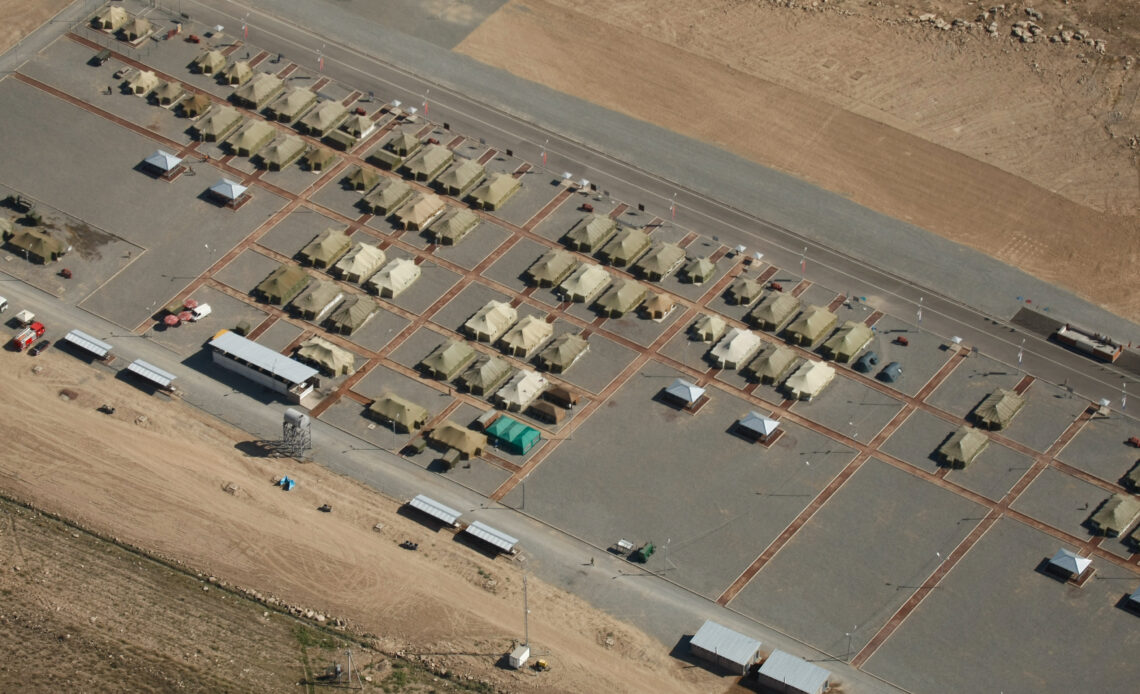
Most coverage of private 5G networks focuses on factories, ports, or campuses. Spain’s latest project moves the conversation into a different setting entirely: an active NATO training base in Slovakia. The Spanish Ministry of Defense is integrating what has been described as NATO’s first permanent tactical 5G network into the Lešť training area, where Spain leads a multinational battlegroup as part of NATO’s forward presence in the region.
Unlike earlier military 5G trials, which were typically run in controlled lab settings or limited to short pilot windows, this deployment is intended to operate continuously at a base that hosts hundreds of military personnel from multiple allied countries. That distinction matters. A permanent installation means the network has to perform under the unpredictable conditions of daily military operations, not just during a scheduled demonstration.
The project is being led by Spain’s Joint Cyber Command, known by its Spanish acronym MCCE, and falls under NATO’s Pilot Project 5 – an alliance-wide initiative for validating emerging communications technologies directly in operational environments. According to NATO’s framework, the Lešť installation could serve as a template that other member nations look to as they evaluate their own approaches to tactical 5G.
What the Network Is Designed to Do
The stated purpose of the Lešť network is to support low-latency communications, connect a large number of devices simultaneously, and maintain service continuity even under electromagnetic interference or degraded conditions – a requirement that has no real equivalent in commercial network design.
Architecturally, the network reportedly uses isolated cores and edge computing co-located with radio equipment, paired with hybrid designs that bridge tactical radios, satellite communications, and legacy systems already in use at the base. The intent is for the network to support Command, Control, Communications, Cyber, Intelligence, Surveillance, and Reconnaissance – commonly abbreviated as C5ISR – by linking intelligence and command systems with autonomous platforms such as drones, ground sensors, and counter-drone systems through deterministic, low-latency connections.
Spain’s Ministry of Defense isn’t approaching this without prior experience. Through the Joint Cyber Command’s partnership with Telefónica, Spain has already deployed what it calls 5G “tactical bubbles” across air, sea, and cyber domains. These have included an airborne 5G system on a military aircraft, a four-month operational 5G deployment aboard a NATO naval vessel – developed with Atika Technologies and cybersecurity firm Ravenloop alongside Nokia – and a dedicated 5G Cyber Defense Center built to protect communications between radars, drones, and weapons systems.
The Lešť deployment is complemented by a second, portable system. Spain’s Army has begun testing a separate tactical 5G unit in Slovakia developed by Atika Technologies, a Spanish company founded in 2022, designed to establish mobile coverage within minutes for deployed units and autonomous systems. The portable unit’s core fits into a carrying case connected to a second case containing servers and applications, with coverage that can reach up to a kilometer, though it has reportedly been limited to between 400 and 500 meters during testing to avoid revealing unit positions. The software is also designed to integrate with the Spanish Army’s Battlefield Management System.
Why This Matters Beyond the Military
Defense deployments like this one don’t stay confined to defense. Networks built to survive jamming, maintain isolated cores, and process data at the edge under degraded conditions are, in effect, stress tests for resilience patterns that civilian critical infrastructure increasingly needs as well – energy grids, ports, and logistics hubs among them.
That overlap isn’t new. Private 5G networks for the military have already been explored in contexts ranging from arctic operations to naval base logistics, and the lessons from those projects have informed how edge computing and network slicing are being applied in commercial settings. NATO’s Pilot Project 5 framework is explicit about this dual purpose: validating tactical 5G architectures that could, if successful, standardize patterns across member nations while informing how other sectors approach private network resilience.
The broader trend is one of military 5G maturing from a demonstration technology into infrastructure treated as mission-critical – where, as with any private cellular deployment, a network failure has direct operational consequences. For organizations watching how private networks evolve to meet demanding reliability and security requirements, defense deployments like Lešť offer an early look at architectures that may eventually filter into other high-stakes environments.
Frequently Asked Questions
Q1: What makes the Lešť deployment different from earlier military 5G trials?
A: Earlier military 5G projects were generally run as lab tests or time-limited pilots. The Lešť network is described as a permanent installation at a base hosting hundreds of troops from multiple allied nations on an ongoing basis, which means it has to perform reliably under real day-to-day military conditions rather than during a scheduled trial window. It is also being developed under NATO’s Pilot Project 5, a formal framework for validating emerging technologies for potential alliance-wide adoption – giving the project a different scope and stakes than a single-country pilot.
Q2: Who is building the network, and what experience are they bringing to it?
A: The project is led by Spain’s Joint Cyber Command (MCCE). Spain’s broader track record with private 5G networks comes largely through its partnership with Telefónica, which has deployed 5G “tactical bubbles” across air, sea, and cyber domains, including an airborne system on a military aircraft and a four-month deployment aboard a NATO naval vessel built with Atika Technologies, Nokia, and Ravenloop. A separate portable tactical 5G unit being tested alongside the Lešť installation was developed by Atika Technologies, a Spanish company founded in 2022 that designed the system to establish mobile coverage within minutes and integrate with the Spanish Army’s existing battlefield management software.
Q3: Why would a military 5G deployment matter to organizations outside the defense sector?
A: Military deployments are often where the most demanding requirements for reliability, security, and edge computing get tested first. The Lešť network’s design goals – isolated cores, edge processing co-located with radios, and continuity of service under degraded or jammed conditions – mirror the resilience requirements of civilian critical infrastructure like energy grids, ports, and logistics hubs. NATO’s Pilot Project 5 explicitly frames the Lešť deployment as a potential template for the alliance, and architectures proven in defense settings have a track record of informing how private cellular networks are designed for other high-stakes commercial environments.