
- Why Centralized Network Management Breaks Down at the Edge of Coverage
- AI at the Edge: What's Actually Changing
- Autonomous Orchestration Between Terrestrial and Non-Terrestrial Networks
- What This Means for the Practitioner Right Now
- Where Does This Leave You?
- Stay Ahead of What's Coming Next
- Frequently Asked Questions
- How is AI-driven NTN orchestration different from the network AI already used in terrestrial 5G?
- Is any of this actually deployed commercially today, or is it still standard work and vendor roadmap?
- What does an SI need to ask a vendor to tell the real edge AI capability from a relabeled centralized system?
- Does autonomous orchestration reduce the need for a dedicated network operations team, or just change what they do?
Quick Answer:
AI is moving out of the centralized telecom cloud and into 5G non-terrestrial networks (NTN) themselves, running on satellites, gateways, and devices to handle beam management and handoff decisions in real time. This matters because satellite links carry propagation delay that a distant, centralized controller cannot always outrun. Vendors and enterprise IT teams evaluating non-terrestrial connectivity should ask exactly where that AI processing actually runs before trusting any orchestration claim.
Satellite and direct-to-device connectivity are no longer just about extending coverage into places terrestrial towers cannot reach. As non-terrestrial links carry more real-time enterprise traffic, the round-trip delay to a centralized network controller becomes an operational problem, not a minor inconvenience. Artificial intelligence is starting to move onto the edge itself, running inference on the satellite, gateway, or device to make handoff and beam management decisions without waiting for instructions from the ground. This article covers three mechanisms: dynamic beam management, predictive handoff between terrestrial and non-terrestrial links, and autonomous orchestration grounded in the 3GPP-defined 5G NTN standard. For systems integrators (SIs) and enterprise IT teams, the takeaway is direct: vendor claims about AI-driven NTN orchestration deserve scrutiny, since genuine edge processing and a centralized system with an AI label are not the same product.
The global satellite NTN market was valued at $297.4 million in 2025 and is projected to reach $3.7 billion by 2034, according to Straits Research.
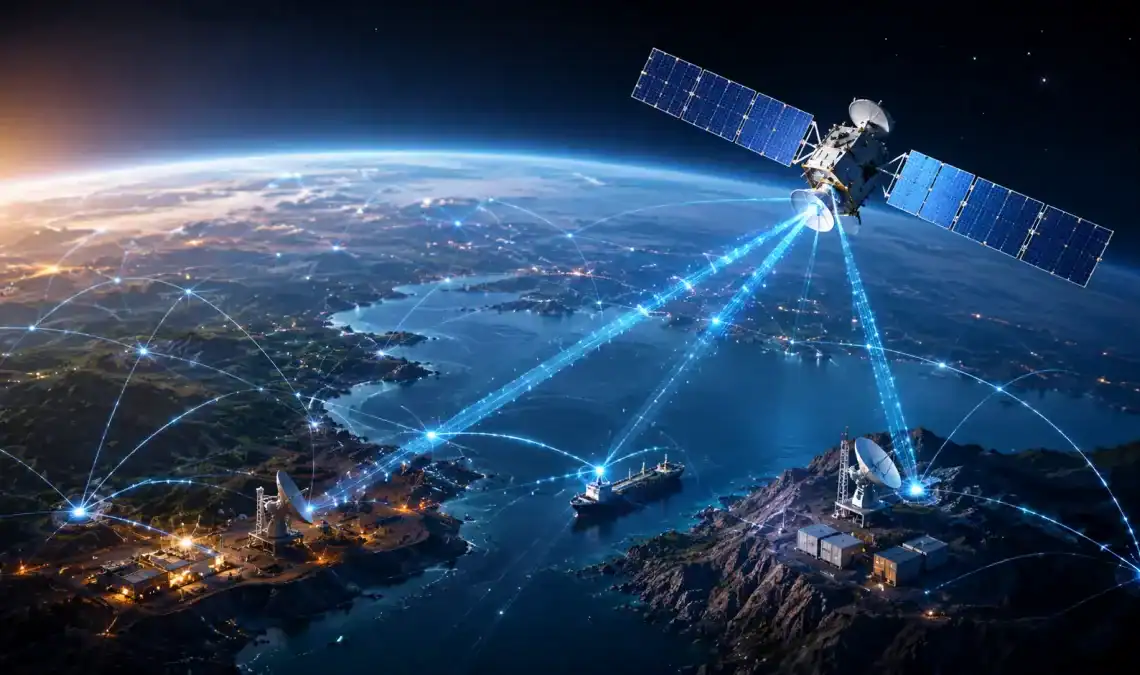
A logistics fleet crossing open water loses its terrestrial LTE signal 50 kilometers offshore. In the old model of non-terrestrial connectivity, the vessel’s onboard system waits. It holds the last known routing table and pings a shore-based network controller for authorization to hand off to the nearest satellite beam. On a good day, that round trip costs a few hundred milliseconds. On a bad day, it costs a dropped session and a re-authentication the crew notices before dispatch does.
Now picture the same vessel with a different system onboard, one that predicts the coverage gap several minutes before it happens, based on signal strength and heading, and pre-stages the handoff to satellite before the terrestrial signal drops. No round trip. No dispatch call. The decision happens where the antenna is, not in a data center 300 miles inland.
That second scenario is not a research demo. It is where non-terrestrial network orchestration is heading, and the reason is not ambition. It is math. Satellite links, especially low Earth orbit links, introduce delays and intermittency that a purely centralized, cloud-based controller cannot always overcome.
Why Centralized Network Management Breaks Down at the Edge of Coverage
Non-terrestrial links have always been the exception in a network built around terrestrial physics. Terrestrial 5G handoffs between small cells happen in milliseconds, fast enough that a centralized controller can authorize the switch without the user noticing. Non-terrestrial links do not offer that margin. The physical distance to a satellite introduces real propagation delay before a signal reaches the network core, and low Earth orbit constellations mitigate some of that delay at the cost of constant handoffs as satellites move overhead.
The Latency Problem in Plain Terms
A terrestrial handoff between adjacent cell towers is typically resolved before a user would ever register a dropped call. A satellite handoff, particularly to a geostationary satellite roughly 35,000 kilometers away, adds propagation delay that a centralized controller in a regional data center cannot engineer around. Low earth orbit constellations, increasingly used as backhaul in remote environments, cut that distance dramatically, part of why LEO is projected to be the fastest growing segment of the satellite NTN market, but LEO satellites also move relative to a fixed ground point, so a device connected to one satellite may need a new handoff decision every few minutes, not every few hours.
Where This Shows Up in Practice
This is not a theoretical concern. It shows up directly in the verticals where NTN is already working today:
• Maritime fleets moving between coastal terrestrial coverage and open ocean satellite coverage.
• Mining and remote industrial sites where a private LTE or CBRS network covers the site, but backhaul depends on satellite.
• Logistics operations tracking assets across regions with inconsistent terrestrial 5G coverage.
In each case, a centralized controller making handoff decisions after the fact means dropped telemetry, delayed alerts, or a maintenance window that starts later than it should.
AI at the Edge: What’s Actually Changing
The network management version of artificial intelligence that most enterprise IT teams have already encountered lives in the cloud. It ingests telemetry from across a terrestrial network, looks for anomalies, and recommends or automates a response from a centralized platform. That model works well when the round-trip to the cloud takes milliseconds. It works far less well when part of the network is a satellite link with a meaningful built-in propagation delay. The shift underway in non-terrestrial networks is about where the intelligence physically sits, not just what it does, one of several open questions about the AI edge that enterprises and SIs are still working through.
| Dimension | Centralized Cloud AI | Edge-Resident AI |
| Where inference runs | Regional or centralized data center | Onboard the satellite, gateway, or device |
| Latency tolerance | Works well when the round-trip is milliseconds | Built for links with meaningful propagation delay |
| Typical maturity today | Common in terrestrial 5G network management | Early stage, built on finalized Release 18 and advancing through Release 19 |
| What to verify with a vendor | What the platform automates centrally | Where the model executes and on what hardware |
Dynamic Beam Management
Traditional satellite beam management allocates capacity on a schedule set from the ground, adjusted periodically as demand patterns become clear. AI-driven beam management works differently. Models running closer to the payload, in some architectures onboard the satellite, adjust beam direction and capacity allocation in near real time based on where demand is actually concentrated, rather than where a schedule assumed it would be. Work within the 3GPP NTN standard on regenerative payloads, where processing happens on the satellite rather than the satellite simply relaying a signal to the ground, is a direct enabler of this shift. A similar shift is happening in terrestrial networks, too, where AI is increasingly driving radio access network operations.
Predictive Handoff Between Terrestrial and Non-Terrestrial Links
Predictive handoff is the mechanism at the center of the maritime scenario described earlier. Rather than reacting to a lost terrestrial signal, a predictive model uses signal degradation patterns, device movement, and historical coverage data to anticipate a coverage gap before it occurs and pre-stage the handoff to a satellite link. This only works if the prediction and the decision happen close to the device. A prediction made accurately but acted on too late, after a round trip to a centralized controller, defeats the purpose.
PRO TIP: Ask vendors where the inference actually runs.
Before evaluating any vendor’s AI-driven NTN orchestration claim, ask directly: does the predictive or beam management model run on the satellite, the gateway, or the device, or in a centralized cloud platform that simply labels its output as AI? A dashboard that visualizes AI-generated recommendations is not the same as a system that acts autonomously at the point of decision. Request a specific answer about where inference executes, not a marketing summary.
Autonomous Orchestration Between Terrestrial and Non-Terrestrial Networks
Beam management and predictive handoff are individual mechanisms. Autonomous orchestration occurs when a network treats terrestrial and non-terrestrial layers as a single system, with AI making continuous decisions about which layer serves a given device or session, without human authorization for each handoff.
3GPP NTN as the Framework, Not Vendor Invention
It is worth being precise about where this capability comes from, because the answer is standards work, not proprietary vendor magic. 3GPP introduced non-terrestrial network support in Release 17, finalized in 2022, establishing 5G NTN as a commercial standard through NR-NTN and IoT-NTN specifications for devices with satellite-capable chipsets and IoT sensors, rather than unmodified consumer handsets. Release 18 expanded mobility procedures between terrestrial and non-terrestrial layers, and Release 19 work includes store-and-forward operation for delay-tolerant IoT traffic and regenerative payloads that move processing onto the satellite itself. Autonomous orchestration is only possible because these releases gave vendors a common framework, rather than each building a proprietary, incompatible approach to satellite handoff. For what’s standardized and what’s next, the release-by-release breakdown is worth its own read.
| Release | Status | Key NTN Capability | Why It Matters for AI at the Edge |
| Release 17 | Finalized, 2022 | NR-NTN and IoT-NTN specifications for satellite-capable chipsets and IoT sensors | Established the baseline standard that made commercial NTN devices possible |
| Release 18 | Finalized, 2024 | Expanded mobility procedures between terrestrial and non-terrestrial layers | Provides the handoff framework predictive AI models operate within |
| Release 19 | In progress | Store-and-forward IoT and regenerative payload architectures | Moves processing onto the satellite itself, the core requirement for genuine edge AI |
What Autonomous Actually Means, and What It Does Not
Autonomous orchestration does not mean unsupervised or unaccountable. In practice, the distinction comes down to a few concrete things:
• What it means: the system makes routine handoff and capacity decisions without waiting for a human or centralized controller to authorize each one.
• What it also means: those decisions are still logged for review, with genuinely ambiguous situations still escalated rather than resolved silently.
• What it does not mean: a system nobody needs to monitor. Any vendor describing autonomous orchestration that way is describing something that does not yet exist commercially.
What exists today, building on Release 18 and expanding through ongoing Release 19 work, is narrower and more credible: routine decisions handled at the edge, with oversight retained further up the stack, echoing the broader trend toward agentic AI in 5G networks.
What This Means for the Practitioner Right Now
None of this is fully mature yet. 3GPP NTN standardization is still working through Release 19; commercial device support remains limited; and most deployed non-terrestrial AI orchestration today is closer to the centralized model described earlier than to the edge-resident model this article covers. Exactly when satellite connectivity goes mainstream is still being debated across the industry, and that gap is what a practitioner needs to track over the next one to two years.
Signals Worth Watching
Three things are worth monitoring directly rather than taking a vendor’s word for it:
• Whether a vendor’s chipsets and gateways support Release 17 and Release 18 NTN capabilities specifically, not just satellite connectivity in general.
• Whether any regenerative payload or onboard processing capability is named specifically in a vendor’s architecture, rather than described only in general marketing terms.
• Whether a vendor can describe a specific handoff or beam management scenario their system has handled autonomously, with a measurable outcome, rather than a general capability statement.
Where Does This Leave You?
The answer looks different depending on which side of the deployment you sit on, but neither version is comfortable, nor is either optional.
For Vendors and Systems Integrators
If you are a vendor or systems integrator building or reselling non-terrestrial connectivity, the work ahead is evaluation, not adoption for its own sake. Push every AI-driven orchestration claim from a prospective partner back to a specific technical question: where does the inference actually run, and what Release 17 through Release 19 capabilities does the hardware support today, not on a future roadmap. Build your client-facing materials around what you can verify, not around the AI label itself. Clients evaluating private wireless and satellite hybrid deployments are sophisticated enough to ask the same question you should already be asking your suppliers. Putting that verified case in front of the practitioners who are actually asking it is its own separate task, and a vendor partnership program is the direct route to those buyers.
For Enterprise IT and OT Leaders
If you are an enterprise IT or operational technology (OT) leader with any deployment that depends on non-terrestrial backhaul, whether a remote industrial site, a maritime fleet, or a logistics operation crossing inconsistent terrestrial coverage, the immediate work is understanding where your own deployments carry that exposure. That means mapping which sites, assets, or operations rely on satellite handoff today, and where a coverage gap would create a real operational cost rather than a theoretical one. Running a wireless self-audit of your current deployment footprint is a concrete starting point, since it surfaces exactly where terrestrial and non-terrestrial coverage overlap and where they do not, before you evaluate any vendor’s AI orchestration claims against your own real exposure.
Stay Ahead of What’s Coming Next
PrivateLTEand5G covers private networks and enterprise wireless connectivity for the people actually building and deploying them. That includes real deployment case studies across manufacturing, mining, maritime, and logistics, standards analysis as it lands, and market research you can use in a business case. Browse the latest expert perspectives on private networks, or work through the private cellular network deployment reports for the sourced data behind the trends covered here.
Frequently Asked Questions
How is AI-driven NTN orchestration different from the network AI already used in terrestrial 5G?
Terrestrial 5G network AI has largely been centralized, running in cloud platforms that ingest telemetry and recommend or automate responses with a round-trip measured in milliseconds. Non-terrestrial AI orchestration pushes some of that intelligence onto the satellite, gateway, or device itself, because the propagation delay and intermittency of satellite links make a centralized round trip less reliable for real-time decisions. The underlying techniques are similar. Where the processing physically happens is the meaningful difference.
Is any of this actually deployed commercially today, or is it still standard work and vendor roadmap?
Both, depending on the specific capability. 3GPP Release 17 5G NTN connectivity is commercially deployed today in early forms, including emergency messaging on compatible smartphones. Fully autonomous, edge-resident orchestration builds on the finalized Release 18 mobility procedures but still depends on Release 19 work that remains in progress, keeping it closer to early vendor implementations than to broad commercial maturity. Expect availability to expand over the next one to two years rather than treating it as available everywhere today.
What does an SI need to ask a vendor to tell the real edge AI capability from a relabeled centralized system?
Ask specifically where the inference runs: on the satellite, the gateway, the device, or in a centralized cloud platform. Ask which 3GPP NTN release the hardware supports, since that determines what capabilities are even technically possible. Ask for a specific example of an autonomous handoff or beam management decision the system has handled, with a measurable outcome, rather than a general description of AI-powered orchestration.
Does autonomous orchestration reduce the need for a dedicated network operations team, or just change what they do?
It changes the work rather than eliminating it. Routine handoff and capacity decisions move to the edge, reducing the manual intervention a network operations team handles day to day. What remains, and in some ways grows, is oversight: reviewing logged decisions, handling ambiguous escalations, and auditing vendor claims about what systems are doing autonomously. Teams should expect their role to shift toward supervision and verification, not to disappear.