

- The Connectivity Gap That’s Costing You
- IoT Gives You Data. AIoT Gives You Decisions.
- Competitive Pressure – and a Security Reality CheckThe Competitive Pressure
- Where IT and OT Have to Meet – and What to Do About It
- Your Next Move, Depending on Where You Sit
- Frequently Asked Questions
- What is AIoT and how is it different from traditional IoT?
- Why is private 5G better than Wi-Fi for industrial predictive maintenance?
- What ROI can industrial organizations realistically expect from AIoT predictive maintenance?
- How serious is the cybersecurity risk for industrial AIoT deployments?
- What should a system integrator’s AIoT-on-private-5G service offering include?
- Where can I go deeper on AIoT, private wireless, and enterprise connectivity?
| QUICK ANSWER Unplanned downtime strips 11% of annual revenues from the world’s 500 largest companies — $1.4 trillion combined. The cause is rarely the sensors or the AI software. It’s the connectivity layer underneath: Wi-Fi drops in metal-dense environments and wired systems can’t follow mobile assets. AIoT (Artificial Intelligence of Things) moves intelligence to the edge — compact processors near machines run inference locally, catching bearing failures and gearbox anomalies in milliseconds. Private 5G is the connectivity layer that makes it reliable across an entire facility. |
| $1.4T Combined annual revenue lost to unplanned downtime across the world’s 500 largest companies – 11% of revenues (Siemens True Cost of Downtime 2024). |
Unplanned downtime now strips 11% of annual revenues from the world’s 500 largest companies – a combined $1.4 trillion, according to the Siemens True Cost of Downtime 2024 report. And yet the cause is rarely the sensors or the AI software. The missing piece is the connectivity layer underneath those tools. Wi-Fi drops out in metal-dense environments. Wired systems can’t follow mobile assets. The result is incomplete, delayed data feeding AI models that are trying to predict failures from imperfect inputs.
Private 5G, paired with AIoT – Artificial Intelligence of Things, the fusion of AI intelligence with IoT sensor networks – is a major infrastructure upgrade. And right now, it is moving from proof of concept to full-scale industrial deployment. Understanding what AI connectivity really means for enterprises starts here: not with the AI model or the sensor, but with the network that connects them.
The Connectivity Gap That’s Costing You
Private 5G is a dedicated wireless infrastructure installed within your facility. It delivers sub-20-millisecond response times, supports thousands of devices per square kilometer, and holds a reliable connection across sprawling indoor and outdoor environments – including mobile equipment and remote assets where Wi-Fi simply cannot follow.
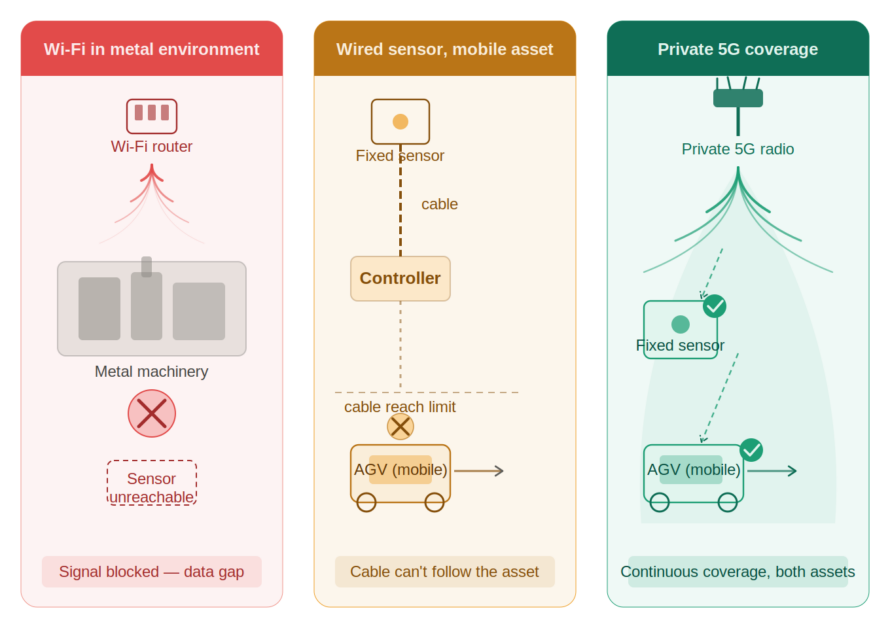
According to Ericsson, industrial assets typically operate for 20 to 30 years. The connectivity layer needs to match that lifespan. The business cost of getting this wrong is visible in every dead zone on the factory floor: every gap in coverage is a gap in data, and every gap in data is a maintenance decision made on incomplete information.
The market is responding accordingly:
- Private 5G network market: $4.1 billion in 2025, projected to reach $122.9 billion by 2035 at 40.5% CAGR – manufacturing the largest sector
- AIoT market: $171.4 billion in 2024, projected to reach $896.8 billion by 2030
- Predictive maintenance market: $15.6 billion in 2025, heading for $91 billion by 2034 at 21% CAGR
- These are not speculative numbers – they reflect capital already committed across manufacturing, energy, ports, and logistics
IoT Gives You Data. AIoT Gives You Decisions.
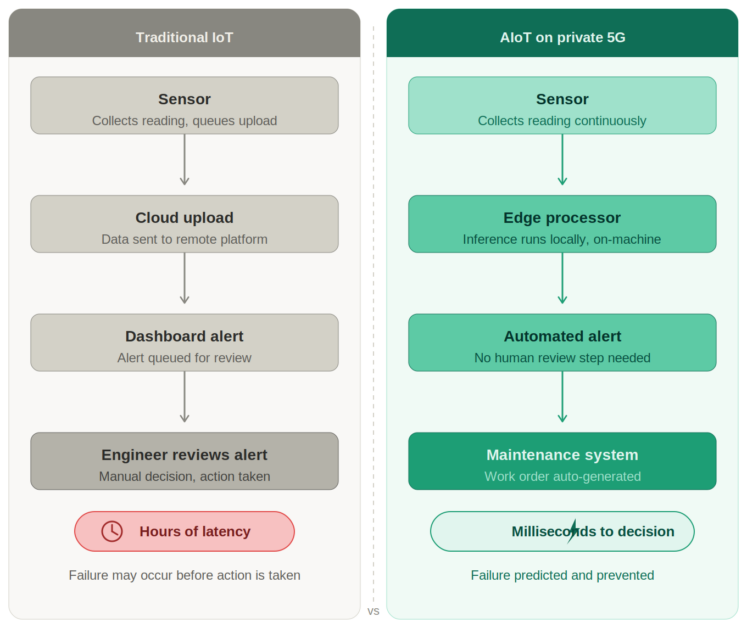
Traditional IoT collects sensor readings and passes them to a central system for analysis. The insight still depends on a human reviewing a dashboard and deciding what to do next. That introduces both latency and the risk of data going unactioned. In semiconductor manufacturing, a single hour of downtime can cost over $1 million – waiting on a dashboard is not a viable maintenance strategy.
AIoT moves the intelligence to the edge. Compact processors installed near the machines run inference models locally, catching the early thermal signature of a failing bearing or the subtle vibration shift that precedes a gearbox failure – in milliseconds, not seconds. Private 5G enables reliable, real-time edge-to-edge communication across an entire facility.
Documented outcomes from production deployments:
- 47% reduction in unplanned downtime – major European automotive manufacturer, AIoT on private 5G across robotic welding and painting lines, over 18 months
- 22% fall in maintenance costs – same deployment; spare parts inventory for critical motors decreased by 30%
- 50% cut in unplanned downtime – General Electric, connected predictive maintenance across power plants, saving $12 million annually
- 20% maintenance cost reduction – Guangzhou Metro’s 5G private network, documented operational outcome
- Cargill’s private 5G deployment on the factory floor followed the same architecture – real-time sensor data, edge inference, and a private network purpose-built for the environment
- Airbus and Ericsson’s smart factory deployment and BMW’s AI-powered Hungarian factory demonstrate the same pattern at aerospace and automotive scale
| Approach | Data Latency | Human-in-Loop? | Mobile Asset Support | Metal-Dense Reliability |
|---|---|---|---|---|
| Traditional IoT + Wi-Fi | Seconds to minutes | Yes – dashboard review required | Poor – coverage drops at range | Low – interference in metal environments |
| Traditional IoT + Wired | Near real-time | Yes – dashboard review required | None – fixed cable only | High – but no mobility |
| AIoT + Private 5G | Milliseconds at edge | No – autonomous inference | Full – AGVs, robots, handhelds | High – dedicated spectrum, no contention |
| ⚡ Audit Connectivity Before Adding More Sensors Before expanding your sensor estate, map which assets are generating data that never reaches your analytics platform – dead zones, bandwidth contention, or latency making data stale on arrival. That gap analysis defines your Phase 1 private 5G scope and ensures you’re not building more network than you need right away. In most facilities, targeted coverage of 20% of the floor space addresses 70–80% of the highest-value maintenance use cases. Organizations that achieved 25–30% reductions in maintenance costs focused first on thehighest-risk assets, not blanket deployment (WorkTrek, 2025). |
Competitive Pressure – and a Security Reality CheckThe Competitive Pressure
Energy and utilities are leading the predictive maintenance market, with the fastest projected CAGR of 34.6% through 2031, driven by grid modernization and reliability mandates. Texas-New Mexico Power’s bet on private wireless to strengthen the grid is one example of that pressure becoming investment. The companies still using reactive approaches are facing:
- $125,000 per hour – median downtime cost in manufacturing
- $2.3 million per hour – downtime cost in automotive facilities
- $1 million+ per hour – downtime cost in semiconductor manufacturing
Those figures tend to settle infrastructure debates quickly. As agentic AI moves into programmable network fabrics, the competitive gap between organizations with real-time maintenance intelligence and those still running reactive models will only widen.
The Security Reality
Dragos tracked 1,693 ransomware attacks on industrial organizations in 2024 – an 87% year-over-year increase, with manufacturing the hardest-hit sector. A properly configured private 5G network offers stronger protection than shared Wi-Fi, thanks to dedicated spectrum, network slicing, and Zero Trust Architecture enforced at the device level. But that posture has to be deliberately designed, not assumed.
The security vulnerabilities of enterprise private networks are real – and they compound significantly when AIoT systems connect to ERP platforms and cloud analytics environments that OT teams were not originally responsible for securing. The questions enterprises and SIs cannot afford to leave unanswered about the AI edge apply here with full force: security architecture has to be designed before the first sensor goes online, not retrofitted afterward.
Where IT and OT Have to Meet – and What to Do About It
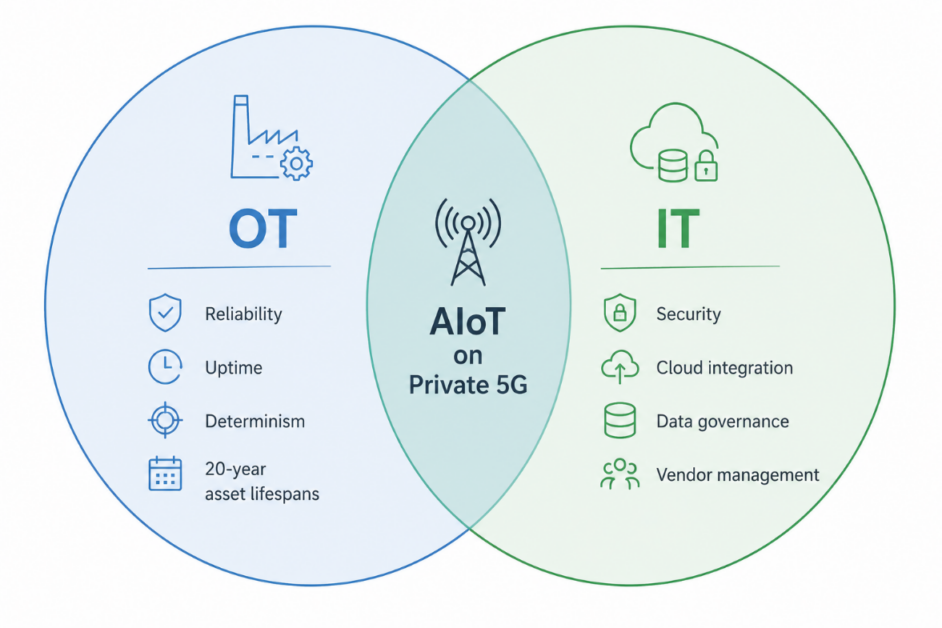
Deploying AIoT on private 5G is not purely a technology project. It is a convergence of operational technology and IT – two functions with different priorities, different vocabularies, and a long history of operating in separate silos. Most deployments stall not in the technology, but in the governance. Who owns the network? Who carries the security mandate? These questions need answers before the first radio unit goes in.
The skills gap in enterprise networking that goes beyond traditional IT is most acute here: the people who can broker between OT requirements and IT architecture are in short supply, and the gap widens with every new AIoT deployment that crosses the IT/OT boundary.
The vendor ecosystem is maturing enough to support this transition:
- Nokia, Ericsson, Cisco, and Celona all offer turnkey private 5G with integrated core, RAN, and orchestration tooling built for industrial environments
- RedCap and eRedCap devices (3GPP Release 18) are significantly lowering per-endpoint hardware costs, making it practical to connect hundreds of legacy sensors to a private 5G fabric without wholesale equipment replacement
- Reference deployments now exist across every major vertical – John Deere’s factory of the future, Lufthansa Cargo replacing Wi-Fi with private 5G at LAX, and Toyota’s automated logistics robots all prove the pattern at scale
- The constraint, in most organizations, is organizational rather than technical – the deployment template exists, the governance model often does not
Your Next Move, Depending on Where You Sit
If You’re a System Integrator
Build a repeatable AIoT-on-private-5G service offering now. The integration expertise that ties IT & OT data streams, edge AI inference, and private 5G into a working system is where the margin is. The system integrator’s expanding role in private network deployments now runs straight through this stack.
A competitive service offering in 2026 needs to cover five layers:
- Sensor selection and placement – knowing which assets to instrument first based on criticality and failure cost, not blanket deployment
- Edge AI infrastructure – compact inference processors near the machines, not just cloud connectivity that introduces latency
- Private 5G network design – spectrum selection, RAN architecture, and coverage mapping for the specific facility environment
- IT/OT integration – connecting OT data streams to existing ERP, CMMS, and analytics platforms without compromising deterministic control
- Security posture – Zero Trust, network slicing, and device-level authentication designed in from day one
Reference architectures for two or three specific verticals – manufacturing, energy, and ports are the most mature – dramatically shorten sales cycles and reduce deployment risk. Integrators who arrive with a working template win the work. Those who arrive with a product list do not.
If You’re on the IT or OT Side of an Industrial Organization
Start the convergence conversation before a vendor does it for you. Commission a connectivity audit as a funded project, not a workshop output, and anchor your business case in avoided downtime costs.
Not sure where to start? The PrivateLTEand5G.com Wireless Self-Audit is a practical first step – it identifies where your current wireless infrastructure is leaving maintenance value on the table.
- 95% of organizations that implement predictive maintenance report positive ROI
- 27% achieve full payback within one year (WorkTrek, 2025)
- Presenting that case to the C-suite is considerably easier when the $1.4 trillion downtime figure is the opening line
- Start with your highest-risk, highest-cost assets – not blanket deployment. See the Pro Tip above: 20% of floor coverage typically addresses 70–80% of highest-value use cases
Frequently Asked Questions
What is AIoT and how is it different from traditional IoT?
AIoT – Artificial Intelligence of Things – is the fusion of AI intelligence with IoT sensor networks. Traditional IoT collects sensor readings and passes them to a central system where a human reviews a dashboard and decides what to do. AIoT moves the intelligence to the edge: compact processors near the machines run inference models locally, detecting the early thermal signature of a failing bearing or a vibration shift preceding a gearbox failure in milliseconds, not seconds. The difference is not just speed – it is the elimination of the human-in-the-loop latency that makes traditional IoT unsuitable for high-value, time-sensitive maintenance decisions. In semiconductor manufacturing, a single hour of downtime costs over $1 million – a dashboard review cycle is not a viable response window. For more on what this shift means for enterprise connectivity strategy, see what AI connectivity really means for enterprises.
Why is private 5G better than Wi-Fi for industrial predictive maintenance?
Wi-Fi uses a listen-before-talk channel access mechanism that introduces unpredictable jitter when large numbers of IoT devices compete for airtime – a physics problem in metal-dense industrial environments, not a configuration one. Wired Ethernet is deterministic but cannot follow mobile assets such as AGVs, collaborative robots, or handheld inspection tools. Private 5G is built for exactly this environment: dedicated spectrum, sub-20-millisecond response times, support for thousands of devices per square kilometer, and reliable coverage across sprawling indoor and outdoor facilities. According to Ericsson, industrial assets operate for 20 to 30 years – private 5G is designed to match that lifespan. For an honest look at where wireless coverage gaps translate directly into business cost, see the real business case for in-building wireless in 2026.
One caveat worth noting: Wi-Fi 7 (802.11be), finalized as a standard in 2024, introduces Multi-Link Operation and Time-Sensitive Networking (TSN) support that meaningfully reduces jitter and improves determinism compared to earlier Wi-Fi generations. For facilities with moderate device density, stable RF environments, and no mobile asset requirements, Wi-Fi 7 may be a viable option for IoT connectivity. The physics gap narrows – but does not close. In high-density, metal-rich industrial environments with AGVs, robotics, or large sensor estates, private 5G remains the stronger choice: licensed spectrum eliminates contention, and the coverage footprint scales without the interference ceiling that constrains Wi-Fi regardless of generation.
What ROI can industrial organizations realistically expect from AIoT predictive maintenance?
The evidence base is now substantial. 95% of organizations that implement predictive maintenance report positive ROI, with 27% achieving full payback within one year (WorkTrek, 2025). A major European automotive manufacturer saw unplanned downtime drop by 47%, maintenance costs fall by 22%, and spare parts inventory decrease by 30% over 18 months. General Electric cut unplanned downtime by 50%, saving $12 million annually. Guangzhou Metro’s 5G private network reduced maintenance costs by 20% as a documented operational outcome. The avoided-cost case is the strongest entry point: median downtime costs run $125,000 per hour in manufacturing, reaching $2.3 million per hour in automotive facilities. See how to present that case to the C-suite.
How serious is the cybersecurity risk for industrial AIoT deployments?
Very serious – and accelerating. Dragos tracked 1,693 ransomware attacks on industrial organizations in 2024, an 87% year-over-year increase, with manufacturing the hardest-hit sector. The risk compounds as AIoT systems connect OT environments to ERP platforms, cloud analytics, and external vendor networks that were previously air-gapped. A properly configured private 5G network offers stronger baseline protection than shared Wi-Fi: dedicated spectrum, network slicing that separates OT and IT traffic, and Zero Trust Architecture enforced at the device level. But that security posture has to be deliberately designed into the architecture from the start. The security vulnerabilities of enterprise private networks are a useful reference for understanding what needs to be addressed before deployment, not after.
What should a system integrator’s AIoT-on-private-5G service offering include?
A competitive service offering in 2026 needs to cover five layers: sensor selection and placement, edge AI infrastructure, private 5G network design, IT/OT integration, and security posture. Reference architectures for two or three specific verticals – manufacturing, energy, and ports are the most mature – dramatically shorten sales cycles and reduce deployment risk. The system integrator’s expanding role in private network deployments covers how that commercial model is evolving. RedCap and eRedCap devices are worth building into the hardware stack – they lower per-endpoint cost significantly for large sensor estates.
Where can I go deeper on AIoT, private wireless, and enterprise connectivity?
For on-demand access, the Wireless Innovations Virtual Bootcamp covers private 5G architecture, AIoT device ecosystems, and IT/OT convergence in depth. For practitioner perspectives and expert analysis, Expert Perspectives on PrivateLTEand5G.com brings together voices from across the private wireless industry.
Subscribe Now to Get More Insights → PrivateLTEand5G.com