
- The Challenge: Layered and Compounding
- The Solution: Private CBRS LTE in Practice
- The Broader Airport Deployment Landscape
- Use Cases and the Revenue Opportunity
- What This Means for Airport Operators and System Integrators
- Related Reading
- Frequently Asked Questions
- Q1: Why can't airports simply rely on public cellular networks for operational connectivity?
- Q2: What made Tulsa International Airport's deployment notable compared to earlier airport trials?
- Q3: Can smaller, regional airports realistically justify the investment in private wireless infrastructure?
- Q4: How should airports structure the revenue case for private wireless beyond operational cost savings?
| QUICK ANSWER Airports are among the most connectivity-dependent facilities in the world – and among the slowest to modernize their wireless infrastructure. Public Wi-Fi serves passengers, but the operational demands of the airfield itself require something different: perimeter security, badging systems, IoT sensors, autonomous vehicles, and regulatory compliance each demand reliable, high-performance wireless that public carriers and aging fiber cannot consistently deliver. CBRS-based private LTE networks are the practical solution – offering carrier-grade performance, security segmentation, and scalability at a fraction of traditional fiber costs. Tulsa International Airport’s deployment with CTS is now the model for regional airports: replacing $750,000 fiber runs with private wireless connections that deploy in one to two days, satisfy TSA segmentation requirements, and lay the connectivity foundation for autonomous operations to come. |
| $750K Typical Cost of a Single Fiber Run to a Remote Perimeter Gate Source: Tulsa International Airport deployment data – private wireless delivered equivalent connectivity at a fraction of this cost |
For most of aviation’s modern history, airport connectivity meant two things: phone lines for operations and Wi-Fi for passengers. The airfield itself – the perimeter gates, the baggage systems, the security cameras, the service roads – ran on legacy fiber or, in many cases, nothing reliable at all. That infrastructure model held up as long as operational demands stayed simple. It no longer holds up.
The pressures now bearing down on airport operators are well-documented: tighter security requirements from the FAA, TSA, and Customs and Border Protection; growing fleets of autonomous vehicles operating on the airfield; IoT sensors monitoring everything from fence intrusions to baggage flow; and airlines demanding real-time data connectivity for their own ground operations. Each of these use cases requires reliable, secure, and fast wireless connectivity – and the legacy infrastructure model cannot meet that bar.
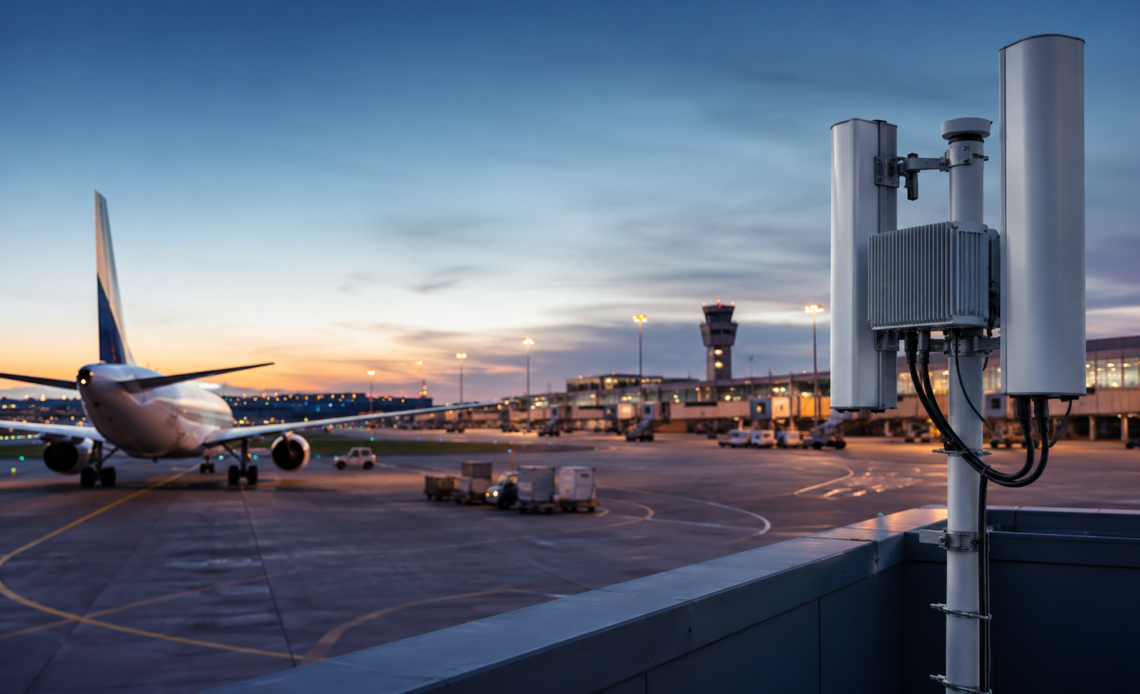
Private wireless networks built on CBRS spectrum are increasingly filling this gap. Early deployments at Dallas-Fort Worth Airport demonstrated that a small number of private LTE radios could cover multiple gates with performance that public networks could not match. Tulsa International Airport’s more recent deployment illustrates a different model – building a comprehensive private cellular infrastructure for a regional airport that addresses current operational needs and positions the airport for the autonomous and AI-driven systems coming next.
The Challenge: Layered and Compounding
Airport connectivity challenges do not exist in isolation – each layer of the problem compounds the others. Tulsa International Airport’s experience illustrates all three clearly.
Aging Perimeter Infrastructure
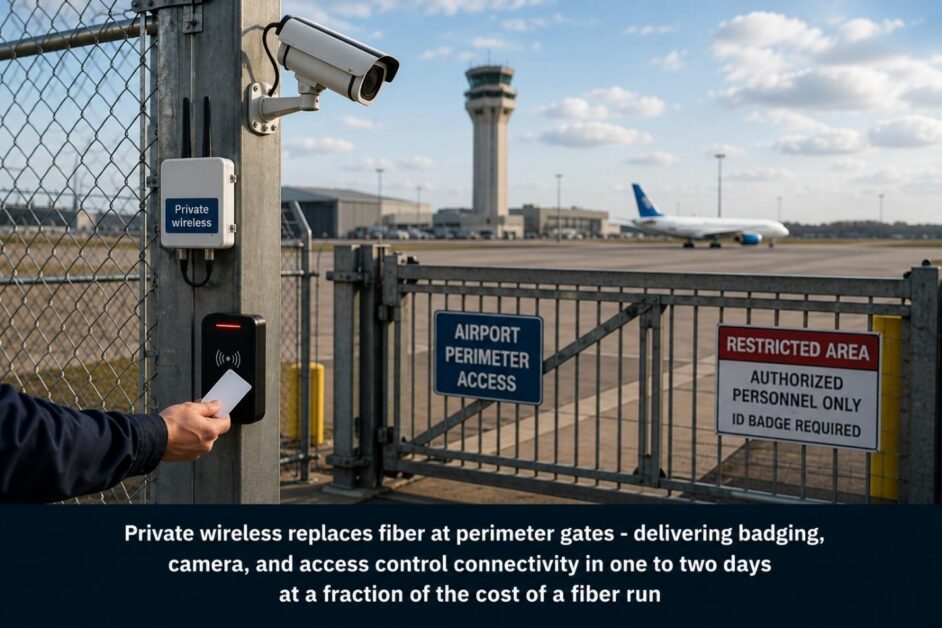
Tulsa’s perimeter entry gates relied on fiber connections to support critical security functions: badging systems, cameras, and emergency access controls. These fiber links were old, prone to failure, and expensive to maintain. When a link went down – which happened with enough regularity to become an operational concern – the gate lost its security and access functions entirely. For a facility operating under FAA and TSA regulatory requirements, a perimeter gate without reliable communications is not a minor inconvenience: it is a compliance event.
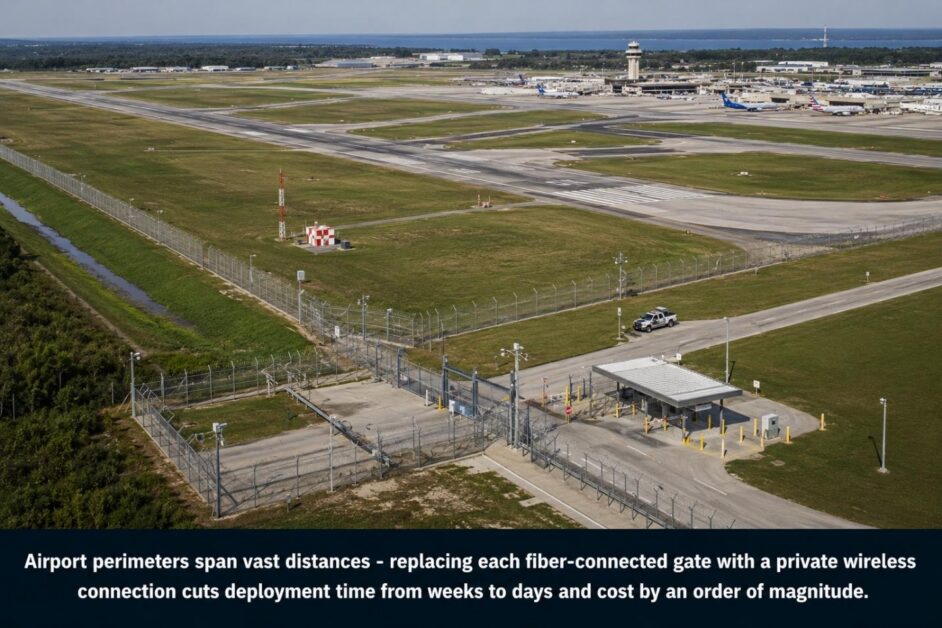
Replacing or repairing aging fiber in an active airport environment is not straightforward. It requires coordination across multiple stakeholders, physical access to areas that are often restricted or operationally active, and significant capital outlay. A single fiber run to a remote perimeter gate could easily cost $750,000 when all costs were factored in.
The Limits of Public Carrier Networks
Commercial carrier networks present a different set of problems. Even where coverage nominally exists, public LTE networks in airport environments face significant RF interference challenges: high-gain carrier tower antennas designed to maximize coverage over wide areas create signal conditions inside terminals and across airfields that are difficult to control. Signal strength metrics can look adequate while actual performance is inconsistent. In operational terms, this means something as basic as scanning a bag tag can fail under poor public LTE conditions – let alone running the richer IoT applications airports increasingly need.
Airlines had historically been skeptical of private wireless, preferring carrier networks with which they already had relationships. But as the operational limitations of those networks became more apparent – and as private wireless deployments at peer airports started demonstrating concrete results – that resistance began to soften.
Security, Segmentation, and Regulatory Requirements
Airports operate under some of the most demanding security and regulatory environments of any facility type. TSA, CBP, first responders, and airlines each have distinct connectivity requirements – and those requirements must be kept strictly separate. A camera network accessible to the wrong party is a security failure. A badging system sharing bandwidth with concessions Wi-Fi is a compliance risk.
| Stakeholder | Connectivity Requirement | Isolation Needed From |
| TSA / Security | Badging, perimeter cameras, access control | All other tenants |
| CBP / Border Protection | Customs processing, surveillance | Airline and concession systems |
| Airlines | Ground ops, gate systems, bag tracking | Airport security systems |
| First Responders | Emergency communications, incident coordination | Commercial and concession traffic |
| Concessions / Retail | POS, inventory, staff communications | Security and operational systems |
Managing this complexity through traditional networking requires extensive VLAN architecture and physical infrastructure separation – both of which add cost and operational burden. The regulatory environment is also active: ICAO standards, FAA requirements, and FCC policy on CBRS spectrum use in aviation settings all affect how airports can deploy and manage wireless infrastructure. The OnGo Alliance has been working with industry stakeholders to establish formal policy positions on CBRS use for airport security and safety.
The Solution: Private CBRS LTE in Practice
The solution Tulsa International Airport implemented – and that DFW had begun to explore earlier – is a CBRS-based private LTE network that replaces legacy fiber for operational connectivity while providing the security segmentation, scalability, and performance the airfield environment requires.
Tulsa International Airport: The Regional Model
TUL worked with Communication Technology Services (CTS) to deploy private cellular across its airfield. The core objective was replacing aging, unreliable fiber at perimeter entry gates with wireless connectivity that would support badging, cameras, and emergency access. The financial case was decisive: where traditional fiber installation at a remote perimeter gate could run to $750,000, the private wireless solution delivered equivalent or better connectivity at significantly lower cost – and deployed in one to two days versus weeks for fiber.
As Brent Wall, Director of Innovation and Technology at Tulsa Airports Improvement Trust, put it: “We believe that what TUL is doing will be the model for many small and mid-size airports around the world by investing in their enhanced capabilities now and letting the commercial use cases evolve.”
CTS brought direct experience from earlier work at Minneapolis-St. Paul International Airport, where private cellular was tested across mobile applications, digital signage, and video surveillance – providing a proven playbook for the Tulsa deployment.
| Factor | Legacy Fiber | Private CBRS LTE |
| Cost per remote gate connection | Up to $750,000 | Fraction of fiber cost |
| Deployment time (new gate) | Weeks to months | 1-2 days |
| Flexibility to relocate | None – physical infrastructure | High – wireless, repositionable |
| Multi-tenant segmentation | Requires extensive VLAN architecture | VXLAN-based, software-defined |
| Regulatory isolation (TSA) | Physical separation required | Logical isolation per tenant |
| Scalability | Each new connection = new fiber run | Add device to existing network |
Technical Architecture
The TUL network launched on LTE with an architecture designed to accommodate future 5G capabilities as use cases and devices evolve. Key design elements include:
- VXLAN-based VLAN segmentation: Security cameras, badging infrastructure, airline systems, and vendor connectivity each operate on isolated logical networks sharing the same physical wireless infrastructure – satisfying TSA requirements for network isolation without requiring physical separation.
- Interference management: Verizon’s high-gain tower antennas in the area created RF conditions that required active management. This is a common challenge in airport environments – a manageable engineering problem that requires ongoing attention rather than a one-time fix.
- Camera configuration optimization: Cameras were initially configured by default to push multiple simultaneous video streams, consuming bandwidth beyond operational need. A configuration adjustment – not a hardware change – resolved the issue. This is typical of early deployments and informs the playbook for airports that follow.
| PRO TIP Camera default configurations are a consistent source of bandwidth overconsumption in new private wireless deployments. Before going live, audit every camera’s stream settings – many are factory-configured to push multiple simultaneous feeds that exceed actual operational requirements. A configuration change, not new hardware, typically resolves it. |
The Broader Airport Deployment Landscape
Tulsa is part of a pattern that is accelerating globally. The table below maps key airport deployments that demonstrate the range of approaches and use cases now proven in operational environments:
| Airport | Technology | Key Use Case | Reference |
| Tulsa International (TUL), USA | CBRS Private LTE | Perimeter gate security, badging, cameras | CTS / TUL deployment |
| Dallas-Fort Worth (DFW), USA | CBRS Private LTE | IoT sensors, smart restrooms, operational data | DFW private network journey |
| Miami International (MIA), USA | CBRS | Digital innovation, operational connectivity | MIA CBRS deployment |
| Schiphol, Netherlands | Private 5G | Ground operations, autonomous vehicles | Schiphol private 5G |
| New Zealand (Undisclosed) | Private 5G | Logistics and baggage operations | NZ airport private 5G |
| Sofia, Bulgaria | Private 5G | Security, operational modernization | Sofia airport 5G |
| First Canadian Airport | Private 5G (TELUS) | Full-facility connectivity | Canada first airport 5G |
| KEY INSIGHT DFW established the proof-of-concept – a single radio covering multiple gates with performance that fiber-dependent public networks could not match. Tulsa established the replicable operational model. The question for airports now is not ‘does this work?’ It is ‘how do we sequence the rollout?’ |
Use Cases and the Revenue Opportunity
The airport transformation opportunity extends well beyond replacing connectivity infrastructure. Private wireless enables a generation of operational and commercial use cases that legacy systems cannot support:
| Use Case Category | Specific Applications | Business Driver |
| Perimeter security | Badging, cameras, emergency access control | Regulatory compliance (TSA, FAA), incident response |
| Autonomous ground vehicles | Baggage carts, wheelchairs, airfield maintenance equipment | Labor cost reduction, airfield safety |
| Smart sensors / IoT | Smartcones, perimeter intrusion detection, environmental monitoring | Situational awareness, incident response time |
| Airline ground operations | Gate systems, bag tracking, turnaround coordination | Airline relationship, terminal fee competitiveness |
| Neutral host / carrier offload | Public carrier signal extension in poor-coverage areas | Revenue from carriers, improved passenger experience |
| Managed connectivity services | Connectivity sold to airlines, concessions, and other tenants | Up to $35M annually for major hub airports (analyst estimates) |
The monetization potential is significant. Analysts have projected that large airports offering connectivity as a managed service to airlines, concession operators, and other tenants could generate up to $35 million annually for major hub airports. Neutral host network models – where the airport’s private wireless infrastructure supplements public carrier coverage in areas of poor signal – add another revenue and service layer on top of that.
ICAO’s standardized regulatory environment for airports actually makes them well-suited for autonomous systems relative to open-road or mixed-use deployments. The highly controlled environment – defined vehicle paths, restricted airside access, clear operational boundaries – reduces the complexity of autonomous deployment compared to public-road alternatives.
What This Means for Airport Operators and System Integrators
For Airport Operations and IT Leadership
The decision framework for airport operators is now well-defined. The Tulsa model provides a replicable starting point:
- Start with compliance-driven use cases. Perimeter gate security, badging, and camera systems that currently depend on aging fiber are the highest-priority targets. These replace known cost and risk, satisfy existing regulatory requirements, and produce immediate ROI.
- Design for segmentation from day one. VXLAN-based logical isolation across TSA, airline, CBP, and concession tenants should be built into the architecture at deployment – not retrofitted after go-live.
- Build the neutral host case in parallel. If carriers have poor coverage in your terminals or airfield areas, the same infrastructure that serves your operational needs can generate recurring revenue from carrier offload agreements.
- Plan for autonomous systems ahead of their arrival. The connectivity foundation needs to be in place before autonomous baggage carts, wheelchairs, and airfield vehicles are commissioned – not built in response to them.
- Engage the OnGo Alliance and regulators early. The FAA, FCC, and TSA policy environment around CBRS in aviation is still being shaped. Airports that engage early have more influence over the framework that governs their own deployments.
For System Integrators
Airport private wireless is a multi-stakeholder sale that requires competency well beyond radio installation. The integrators who establish durable airport relationships will be those who can navigate TSA/FAA/CBP regulatory requirements, design VXLAN segmentation architectures that satisfy each tenant’s isolation requirements, integrate with existing airport access control and security systems, and structure a managed connectivity commercial model that unlocks the neutral host revenue opportunity.
CTS’s approach at Tulsa – leveraging documented experience from Minneapolis-St. Paul and presenting a proven playbook rather than a proposal – is the right template. Airports are risk-averse procurers. Documented deployments at comparable facilities close deals that technical specifications alone do not.
Related Reading
- CTS Helps Tulsa Airport Set New Standard for Regional Aviation
- DFW Airport’s Private Network Journey Started in the Restrooms
- Taking Flight with CBRS – DFW Airport’s Private Cellular Innovation
- Miami International Airport Drives Digital Innovation with CBRS
- Private Networks Transform Airport Operations – Report
- Emerging Neutral Host Networks – White Paper
- Airport Transformation Webinar
- From Experiment to Essential – The Rise of CBRS with OnGo Alliance
Frequently Asked Questions
Q1: Why can’t airports simply rely on public cellular networks for operational connectivity?
Public cellular networks are engineered for broad coverage across wide areas, not for the specific RF environment and operational requirements of an individual airport. In practice, this means inconsistent coverage across terminals and airfields, interference from high-gain carrier antennas, and no mechanism for the security segmentation that TSA and other regulators require. Even basic functions – scanning a bag tag, for example – can fail under poor public LTE conditions. Beyond performance, a shared carrier network gives the airport no control over coverage, capacity prioritization, or tenant isolation. A private wireless network provides all of that – and does so at a scale and cost that is now well-proven across multiple operational airport deployments.
Q2: What made Tulsa International Airport’s deployment notable compared to earlier airport trials?
Earlier trials at DFW were important for demonstrating that private wireless could work in airport environments – showing that a single radio could cover multiple gates with meaningful performance improvements. Tulsa’s deployment went further by treating private wireless as operational infrastructure, not a trial: addressing real compliance-driven needs (perimeter gate security, badging, and camera systems) that had previously relied on costly, unreliable legacy fiber. The cost comparison was stark – fiber installation at a remote perimeter gate could reach $750,000, while the private wireless alternative delivered equivalent or better performance at a fraction of that cost, deployed in days rather than weeks. Tulsa’s deployment is also notable for what it is building toward: the private cellular foundation for AI-driven automation and autonomous vehicle integration as those use cases mature.
Q3: Can smaller, regional airports realistically justify the investment in private wireless infrastructure?
Yes – and Tulsa’s experience is specifically relevant here because TUL is a regional airport, not a major hub. The business case for regional airports is built primarily on cost avoidance: private wireless replaces fiber installations that would cost hundreds of thousands of dollars per connection, with a solution that deploys faster, scales more easily, and supports a wider range of use cases. Beyond cost avoidance, regional airports that invest now are positioning themselves to attract airline technology investment – airlines increasingly look for airports that can support their own connected ground operations, and connectivity infrastructure is a factor in those decisions. The private networks airport report provides additional context on how airports of various sizes are building the financial case.
Q4: How should airports structure the revenue case for private wireless beyond operational cost savings?
The full revenue case has three components. First, cost avoidance: eliminating costly fiber runs and reducing unplanned downtime from infrastructure failures. Second, managed connectivity services: selling connectivity to airlines, concession operators, and other tenants as a recurring revenue line – analyst estimates put this at up to $35 million annually for major hub airports. Third, neutral host revenue: carrier agreements to offload public cellular traffic onto the airport’s private wireless infrastructure in areas where carrier coverage is poor. Each of these components can be modeled independently, but the strongest business case presents all three together – converting the private wireless deployment from a cost center into a revenue-generating infrastructure asset.
| Covering private wireless deployments across airports, transportation, and critical infrastructure. Visit PrivateLTEand5G.com for in-depth case studies, market analysis, and deployment intelligence covering enterprise private wireless worldwide. |