

| QUICK ANSWER Most private 5G pilots stall at a single site – not because the technology fails, but because the architecture, spectrum strategy, and governance weren’t designed for scale from day one. The three root causes: IT/OT integration gaps, spectrum choices that don’t travel across sites, and no repeatable blueprint with clear ownership. The organizations that scale – Tesla Gigafactory Texas, BMW Spartanburg, Port of Virginia – treated their pilot as a test of the architecture, not just the technology. |
| 6,500+ Private LTE/5G networks deployed globally by end of 2025 – a large majority still single-site |
There’s a story playing out in boardrooms right now. A team deploys a private LTE or 5G network at a single site – a factory floor, a distribution center, a port terminal. The pilot runs well. Latency drops. The operations team is impressed. Leadership signs off on phase two. And then nothing. The project stalls, the budget gets redirected, and the network quietly sits at one site for another 18 months.
This is so common it has its own name: pilot purgatory. And it’s where most private network initiatives go to die. The leap from a working pilot to a scaled, multi-site production network is proving to be the hardest step in the entire deployment journey. The questions enterprises and SIs can’t afford to leave unanswered about private wireless almost always come back to this exact gap.
The Market Is Growing. The Scaling Problem Isn’t Solved.

2025 was supposed to be the year private 5G went mainstream. That wave did arrive – but it came with a lot of foam. 5G Americas noted that many deployments ‘remain siloed and limited in scope’ and that operational transformation ‘can often take up to five to seven years.’ That’s a long runway for technology enterprises expected to deliver ROI in months.
Our MWC 2026 reality check for private networks captured this tension precisely: the industry is long on announcements and short on repeatable, scaled deployments. Nearly 60 vendors compete across RAN equipment and core network software alone, and enterprises are stitching together Nokia, Ericsson, Celona, and Cisco with SIs who each bring different deployment philosophies. Getting the pilot to work is one challenge. Getting it to work at every site is another entirely.
Three Reasons Pilots Stop There
1. The IT/OT Integration Wall
This is the issue that derails more deployments than any other. Private 5G networks need to connect to operational technology systems – SCADA, PLCs, industrial IoT platforms – that were never designed for cellular. Research from early manufacturing deployments found that ‘without OT alignment, even strong networks initially showed jitter or inconsistent robotic responses.’ The connectivity layer was fine. The integration layer wasn’t.
A pilot covering one production cell and a curated set of sensors runs beautifully. Scale to ten cells and 400 endpoints – including legacy equipment from decades past – and the gaps surface fast. It’s why enterprise wireless infrastructure needs a fundamental rethink, not just a technology upgrade.
What goes wrong at scale:
- Jitter and inconsistent robotic responses when OT alignment is missing from the design stage
- Legacy equipment with proprietary protocols refuses to integrate cleanly with cellular backhaul
- IT owns the network stack; OT owns the machines – and they rarely collaborate until problems surface
- Protocol and timing mismatches create reliability failures that a single-cell pilot never exposed
2. Spectrum Decisions That Don’t Travel
In the U.S., CBRS made early experimentation accessible – but shared spectrum models require continuous interference monitoring and higher-frequency bands demand tighter RF design in metal-rich environments. Enterprises that chose a spectrum model to launch a pilot quickly often find it doesn’t hold up when adding sites, expanding indoors, or entering denser environments.
Spectrum model comparison:
| Spectrum Model | Best For | Scaling Risk |
| CBRS (Shared GAA) | Quick pilot launch, low upfront cost | Interference in dense or metal-rich multi-site environments |
| CBRS Priority Access License | Predictable mid-scale deployments | Higher upfront; still shared band |
| Licensed mmWave | High-density, high-throughput indoors | Cost; requires detailed per-site RF planning |
| Private Licensed (PLMN) | Enterprise-grade guaranteed SLAs | Regulatory lead time; higher entry cost |
Spectrum is foundational. Getting it wrong at the pilot stage creates technical debt that compounds at every subsequent site. For a deeper look at where CBRS works well and where it doesn’t, see our analysis of CBRS as the engine behind America’s manufacturing comeback.
3. No Blueprint, No Ownership
Pilots are bespoke by nature – tailored, resourced, attention-getting. Bespoke doesn’t scale. Industry panels at the Industrial Wireless Forum in late 2025 identified repeatable architecture as the clearest dividing line between deployments that scale and those that don’t. The organizations making progress had standardized network stacks – core, RAN, SIM management, security, IT/OT integration – that could be replicated across sites with configuration changes, not ground-up redesign.
The governance failure underneath:
- No one owns the scaled outcome. Pilots live in IT. Scaling requires OT, facilities, security, finance, and the C-suite.
- Cross-functional ownership is undefined before the pilot launches
- When that ownership is unclear, projects stall at the handoff – this is precisely the skills gap in enterprise networking that goes beyond traditional IT
- The people and governance structures needed to bridge those silos don’t yet exist in most organizations
| ⚡ PRO TIP: Design for Scale Before You Run the Pilot Before a single radio goes in the ground, map what the scaled version looks like: How many sites? What spectrum model works at each one? Which OT systems need to integrate? Who owns the network post-deployment? Run your pilot with the same network stack you’d deploy at scale – standardized core, consistent SIM management, documented integration patterns – and you’ll know whether the blueprint holds before you’ve spent the real budget. The organizations that scale treat the pilot as a test of the architecture, not just the technology. |
What Successful Deployments Do Differently

Organizations such as Tesla’s Gigafactory Texas, BMW Group’s Spartanburg plant, and the Port of Virginia all moved their private networks from trial to production. What they share isn’t the vendor – it’s the approach.
| What They Did | Why It Mattered |
| Defined operational transformation first | Network requirements derived from business outcomes, not deployed connectivity hoping use cases follow |
| Cross-functional alignment before architecture lock | IT, OT, automation, and safety teams at the table before the network stack was finalized |
| Standardized network stack from pilot onward | Core, RAN, SIM management, security, and IT/OT patterns replicable across sites with config changes |
| Used managed services for scale-out | Most enterprises lack the in-house RF, core network, and OT security depth to replicate across 20 sites |
| ROI within 24 months (managed service model) | Value came from unlocking new workflows, not pure connectivity (Metro Wireless / IoT Business News) |
For guidance on framing the internal investment case, see Presenting Private Network ROI to the C-Suite.
The Economics Are Shifting in Your Favor
| 41% CAGR Projected annual growth in private 5G investment for vertical industries, 2025–2028, surpassing $5B by 2028. |
Three forces are lowering the entry cost:
- CBRS and shared spectrum frameworks have reduced licensing overhead significantly across U.S. manufacturing and logistics sites
- RedCap and eRedCap devices (3GPP Release 18) dramatically lower IoT endpoint hardware costs, making hundreds of connected sensors per site economically viable
- NaaS models mean enterprises can deploy without owning the infrastructure outright – shifting capex to opex and accelerating time-to-value
That projected $5B+ market isn’t just new pilots – it’s organizations scaling what they’ve already built. The 2026 enterprise wireless playbook has materially changed from even 18 months ago.
What This Means for You
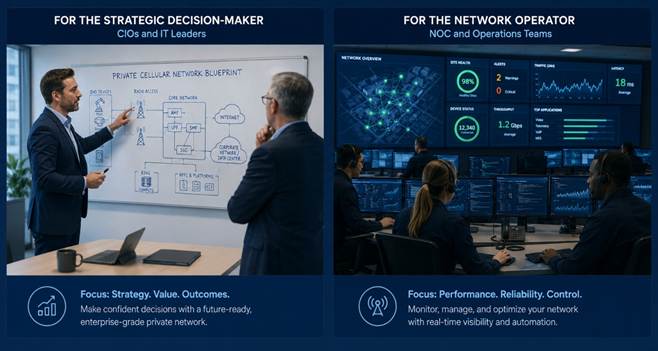
If You’re a System Integrator
The opportunity sits in the gap between pilot and production. Enterprises have proven the technology works. What they need now is a repeatable deployment methodology, a credible IT/OT integration playbook, and a support model that holds across multiple sites. The system integrator’s expanding role in private network deployments now extends well beyond hardware and installation hours.
- Arrive with architecture blueprints – pre-designed stacks covering core, RAN, SIM management, security, and IT/OT integration patterns
- Bring outcome-based pricing that shares risk with the enterprise customer
- Develop credible OT integration expertise alongside your RF and core network skills
- Build the template before the customer asks for it – that’s the differentiator
If You’re in IT or Network Operations
The most valuable investment right now isn’t more radio hardware – it’s governance.
- Define ownership of the scaled outcome clearly before the pilot launches
- Get OT in the room before the architecture is locked
- Run your pilot with the same network stack you’d deploy at scale
- The technology is ready. The question is whether your organization is.
Frequently Asked Questions
What is pilot purgatory in private network deployments?
Pilot purgatory describes the common situation where an enterprise successfully deploys a private LTE or 5G network at a single site – proving the technology works – but then fails to scale it further. The project stalls due to budget reallocation, unresolved IT/OT integration challenges, unclear governance, or a network architecture designed for the pilot environment rather than multi-site production. Berg Insight estimated 6,500 private LTE/5G networks globally by end of 2025, with a large proportion still single-site.
What is the IT/OT integration wall and why does it stop scaling?
OT systems – SCADA, PLCs, industrial IoT platforms – were built for wired, purpose-built networks and were never designed for cellular connectivity. When a private 5G network tries to integrate at scale, mismatches in protocol, timing, and data handling create jitter and reliability issues that a single-cell pilot never exposed. See also: Rethinking Wireless for the Modern Enterprise.
What spectrum choices should enterprises consider for scalable private networks?
CBRS is the most accessible starting point in the U.S., but shared spectrum requires continuous interference monitoring and may not perform reliably in metal-rich or dense multi-site environments. The key principle: choose your spectrum model based on the full-scale deployment, not the fastest path to a pilot. Changing spectrum strategy mid-rollout creates compounding technical debt. Review our spectrum band analysis for a full breakdown.
How long does it typically take to see ROI from a private 5G deployment?
Metro Wireless data suggests enterprises using managed service models typically see ROI within 24 months. 5G Americas notes that full operational transformation can take 5 to 7 years. The fastest ROI comes from organizations that define the operational transformation they want first, then specify network requirements to match. See Presenting the ROI case to the C-Suite for how to frame that conversation.
What should system integrators do differently to win scale-out contracts?
SIs winning scale-out contracts arrive with standardized architecture blueprints, outcome-based pricing, and credible OT integration expertise. The expanding role of the system integrator now covers governance design, cross-functional alignment facilitation, and managed service delivery at scale – not just connectivity.
Where can I go deeper on private wireless, AI edge, and enterprise connectivity?
The PrivateLTEand5G.com Connected AI Edge Virtual Bootcamp Series runs May through December 2026 – nine focused sessions for enterprise IT/OT leaders, systems integrators, and MSPs. Sessions cover private 5G architecture, IT/OT convergence, AIoT device ecosystems, programmable networks, and vertical-specific deployments. Every bootcamp ends with a Pro Tips segment and a downloadable reference card. Sessions are recorded and available on-demand to registered attendees.
Subscribe Now to Get More Insights → PrivateLTEand5G.com