
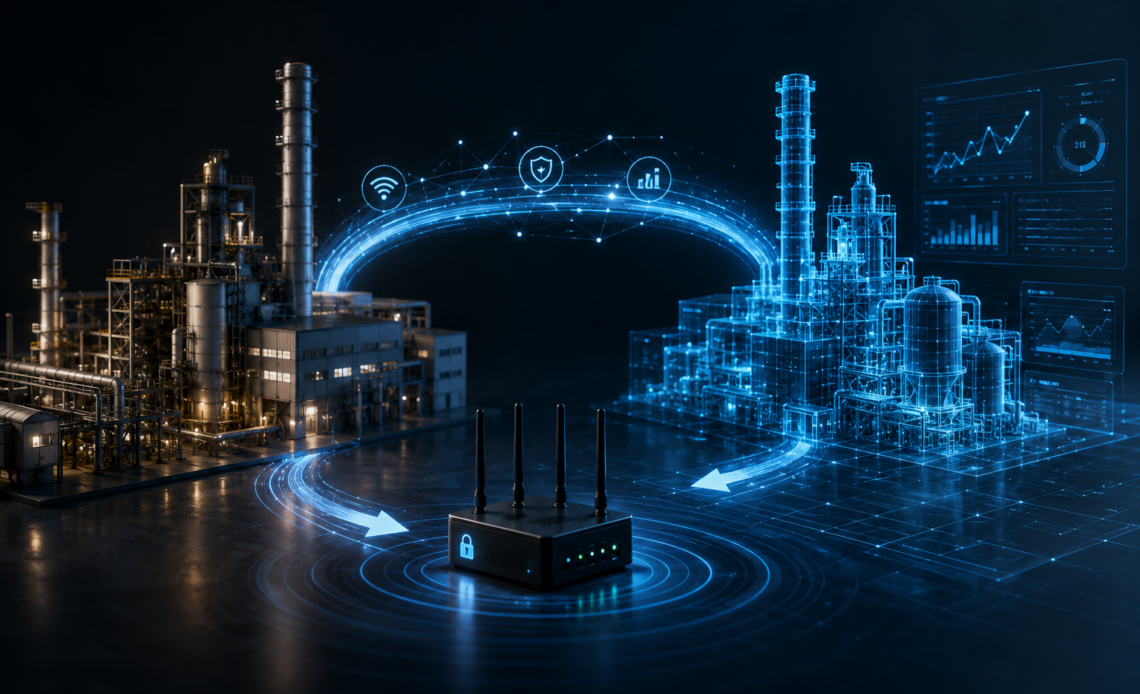
| QUICK ANSWER A digital twin is only as good as the data feeding it. Without continuous, low-latency connectivity from every sensor and asset on the factory floor, the model drifts from reality – and a twin disconnected from its physical counterpart is just a simulation. Private 5G solves the connectivity half of that equation. The global digital twin market stands at roughly $25 billion in 2024, on track to reach $155 billion by 2030. The private 5G market is growing at nearly 59% annually. These two technologies are deeply dependent on each other – which is why 94% of enterprises in a 2025 study paired private wireless with edge computing for real-time analytics. Companies using digital twins average 19% cost savings and 22% annual ROI. But 80% of digital twin projects still hit significant data integration hurdles, and AI-integrated industrial networks saw a 34% rise in cyberattacks between 2024 and 2025. This article explains the feedback loop, where ROI actually shows up, the friction points that stall most deployments, and what system integrators and IT/OT leaders should prioritize right now. |
| 22%Average Annual ROI for Enterprises Deploying Digital TwinsSource: Hexagon 2024 Digital Twin Industry Report – 660 executives across 11 industries; average cost savings of 19% |
There is something almost paradoxical about the phrase ‘digital twin.’ At its core, it is a living mirror of something physical – a machine, a factory floor, a port, an energy grid – that updates in real time as its physical counterpart changes. The twin only works when the two are inseparable, trading information back and forth.
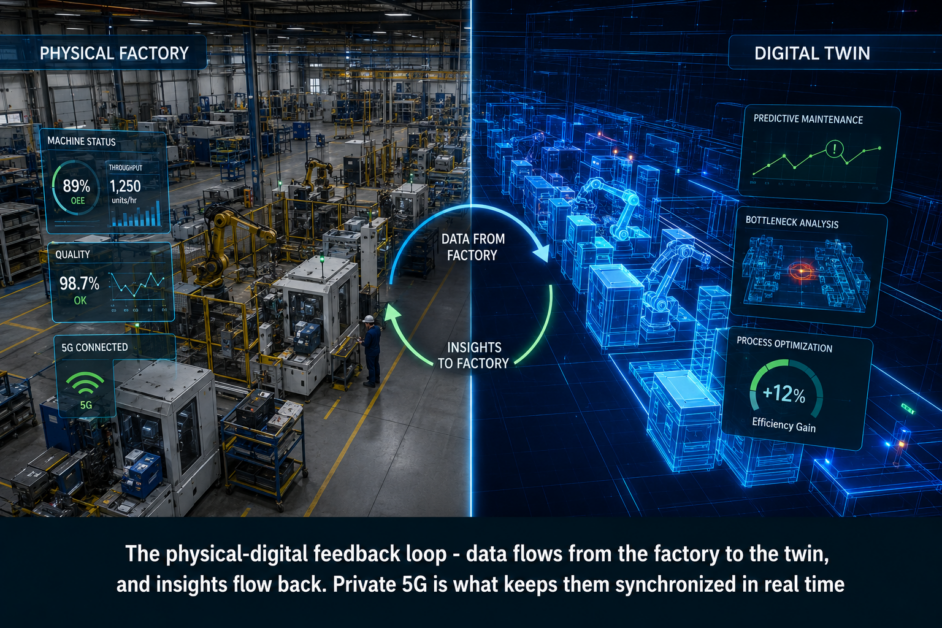
Right now, across manufacturing plants in Germany, container terminals in Singapore, and mines in Chile, that conversation is finally happening at scale. The combination of private 5G networks and industrial digital twins is creating what engineers call a physical-digital feedback loop – a continuous cycle where the physical world informs the digital model, and the model instructs the physical world. Earlier analysis of how digital twins and private networks create value from complex systems laid the foundations clearly. What is different now is the scale at which it is actually deploying.
The Market Says This Is Real
| Market | 2024/2025 Baseline | Forecast |
| Global digital twin market | ~$25 billion (2024) | $155 billion by 2030 (34% CAGR) |
| Private 5G network market | $3.89 billion (2025) | ~59% CAGR through 2033 |
| Private LTE/5G installations globally | ~6,500 (end-2025) | Up from 4,700 the prior year |
| Private 5G investment for Industry 4.0 (through 2028) | $5.1 billion forecast | 70%+ of total private 5G spend |
According to the latest private cellular network deployments report, approximately 6,500 private LTE/5G installations were active worldwide by end-2025 – up from 4,700 the prior year. SNS Telecom & IT estimates that over 70% of forecast private 5G investment through 2028 will go into standalone networks purpose-built for Industry 4.0. Two technologies growing at extraordinary speed, deeply dependent on each other.
| KEY INSIGHT A digital twin without reliable, low-latency data is just a simulation. A private 5G network without intelligent applications is just expensive infrastructure. The value is in the combination – and the market data makes clear that enterprises have figured this out. |
Why Private Networks, Not Public?
A digital twin running a real-time feedback loop needs continuous, accurate, and immediate data. As Ericsson noted in a January 2026 analysis, a vibration signature on a turbine blade captured 500 milliseconds late is “disconnected from the event it represents.” Public 5G is shared infrastructure – performance varies with subscriber demand. A private 5G network runs on dedicated spectrum with guaranteed service levels, which is why the two technologies suit each other so well.
The broader question of what AI connectivity really means for enterprises runs through exactly this requirement: AI-augmented twins processing real-time sensor data need network guarantees, not best-effort delivery. The Nokia and GlobalData 2025 Industrial Digitalization Report – covering 115 industrial enterprises across manufacturing, energy, logistics, mining, and transportation – confirmed this in practice:
- 87% of private wireless and edge adopters saw positive ROI within one year
- 68% achieved positive ROI within six months
- 94% paired private wireless with edge computing for real-time analytics
The Feedback Loop, Explained
The physical-digital feedback loop has four stages that run continuously:
| Stage | What Happens | Technology Role | Example |
| 1 | Sensors collect data continuously across machines and assets | Dense sensor layer, increasingly RedCap-enabled; private 5G backhauls signals reliably from every asset or gateway | Vibration sensors on turbine blades, temperature monitors on presses |
| 2 | Private 5G carries data to the digital twin at the edge | Dedicated spectrum; guaranteed latency under 20 ms; no shared contention | Sub-20 ms delivery from shop floor to edge server |
| 3 | AI-augmented twin identifies patterns, predicts failures, runs simulations | Edge compute; AI inference; digital twin platform (Omniverse, Xcelerator, Vuforia) | Anomaly detected in bearing vibration pattern; failure predicted 72 hours out |
| 4 | Insights push back to the physical environment | Automated alerts, parameter adjustments, autonomous machine responses | Maintenance window scheduled; machine slows to reduce bearing stress |
Every cycle refines the model. Over time, the twin often knows more about an asset’s future behavior than any human technician. Tesla’s Gigafactory Berlin shows this in practice: private 5G on the shop floor helped eliminate up to 90% of overcycle issues in one general assembly process. John Deere’s private 5G deployment is targeting a drop in wired Ethernet dependency from 70% to 10% across its global facilities – the sensor-dense environment digital twins require simply cannot run on cable at scale.
The rise of agentic AI in programmable 5G networks tightens the loop further. When AI inference runs inside the network itself, the model does not just observe the factory – it responds to it in near-real time, without waiting for a round-trip to a central system.
Where the ROI Shows Up
The ROI case for digital twins paired with private 5G is now well-documented across multiple independent studies. The business case for the C-suite becomes compelling once all three ROI categories are on the table together:
| ROI Category | Data Point | Source |
| Cost savings | 19% average cost savings for digital twin users | Hexagon 2024 Digital Twin Industry Report (660 executives, 11 industries) |
| Annual ROI | 22% average annual ROI | Hexagon 2024 |
| Operational cost reduction | 78% of enterprises deploying private wireless + AI cut operational costs by >10% | Nokia & GlobalData 2025 Industrial Digitalization Report |
| Time to ROI (private wireless + edge) | 87% positive ROI within 1 year; 68% within 6 months | Nokia & GlobalData 2025 (115 enterprises) |
| Outage cost avoided | Average unplanned IT outage costs $14,056/minute (ITIC/EMA Research); 57% of significant outages exceed $100,000 (Uptime Institute) | ITIC/EMA Research 2024; Uptime Institute 2026 Annual Outage Analysis |
| Catastrophic outage exposure | 20% of significant outages now exceed $1 million | Uptime Institute 2026 Annual Outage Analysis |
| KEY INSIGHT The avoided-outage calculation alone often justifies the private 5G investment before any productivity or efficiency metric is applied. At $14,056 per minute of unplanned downtime (ITIC/EMA Research), a single prevented 2-hour outage pays for months of network operating costs. |
The Friction Points
For all the momentum, the deployment obstacles are real and consistent across industries. Three friction points account for the majority of stalled projects:
1. Data Integration Hurdles – 80% of Projects
Legacy SCADA systems, older PLCs, and incompatible protocols like OPC-UA and Modbus were never designed to feed a real-time digital model. Connecting them requires protocol translation, data normalization, and often custom middleware – work that is labor-intensive, poorly documented, and not covered by most digital twin platform vendors. This is the most common reason projects stall after a promising proof-of-concept phase.
2. Workforce Capability – 62% Cite This as the Primary Drag
The technology is not the bottleneck – the people to deploy, manage, and interpret it are. The skills gap in enterprise networking that goes beyond traditional IT is real and structural: organizations need staff who understand private 5G architecture, OT system integration, digital twin platform configuration, and AI model management simultaneously. That profile does not exist in volume. Workforce development plans should be scoped before technology procurement, not after.
3. Cybersecurity – 34% Rise in Attacks on AI-Integrated Industrial Networks
AI-integrated industrial networks saw a 34% year-on-year rise in cyberattacks between 2024 and 2025. The risk compounds as digital twins connect to ERP systems and cloud platforms – expanding the attack surface beyond what either IT or OT teams have historically been responsible for securing. Security vulnerabilities at the private network perimeter are not theoretical when the twin has read-write access to physical systems. Joint IT/OT security governance is a deployment prerequisite, not an afterthought.
| PRO TIP Structure your IT/OT security governance before the first sensor goes live. Digital twins that connect to ERP platforms and cloud systems sit at the IT/OT boundary – which is exactly where 75% of OT attacks originate (Dragos 2025). Joint security ownership between IT and OT teams must be established before deployment, not resolved after an incident. |
What Is Happening Right Now
The competitive landscape is converging fast across three dimensions:
Hyperscaler and Industrial Vendor Convergence
Siemens and Schneider Electric are pushing digital-twin-as-a-service models to lower entry barriers for mid-market manufacturers. NTT Data and Schneider Electric have already demonstrated the bundled model in production. NVIDIA’s Omniverse, Siemens’ Xcelerator, and PTC’s Vuforia are all positioning themselves as the operating environment for enterprise twins with spatial computing and AR overlays – a trend that ties directly to why NVIDIA’s AI-RAN bet is not just a telco headline.
Managed Service Bundling
In October 2025, Accenture launched its Physical AI Orchestrator – a platform for software-defined factories that uses live digital twins to detect issues and simulate process changes in real time. That bundled model – network, AI, and twin capabilities delivered as a managed service – is likely the dominant go-to-market pattern for system integrators within the next three years. Integrators who have not built this capability yet are already behind the leading edge of the market.
Government Policy as Tailwind
Germany committed €130 million in January 2025 under its Digital Germany 2030 initiative, with a significant share earmarked for private 5G in industrial zones. China, operating nearly 5 million 5G base stations as of late 2025, is already running thousands of smart factory deployments pairing private 5G with industrial twins at a scale that is difficult to picture from a Western vantage point. Policy support is no longer a differentiator in leading markets – it is the floor.
What This Means for You
For System Integrators
The window to build genuine expertise is narrowing. Customers are not going to buy a digital twin platform and a private 5G network separately and figure out integration on their own. They need a partner who can design the sensor layer, specify the network, choose the twin platform, and connect all three to existing OT and IT systems. The system integrator’s expanding role in private network deployments now runs straight through twin integration.
- Start with mature verticals: Manufacturing and ports have the most defined use cases and proven ROI. Build reference architectures you can repeat before moving into less-documented verticals.
- Build the full stack: Sensor layer specification, private 5G design, twin platform selection, and OT/IT integration for common legacy protocols (PROFINET, OPC-UA, Modbus). Customers hiring a specialist integrator expect end-to-end competency.
- Position for managed service contracts: Integrators who build that end-to-end competency now will be signing multi-year managed service contracts in 2027 and 2028. The 2026 enterprise wireless playbook has already rewritten what customers expect from a full-stack partner.
- Address cybersecurity as a service line: The 34% rise in attacks on AI-integrated industrial networks is a new revenue opportunity for integrators who can deliver joint IT/OT security architecture alongside the twin deployment.
For IT and OT Leaders
Start with data readiness, not technology selection. Three questions to answer before any vendor conversation:
- What operational data do you actually have, and where does it live? Map every sensor, PLC, and SCADA system that would feed the twin.
- What does latency look like from sensor to system? Run a network assessment before committing to twin software. If critical assets cannot deliver data within 20 ms reliably, the twin will be working with an incomplete picture.
- Who owns security at the IT/OT boundary? The twin sits at exactly the junction where attacks originate. Establish joint governance before the first device connects.
Organizations that get this foundation right see ROI in months. Those that skip it join the 80% who cite integration as their primary obstacle. The physical-digital feedback loop works when the physics and the data are both honest.
| PRO TIP Start with one asset or one production line – not the whole factory. A well-instrumented, tightly scoped digital twin on a single critical asset delivers faster ROI, surfaces integration problems early, and builds the internal capability needed to scale. The enterprise-wide rollout is a Phase 2 decision, not a Day 1 commitment. |
Real-World Deployments at a Glance
| Organization | Private 5G Platform | Digital Twin / AI Use Case | Result |
| Tesla Gigafactory Berlin | Private 5G on shop floor | Real-time assembly process monitoring | Up to 90% reduction in overcycle issues in general assembly |
| John Deere | Private 5G across global facilities | Sensor-dense factory floor connectivity for twin data acquisition | Wired Ethernet dependency targeted to drop from 70% to 10% |
| NTT Data / Schneider Electric | Private 5G at Marienpark | Bundled network + AI + twin managed service model | Reference deployment for the industrial managed service pattern |
| Siemens | Xcelerator platform + private 5G | Spatial computing and AR overlays on live digital twins | Permanent 5G technology showcase driving customer deployments |
| Supply chains broadly | Various | Supply chain uncertainty modeling via digital twin simulation | Operational resilience through what-if scenario planning |
Related Reading
- Digital Twins and Private Networks – Reaping Value from Complex Systems
- The Rise of Agentic AI and Programmable 5G Networks
- What Does AI Connectivity Really Mean for Enterprises?
- The Skills Gap in Enterprise Networking Beyond Traditional IT
- Why NVIDIA’s AI-RAN Bet Isn’t Just a Telco Headline
- Building the Enterprise Case – Presenting Private Network ROI to the C-Suite
- Private Networks and Security: Vulnerabilities of the Fortress
- The System Integrator’s Expanding Role in Private Network Deployments
- The Connected AI Edge 2026 – Virtual Bootcamp Series
Frequently Asked Questions
Q1: What is a physical-digital feedback loop and why does it need private 5G?
A physical-digital feedback loop is the continuous cycle in which sensors gather data from physical assets, a digital twin processes and models that data, and the resulting insights push back to the physical environment – adjusting machine parameters, triggering maintenance alerts, or driving autonomous responses. The loop only works when data arrives continuously and within a bounded time window. As Ericsson noted, a vibration signature on a turbine blade captured 500 milliseconds late is disconnected from the event it represents. Public 5G shares bandwidth across subscribers; private 5G runs on dedicated spectrum with guaranteed service levels, making it the right infrastructure for latency-sensitive twin applications. For context on the earlier foundations of this pairing, see digital twins and private networks: reaping value from complex systems.
Q2: What ROI can enterprises expect from digital twin deployments paired with private 5G?
Hexagon’s 2024 Digital Twin Industry Report found companies using digital twins average 19% cost savings and 22% annual ROI. The Nokia and GlobalData 2025 report found 87% of private wireless and edge adopters achieved positive ROI within one year, with 68% achieving it within six months. The avoided-outage case adds a third dimension: with the average unplanned IT outage costing $14,056 per minute (ITIC/EMA Research), a single prevented major incident can pay for months of network operating costs. See also: presenting private network ROI to the C-suite.
Q3: What are the most common reasons digital twin projects fail or stall?
Three root causes account for most failures. First, data integration hurdles: 80% of projects face significant challenges connecting legacy SCADA systems, older PLCs, and protocols like OPC-UA and Modbus to a real-time model. Second, workforce capability: around 62% cite this as the primary drag – the skills gap in enterprise networking that goes beyond traditional IT is a real structural constraint. Third, cybersecurity: AI-integrated industrial networks saw a 34% year-on-year rise in attacks between 2024 and 2025, and the risk compounds as twins connect to ERP platforms and cloud systems that IT and OT teams are not yet jointly structured to secure.
Q4: How do AI and digital twins work together in a private 5G environment?
In a mature deployment, AI runs inside the digital twin to identify anomaly patterns, predict asset failures, and simulate process changes before implementing them. In more advanced architectures – particularly as agentic AI moves into programmable 5G networks – AI inference runs at the network edge itself, tightening the feedback loop further. Instead of data traveling to a central twin for analysis, the network can make autonomous adjustments in near-real time. NVIDIA’s Omniverse, Siemens’ Xcelerator, and Accenture’s Physical AI Orchestrator all represent this convergence: network, AI, and twin capabilities bundled as managed services rather than separate technology purchases.
Q5: Where should a system integrator start when building a digital twin practice?
Start with one or two mature verticals where use cases are well-defined and ROI is proven – manufacturing and ports are the clearest choices in 2026. Within those verticals, build reference architectures that cover the full stack: sensor layer specification, private 5G network design, digital twin platform selection, and IT/OT integration patterns for common legacy systems (PROFINET, OPC-UA, Modbus). The integrators winning multi-year managed service contracts are not selling technology components – they are selling outcomes with repeatable delivery models. The system integrator’s expanding role in private network deployments is the starting point for understanding how that commercial model is evolving. Build the template before your first customer asks for it.
| Covering the intersection of private wireless, AI, and industrial operations.Visit PrivateLTEand5G.com for in-depth analysis, case studies, and the Connected AI Edge Virtual Bootcamp Series – built for enterprise IT/OT leaders and system integrators making real deployment decisions. |