
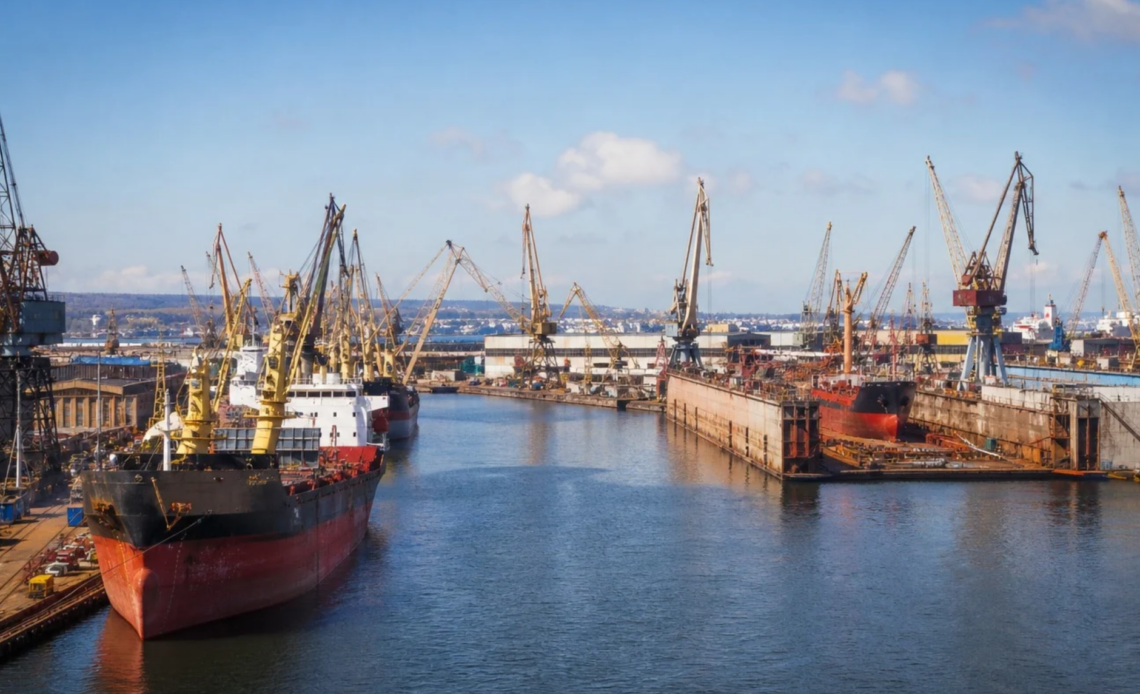
Pic Credit: T&I news
Vertical: Maritime and Manufacturing
Application: Shipyard automation, AI-powered industrial IoT, digital twin solutions, autonomous inspection robots, robotic hull cleaning, automated welding and surface preparation
Ecosystem: stc Bahrain, ASRY (Arab Shipbuilding and Repair Yard Company)
Private Network: 5G
| stc Bahrain and ASRY describe the deployment as Bahrain’s first commercial private 5G network, now in production at a major Arabian Gulf shipyard. The deployment at ASRY supports AI-powered CCTV, digital twins, and autonomous robots across 250,000 square meters of fabrication space, marking a milestone in maritime Industry 4.0 transformation. |
stc Bahrain has deployed what it describes as Bahrain’s first commercial private 5G network at the Arab Shipbuilding and Repair Yard Company (ASRY), bringing ultra-low latency connectivity to one of the Arabian Gulf’s most experienced marine repair facilities. The partnership, announced on November 11, 2026, positions ASRY at the forefront of digitalization in the maritime sector, enabling AI-powered industrial IoT, digital twin solutions, and autonomous inspection robots across the shipyard’s extensive facilities. This follows the Alba aluminum smelter network that Batelco by Beyon and Nokia announced in April 2025, which was reported as Bahrain’s first private 5G network and its first for industrial use. stc Bahrain and ASRY position the ASRY system as the first commercial deployment, but neither company has said how “commercial” differs from Alba’s operator-delivered network.
The network infrastructure supports mission-critical Industry 4.0 environments with secure, high-bandwidth connectivity designed for shipyard automation. ASRY’s facilities include a fabrication area exceeding 250,000 square meters, a dry dock with 500,000 deadweight tonnage capacity, 15 repair berths, two floating docks (measuring 252 meters and 227 meters in length), and a comprehensive range of workshops and service centers. Established in 1977, ASRY has repaired over 3,500 ships and maintains approximately 5 kilometers of berthing space, serving as a key player in Arabian Gulf maritime operations.
| Metric | Detail |
| Network type | Private 5G |
| Coverage | 250,000+ square meter fabrication area, 5 km repair berths |
| Facility capacity | 500,000 dwt dry dock, 15 repair berths, 2 floating docks |
| Operator / integrator | stc Bahrain |
| Timeline | Announced November 11, 2026 |
ASRY’s Operating Environment and Digital Transformation Imperative
ASRY operates a complex maritime repair and maintenance environment with a 375 meter by 75 meter dry dock, twin 255-meter slipways, a graving dock, and berthing capacity spanning 5.1 kilometers. The shipyard’s aging infrastructure and the increasing complexity of modern vessels demanded a connectivity solution capable of supporting real-time data analytics, remote monitoring, and automated inspection workflows. Traditional Wi-Fi and wired networks could not deliver the latency, security, and coverage required for Industry 4.0 applications across such expansive outdoor facilities.
The deployment aligns with Bahrain’s Economic Vision 2030, which prioritizes building a robust, knowledge-based digital economy. ASRY’s digital transformation strategy focuses on harnessing digitalization and automation to enhance operational efficiency, improve safety, and enable data-driven decision-making. The shipyard’s Deputy CEO, Shaikh Mohammed bin Rashid Al Khalifa, emphasized that adopting a commercial private 5G network positions ASRY at the forefront of maritime technological advancement. The network’s enterprise-grade security protects sensitive operational data and intellectual property, while ultra-low latency supports time-sensitive applications such as autonomous inspection robots similar to deployments at Ontario International Airport.
Network Deployment and Technical Architecture
The private 5G network delivers dedicated spectrum and infrastructure purpose-built for maritime and industrial applications, ensuring predictable performance and eliminating interference from public mobile traffic. The architecture provides ultra-low latency, high bandwidth, and enterprise-grade security required for mission-critical Industry 4.0 workflows. While the specific equipment vendor for the ASRY deployment was not disclosed, stc Bahrain launched Bahrain’s first 5G standalone core network using Huawei equipment in 2022 and has integrated multi-vendor infrastructure including Huawei, Cisco, Ericsson, and Nokia across its broader 5G rollout.
The network deployment across ASRY’s 250,000-square-meter fabrication area and multiple berths required careful radio planning to ensure coverage in challenging outdoor environments with large metal structures, dry docks, and floating facilities. The system supports a range of industrial IoT devices, AI-powered CCTV cameras, digital twin sensors, and autonomous robots operating in harsh maritime conditions. This deployment mirrors Verizon and Nokia’s five-site private 5G rollout at Thames Freeport, which also addressed multi-facility maritime coverage challenges. The network’s low latency enables real-time video analytics, remote expert collaboration, and instant data synchronization across digital twin platforms.
AI-Powered Use Cases and Autonomous Operations
The private 5G network enables innovative use cases designed to transform shipyard operations, improve worker safety, and optimize asset performance. AI-powered CCTV systems provide intelligent monitoring capabilities, using computer vision to detect safety hazards, track worker movements in restricted areas, and identify equipment anomalies in real time. Digital twin solutions create virtual replicas of ships, dry docks, and equipment, enabling predictive maintenance, performance optimization, and scenario planning based on live sensor data. Autonomous inspection robots navigate ASRY’s facilities to conduct visual inspections, detect corrosion, measure structural integrity, and perform other tasks in hazardous or hard-to-reach locations.
The network also facilitates automated industrial operations including robotic hull cleaning, welding, and surface preparation. These applications demand reliable, low-latency connectivity to coordinate robot movements, transmit high-definition video feeds, and exchange control commands without delay. The 5G infrastructure supports accurate decision-making through real-time data analytics, allowing supervisors to monitor multiple operations simultaneously and respond instantly to changing conditions. Similar AI-driven applications have been deployed in solar farm operations in Malaysia, demonstrating the versatility of private 5G in supporting autonomous industrial workflows across diverse sectors.
| “This further strengthens our efforts to transform our operations by harnessing the potential of digitalization and automation, while enabling more accurate decision-making through real-time data analytics.” Shaikh Mohammed bin Rashid Al Khalifa, Deputy Chief Executive Officer, ASRY |
Regional and Global Maritime Private Network Context
The ASRY deployment is part of a broader trend of private cellular adoption in maritime and port operations across the Middle East and globally. In June 2026, Omantel partnered with the Port of Salalah in Oman to deploy the country’s first managed private 5G network, marking another GCC maritime facility embracing dedicated spectrum. In Europe, Verizon completed a five-site private 5G deployment across Thames Freeport, covering DP World London Gateway, DP World Logistics Park, Ford Dagenham, and the Port of Tilbury in one of the region’s highest-profile carrier-led private 5G projects.
Other 2026 maritime deployments include Deutsche Telekom and Ericsson’s private 5G network at the Port of Hamburg in Germany, Santos Port Authority’s installation at the Port of Santos in Brazil under the Porto de Santos Conecta program, and Spark New Zealand and Ericsson’s deployment at Port Nelson. At the Port of Valencia in Spain, physical deployment was underway for a private 5G standalone network with 6.9 million euros in infrastructure investment. In South Korea, a private 5G and physical AI plan was announced at Gunsan Shipyard in July 2026. Hutchison Ports’ UK operations at the Port of Felixstowe, Harwich International Port, and London Thamesport also saw private 5G deployment in 2026, demonstrating the global momentum behind maritime private networks.
Industry 4.0 Impact and Strategic Outcomes
Hesham Mustafa, Chief Business and Wholesale Officer at stc Bahrain, highlighted that the deployment marks a significant milestone in Bahrain’s digital transformation journey, demonstrating how advanced connectivity can accelerate shipyard automation and enable AI-powered industrial innovation. The partnership empowers ASRY with secure, reliable, and future-ready digital infrastructure that enhances operational efficiency, safety, and productivity. The network goes beyond providing advanced connectivity, representing an important step toward modernizing maritime operations and strengthening the sector’s capabilities across Bahrain and the broader region.
The deployment enables ASRY to adopt Industry 4.0 technologies at scale, transforming traditional manual processes into data-driven, automated workflows. Real-time data analytics support more accurate decision-making, reducing downtime, optimizing resource allocation, and improving quality control. Enhanced safety outcomes result from AI-powered monitoring and autonomous robots conducting inspections in hazardous environments, reducing human exposure to risk. The network’s scalability allows ASRY to expand its digital capabilities incrementally, adding new use cases and devices as operations evolve. This strategic approach to digital transformation mirrors broader trends in industrial mining operations and smart office environments, where private cellular networks serve as the foundation for comprehensive digital ecosystems.
| “We are proud to partner with ASRY to successfully deploy Bahrain’s first commercial Private 5G Network, marking a significant milestone in the Kingdom’s digital transformation journey.” Hesham Mustafa, Chief Business and Wholesale Officer, stc Bahrain |
| “This collaboration demonstrates how advanced connectivity can accelerate shipyard automation and enable AI-powered industrial innovation.” Hesham Mustafa, Chief Business and Wholesale Officer, stc Bahrain |
| “Through Private 5G, Industrial IoT, AI, and robotics, we are empowering ASRY with secure, reliable, and future-ready digital infrastructure that enhances operational efficiency, safety, and productivity.” Hesham Mustafa, Chief Business and Wholesale Officer, stc Bahrain |
| “The deployment of this network represents an important step towards modernizing maritime operations and strengthening sector’s capabilities, helping shape the future of shipyards in Bahrain and across the region.” Hesham Mustafa, Chief Business and Wholesale Officer, stc Bahrain |
| “ASRY has adopted a commercial Private 5G network to enhance its operational efficiency, positioning the company at the forefront of this field.” Shaikh Mohammed bin Rashid Al Khalifa, Deputy Chief Executive Officer, ASRY |
Lessons for Maritime and Heavy Industry Deployments
The ASRY deployment offers valuable lessons for maritime and heavy industry organizations considering private cellular networks. First, the scale of coverage required (250,000 square meters, 5 kilometers of berths, dry docks, and floating facilities) demonstrates the importance of comprehensive radio planning and site surveys in complex outdoor environments with significant RF propagation challenges. Second, the breadth of use cases (AI-powered CCTV, digital twins, autonomous robots, automated welding) illustrates the value of planning for multiple applications from the outset, ensuring the network architecture can support diverse device types, latency requirements, and bandwidth demands.
Third, the emphasis on security and reliability highlights the criticality of enterprise-grade performance for mission-critical operations in industries where downtime carries significant financial and safety consequences. Fourth, alignment with national economic development goals (Bahrain’s Economic Vision 2030) can strengthen the strategic case for investment, positioning private networks as enablers of broader digital transformation rather than isolated technology projects. Finally, the choice of a carrier-managed commercial private network model (via stc Bahrain) offers an alternative to self-managed networks, providing access to operator expertise, ongoing support, and integration with existing public network infrastructure where appropriate. These lessons resonate with high-mobility deployments in motorsports and other sectors demanding reliability at scale.
| KEY INSIGHT Maritime and heavy industry deployments benefit from carrier-managed private 5G models that combine dedicated spectrum and enterprise-grade security with operator expertise, enabling organizations to focus on use-case development (AI, digital twins, robotics) rather than network management. The ASRY deployment demonstrates that comprehensive coverage planning for complex outdoor environments with large metal structures is essential for success. |
Related Reading
- Private 5G at Thames Freeport: Verizon & Nokia Complete Rollout
- Private 5G Network for Airports: Boldyn Deploys System at Ontario International Across 1,700 Acres
- Private 5G Network for Solar Farms: U Mobile and HLGY Energy MoU Targets AI-Driven Operations in Malaysia
- Private 5G Network for Rail Maintenance: SNCF Deploys Nokia, HPE Solution Across 19,000 m² Facility in Rennes
- Private LTE Network for Mining: Star Solutions Deploys System at Alaska’s Red Dog Mine
- Private 5G Network for Finance: Samsung Deploys Smart Office at Hana Financial Group in South Korea
- Private 5G Network for Motorsports: DTM Deploys Riedel Easy5G Across 21 Cars for Onboard Video at 140 Mbps
Frequently Asked Questions
Q1: What makes the ASRY private 5G network Bahrain’s first commercial deployment?
stc Bahrain and ASRY describe the network as Bahrain’s first commercial private 5G deployment. It follows the Alba aluminum smelter network announced by Batelco by Beyon and Nokia in April 2025, which was reported as Bahrain’s first private 5G network and first for industrial use. The companies have not said how “commercial” differs from Alba’s network. The ASRY system supports commercial shipyard operations with AI, IoT, and robotics across 250,000 square meters.
Q2: What specific AI-powered use cases does the network enable at ASRY?
The network supports AI-powered CCTV for intelligent monitoring and hazard detection, digital twin solutions for predictive maintenance and asset optimization, autonomous inspection robots for safety and structural assessments, and automated operations including robotic hull cleaning, welding, and surface preparation across the shipyard’s extensive facilities.
Q3: How large is ASRY’s facility and what capacity does it serve?
ASRY operates a 250,000-square-meter fabrication area, a 500,000 deadweight tonnage dry dock (375 meters by 75 meters), 15 repair berths totaling 5 kilometers, two floating docks (252 and 227 meters), and twin 255-meter slipways. Since 1977, the yard has repaired over 3,500 ships.
Q4: Which company deployed the private 5G network at ASRY?
stc Bahrain deployed the commercial private 5G network at ASRY, announced on November 11, 2026. While the specific equipment vendor was not disclosed, stc Bahrain has worked with Huawei, Ericsson, Nokia, and Cisco on its broader 5G infrastructure rollout across the country.
Q5: How does this deployment align with Bahrain’s national strategy?
The ASRY private 5G network supports Bahrain’s Economic Vision 2030, which prioritizes building a robust, knowledge-based digital economy. The deployment demonstrates how advanced connectivity enables maritime Industry 4.0 transformation, strengthening the sector’s capabilities regionally while enhancing operational efficiency, safety, and data-driven decision-making.
Q6: What are comparable private 5G deployments in maritime and port operations?
Comparable 2026 maritime deployments include Omantel’s private 5G at Port of Salalah (Oman’s first managed private network), Verizon and Nokia’s five-site Thames Freeport rollout, Deutsche Telekom and Ericsson’s Port of Hamburg network, Spark and Ericsson’s Port Nelson deployment, and Hutchison Ports UK deployments across Felixstowe, Harwich, and Thamesport.