
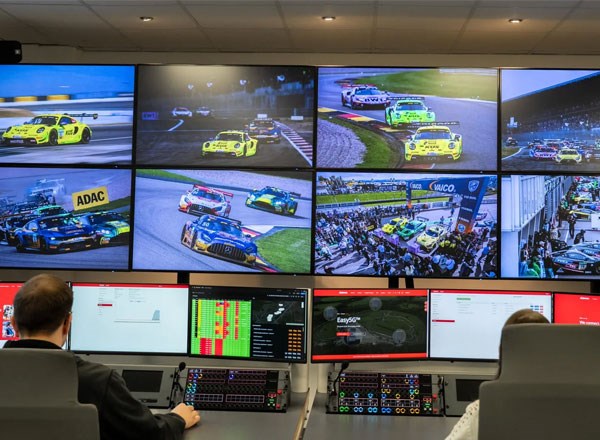
Image credit: Riedel
Vertical: Motorsports and live broadcast production
Application: Onboard camera video transmission, live sports production, high-speed wireless connectivity
Ecosystem: Riedel Communications, TV Skyline, Deutsche Tourenwagen Masters
Private Network: Private 5G
| Deutsche Tourenwagen Masters becomes the world’s first racing series to rely permanently on private 5G for onboard camera signals. Riedel’s Easy5G platform delivers 140 Mbps uplink speeds to all 21 DTM race cars across German circuits, using only four to seven antennas per track. |
Deutsche Tourenwagen Masters (DTM) has deployed Riedel Communications’ Easy5G private 5G platform as its permanent transmission system for onboard camera signals across all 21 race cars competing in Germany. Announced in October 2026, the deployment marks the first time a racing championship has adopted private 5G as its primary transmission path for onboard video, replacing traditional RF and wireless systems that have struggled with reliability at high speeds. Developed in collaboration with broadcast service provider TV Skyline, the network operates on 100 MHz of spectrum and delivers uplink data rates of up to 140 Mbps, even as cars reach top speed.
The rollout began at the start of the 2026 season in Spielberg. By the final race at Hockenheim in October, every DTM car carried at least one onboard camera, with six cars featuring additional action cameras. The topography-optimized infrastructure requires only four to seven antenna locations depending on each track’s layout, demonstrating the spectrum efficiency and coverage range of Riedel’s Easy5G system compared to conventional broadcast wireless solutions. This deployment follows a similar private 5G rollout for Brazil’s Stock Car Championship, which focused on telemetry rather than video transmission.
| Metric | Detail |
| Network type | Private 5G (Easy5G platform) |
| Spectrum | 100 MHz bandwidth |
| Sites / cells | 4 to 7 antenna locations per track |
| Uplink data rate | Up to 140 Mbps |
| Devices | 21 race cars with onboard cameras (6 with action cameras) |
| Vendor(s) | Riedel Communications |
| Integrator | TV Skyline (broadcast service provider) |
| Timeline | 2026 season (Spielberg to Hockenheim) |
Operating Environment and Broadcast Challenge
DTM is Germany’s premier touring car racing series, featuring high-performance GT3 race cars competing on circuits across Europe. The series attracts significant broadcast audiences and sponsors, driving demand for increasingly immersive camera coverage and innovative content formats. Traditional wireless camera systems in motorsports have relied on analog RF links and proprietary digital systems, which often face interference, capacity constraints, and limited scalability when trying to equip every car with multiple camera angles. As TV Skyline and DTM sought to expand onboard camera coverage from a handful of cars to the entire grid, the limitations of legacy wireless transmission became clear.
Wolfgang Reeh, CEO of TV Skyline, explained the motivation: the broadcast partner identified a bottleneck in onboard camera capacity that conventional RF technology could not overcome. The production team needed a solution capable of reliably transmitting high-resolution video from 21 moving vehicles simultaneously, maintaining robust data rates at speeds exceeding 200 kilometers per hour, and adapting quickly to different track geometries without extensive infrastructure. The requirement mirrored challenges faced in other live sports and event production, such as T-Mobile’s private 5G deployment for Apple TV at Dodger Stadium, where dedicated spectrum ensured interference-free transmission for multiple camera feeds.
What Was Deployed and How It Works
Riedel deployed its Easy5G private 5G platform, a self-contained network solution designed for live production environments. The system consists of a compact 5G core unit, base station radios, and client-side equipment installed in each race car. Operating on 100 MHz of dedicated spectrum, the network achieves uplink data rates of up to 140 Mbps per car, sufficient for real-time transmission of HD and 4K video feeds from onboard cameras. The architecture has been designed to scale from the outset, providing capacity for additional camera angles, higher data volumes, and future production requirements such as augmented reality graphics or real-time telemetry overlays.
Each DTM circuit requires between four and seven antenna locations, strategically positioned around the track to ensure continuous coverage as cars circulate at race speeds. This topography-optimized design minimizes infrastructure complexity and deployment time compared to traditional broadcast systems, which often demand more transmitter sites and line-of-sight considerations. The network integrates with Riedel’s DIVA+ infrastructure (Data, Intercom, Video, and Audio), the technical backbone for on-site production near the track. By centralizing all signals into a single IP-based platform, the production team can route camera feeds, manage intercom channels, and control data flows from a unified control room. The deployment shares architectural principles with Sony’s private 5G network at Yokohama Arena, where a compact infrastructure serves high-density live event requirements.
| “With Easy5G, we’re bringing private 5G into live operations for an international racing series for the first time, and this is just the beginning. This isn’t just a one-off solution; it’s a future-proof platform for professional live productions.” Lutz Rathmann, CEO Managed Technology, Riedel Communications |
| “As the DTM’s TV production partner and technical service provider, we are constantly working to innovate and further develop our product. We have identified a limitation in the area of onboard cameras, which we plan to resolve in the future using private 5G technology.” Wolfgang Reeh, CEO, TV Skyline |
Technical Specifications and Network Performance
The Easy5G network’s 100 MHz spectrum allocation enables high network capacity with comparatively low bandwidth compared to public mobile networks, a key advantage for live production where spectrum is often licensed temporarily or shared. The system’s uplink-focused design prioritizes transmitting video from the cars to the production facility, rather than delivering downlink data to the vehicles. At 140 Mbps uplink, each car can transmit multiple HD video streams or a single 4K feed, with headroom for additional data such as audio, telemetry, and timing information. Data rates remain robust even at top speed, a critical requirement when race cars accelerate through high-speed corners and straights where Doppler shift and rapid handoffs between cells can degrade performance on less optimized systems.
Riedel’s topography-optimized antenna placement leverages terrain and sightlines to maximize coverage with minimal infrastructure. On a typical DTM circuit, four antennas may suffice for an open layout with long straights, while tighter street circuits or tracks with elevation changes may require up to seven antennas to eliminate dead zones. The network’s architecture supports seamless handoff as cars move between cells at race speeds, maintaining uninterrupted video transmission throughout the lap. This level of reliability is essential for live broadcast, where dropped frames or signal loss can disrupt the viewer experience and reduce production value. The deployment contrasts with venue-specific private 5G systems such as Boldyn’s 1,700-acre airport deployment at Ontario International, where stationary devices and fixed infrastructure dominate the use case.
Results and Broader Production Impact
The permanent adoption of Easy5G has enabled DTM and TV Skyline to achieve full onboard camera coverage across all 21 race cars, a milestone that sets a new standard in motorsports broadcasting. Production of the Porsche Sixt Carrera Cup Germany, which runs alongside DTM events, now incorporates 24 different camera angles thanks to the expanded capacity of the private 5G network. The system has proven reliable across multiple race weekends and varying track conditions, demonstrating that private 5G can serve as the primary transmission path rather than a backup or supplementary technology. This reliability translates directly into broadcast quality and content flexibility, allowing directors to cut to any car at any time without worrying about signal availability.
Claudia Wagner, Managing Director of DTM, emphasized the strategic importance of the deployment, noting that private 5G lays the digital foundation for the next generation of DTM production. The network’s scalability supports future business models, including new content formats such as onboard rider-along streams for fans, data-driven storytelling using real-time telemetry overlays, and interactive experiences that leverage the fully digitally connected cars. These opportunities mirror broader trends in sports broadcasting, where private cellular networks enable differentiated content delivery and fan engagement, similar to Apple TV’s immersive baseball coverage powered by T-Mobile’s private 5G at Dodger Stadium.
| “With this technology and the ability to show spectacular onboard footage of all participants in every race, the DTM is setting a new standard. This gives us the foundation for new content formats and innovative fan experiences, thereby creating opportunities for sustainable new business models in motorsports.” Claudia Wagner, Managing Director, DTM |
Industry Context and Comparable Deployments
DTM’s permanent adoption of private 5G for onboard video marks a turning point in motorsports production, distinguishing it from earlier demonstration projects and temporary deployments. In August 2021, MotoGP showcased a standalone private 5G network at the British Grand Prix in collaboration with BT Sport, Dorna, and Vislink, broadcasting live pictures from a handheld camera on the grid and an onboard test bike. That deployment proved the technical viability of 5G in motorsports but remained a one-time demonstration rather than an operational system. Similarly, Formula 1 has seen private 5G and advanced wireless deployments at specific events, including Verizon’s network at the Miami Grand Prix in 2023 and T-Mobile’s system at the Las Vegas Grand Prix, which powered 360-degree cameras and drone feeds. However, those systems primarily serve venue operations and fan experiences rather than replacing the primary onboard camera transmission path used by the broadcast feed.
In September 2026, Mediacom independently deployed Easy5G for live coverage of La Vuelta cycling race in Monaco, using the system to provide dedicated wireless connectivity for two HD cameras covering the departure ceremony. That deployment demonstrated the portability and rapid setup time of Easy5G, with Mediacom purchasing and operating the system autonomously. Riedel’s RefCam Live also used Easy5G during an international soccer match between Germany and Ghana in July 2026, handling wireless signal transmission via SDI from referee-mounted cameras. These projects, along with Brazil’s Stock Car Championship private 5G deployment for telemetry, underscore the growing momentum of private cellular in live sports production. DTM’s commitment to permanent, year-round use of the technology signals a maturation of private 5G from trial to production-grade infrastructure.
Strategic Implications and Future Development
The close collaboration between DTM, TV Skyline, and Riedel was central to the project’s success, with all three partners aligning early on a vision to prove private cellular networks under real racing conditions and deliver a lasting, efficient production solution. This partnership model, where the rights holder, broadcast producer, and technology vendor work together from concept through deployment, contrasts with more transactional technology procurements and has enabled rapid iteration and optimization. Lutz Rathmann, CEO of Managed Technology at Riedel, highlighted that Easy5G represents a future-proof platform for professional live productions, indicating that Riedel sees motorsports as a beachhead for broader adoption in other high-speed, high-mobility production environments.
The DTM deployment’s scalability positions it to support additional use cases beyond video transmission. Real-time telemetry, team radio integration, and augmented reality graphics all become feasible when a high-capacity, low-latency network connects every car. As 5G networks evolve to support ultra-reliable low-latency communication (URLLC) and network slicing, DTM could segment its private 5G spectrum to prioritize mission-critical feeds while accommodating secondary data streams. This flexibility mirrors the architectural approach seen in Ericsson’s private 5G deployment at Minneapolis-St. Paul Airport, where network slices serve distinct operational and commercial applications over shared infrastructure. For motorsports, the ability to deliver differentiated content streams to multiple broadcast partners, digital platforms, and fan apps from a single network could reshape the economics of racing media rights.
| KEY INSIGHT: DTM’s permanent deployment of private 5G for onboard video transmission demonstrates that dedicated cellular networks can now serve as the primary broadcast transmission path in high-speed motorsports, displacing legacy RF systems and enabling full-grid camera coverage with minimal infrastructure. |
Related Reading
- Private 5G Network Powers Brazilian Stock Car Championship with Real-Time Telemetry at 250 km/h
- Private 5G Network for Broadcasting: T-Mobile Deploys Dedicated Stadium System for Apple TV at Dodger Stadium
- Private 5G Network at Yokohama Arena: Sony Wireless Deploys MOREVE for 17,000-Person Event Venue
- Private 5G Network for Airports: Boldyn Deploys System at Ontario International Across 1,700 Acres
- Private 5G Network at Minneapolis-St. Paul Airport: Ericsson, Insight Enterprises Deploy System
Frequently Asked Questions
Q1: What is the Deutsche Tourenwagen Masters private 5G network deployment?
DTM deployed Riedel’s Easy5G private 5G platform as the permanent transmission system for onboard camera video across all 21 race cars. The network operates on 100 MHz of spectrum, delivering uplink data rates of up to 140 Mbps using four to seven antennas per track.
Q2: Why did DTM choose private 5G instead of traditional RF systems?
Traditional RF systems faced capacity and reliability constraints when scaling to full-grid camera coverage. Private 5G provides high-capacity, interference-free uplink transmission that maintains robust data rates even at race speeds, enabling every car to carry onboard cameras simultaneously.
Q3: How many camera angles does the private 5G network support?
The network supports onboard cameras on all 21 DTM race cars, with six cars equipped with additional action cameras. Production of the Porsche Sixt Carrera Cup Germany, which runs alongside DTM, incorporates 24 different camera angles enabled by the expanded capacity.
Q4: What uplink speeds does the Easy5G network achieve?
The Easy5G private 5G network achieves uplink data rates of up to 140 Mbps per car, sufficient for real-time transmission of HD and 4K video feeds. The 100 MHz spectrum allocation enables high network capacity while maintaining robust performance at top speed.
Q5: How many antennas are required per race track?
Each DTM circuit requires between four and seven antenna locations, depending on track layout and topography. Open tracks with long straights may need only four antennas, while tighter circuits or tracks with elevation changes require up to seven to eliminate coverage gaps.
Q6: Is this the first permanent private 5G deployment in motorsports?
Yes, DTM is the world’s first racing series to adopt private 5G as its permanent, primary transmission system for onboard camera signals. Earlier motorsports 5G projects, including MotoGP and Formula 1 demonstrations, were temporary or served venue operations rather than replacing broadcast transmission paths.