
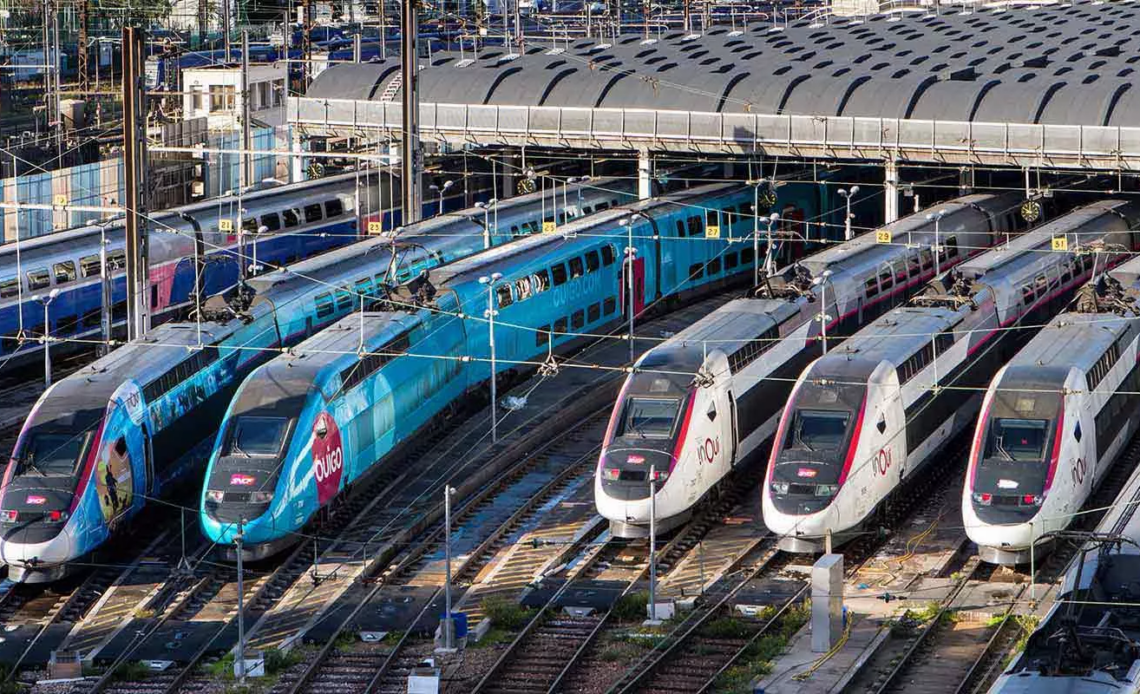
Pic Credit: SNCF Group
Vertical: Rail Transportation
Application: Rail maintenance connectivity, operational mobility, industrial asset tracking, connected maintenance terminals
Ecosystem: Nokia, HPE (Athonet), Eiffage Energie Systemes, HubOne
Private Network: Private 5G
| SNCF Group has deployed a private 5G network across one of its largest rail maintenance facilities, setting the stage for a nationwide rollout that will transform how France’s national railway operator manages rolling stock. The implementation at Rennes, covering 19,000 square meters of metal-dense industrial space with seven antennas in the 3.8 GHz band, addresses connectivity challenges for 700 maintenance terminals and positions SNCF to scale the architecture to ten technicentres started in 2025. |
SNCF Group, France’s state-owned railway operator, has completed deployment of a private 5G network at its industrial technicentre in Rennes, one of the largest rail maintenance facilities in the country. The deployment, executed in partnership with Nokia for radio infrastructure, HPE’s Athonet division for core network technology, and integration support from Eiffage Energie Systemes and HubOne, addresses longstanding connectivity challenges in metal-intensive industrial environments where traditional wireless coverage fails.
The Rennes installation serves as the anchor deployment for a nationwide expansion plan targeting ten maintenance centers across France that began in 2025. SNCF operates 27 routine maintenance technicentres and nine complete refurbishment facilities nationwide, maintaining rolling stock ranging from TGV high-speed trains to regional TER services, metros, and tramways. The Rennes facility alone employs 380 staff and specializes in braking components for all train types, requiring seamless digital connectivity for operational workflows, quality control, and asset tracking across vast industrial spaces.
| Metric | Detail |
| Network type | Private 5G (3.8 GHz band at Rennes, 2.6 GHz at Bischheim) |
| Spectrum | 3.8 GHz band (Rennes), 2.6 GHz band (Bischheim), licensed from ARCEP |
| Sites / cells | 7 antennas (Rennes 19,000 m²), 2 antennas (Bischheim 20,000 m²) |
| Coverage | 19,000 m² (Rennes facility), 20,000 m² (Bischheim facility including maintenance pits) |
| Devices | 700 terminals (Rennes facility) |
| Vendor(s) | Nokia (RAN), HPE/Athonet (core) |
| Integrator(s) | Eiffage Energie Systemes, HubOne |
| Timeline | 2025 deployment, nationwide rollout to 10 centers started in 2025 |
Overcoming Metal-Dense Industrial Connectivity Challenges
Rail maintenance facilities present unique wireless connectivity obstacles. The Rennes technicentre spans 19,000 square meters of industrial space filled with metal rolling stock, heavy tooling, and structural steel that creates radio-frequency shadows and multi-path interference. Traditional Wi-Fi and cellular coverage struggle to penetrate maintenance pits, under-train work areas, and spaces between parked rail cars. SNCF deployed seven 5G antennas operating in the 3.8 GHz frequency band to blanket the Rennes facility, ensuring that all 700 connected terminals used by maintenance crews maintain reliable connectivity as workers and equipment move throughout the building.
At the Bischheim industrial technicentre, which specializes in TGV fleet maintenance and renovation across 20,000 square meters, SNCF deployed two 5G antennas in the 2.6 GHz frequency band. The lower frequency provides superior propagation characteristics for reaching difficult-to-access locations, particularly maintenance pits located beneath rolling stock where technicians perform critical undercarriage work. This dual-spectrum approach, mirroring strategies used in private 5G deployments at Minneapolis-St. Paul Airport, allows SNCF to optimize coverage density and capacity based on each facility’s unique physical layout and operational requirements.
Multi-Vendor Architecture and Spectrum Strategy
SNCF structured its private 5G deployment around a disaggregated architecture separating radio access network (RAN) functions from core network operations. Nokia supply radio network equipment, while HPE’s Athonet division provides the 5G core network infrastructure. This approach, which parallels architectural decisions in private 5G implementations at large venues like Yokohama Arena, gives SNCF flexibility to scale capacity and functionality independently at the RAN and core layers as maintenance operations evolve.
Eiffage Energie Systemes and HubOne, operating through Eiffage’s Mobile Network subsidiary, won the integration contract described as the largest currently underway in France’s emerging private 5G sector. Frederic Rullac, Private 5G Development Manager at Eiffage Energie Systemes, explained the integrator’s role: “We are responsible for studies, jointly with SNCF for part of the engineering, installation of antennas, connectivity audits, and maintenance.” This turnkey approach ensures SNCF maintains operational control while leveraging specialized 5G deployment expertise.
SNCF obtained dedicated spectrum authorization from ARCEP, France’s telecommunications regulator, to operate in the 3.8 to 4.0 GHz band. SNCF Reseau secured one of the private 5G licenses in the band. Operating on licensed spectrum eliminates interference from public networks and provides guaranteed quality of service for mission-critical maintenance workflows, quality control imaging, and real-time operational data transfer.
Operational Benefits and Performance Gains
The private 5G infrastructure delivers tangible improvements in maintenance operations. SNCF reports faster traceability of maintenance operations, higher throughput for connected objects and processed data, and improved user experience for maintenance agents due to elimination of connection dropouts as workers move between work zones. Where technicians previously experienced dead zones requiring manual data entry and later synchronization, the 5G network maintains continuous connectivity for handheld terminals, tablets, and industrial sensors throughout the facility.
Christophe Fanichet, Deputy CEO Digital of SNCF Group and CEO of SNCF Voyageurs, positioned the deployment within SNCF’s broader digital transformation: “This new phase of experimentation extended to our industrial activities is strategic because it opens the way to innovations that can be decisive and give us an edge in terms of reliability and competitiveness of our maintenance.” The network supports augmented reality applications for remote expert assistance, real-time parts tracking to reduce inventory search times, and digital checklists synchronized instantly to central quality management systems.
| “This new phase of experimentation extended to our industrial activities is strategic because it opens the way to innovations that can be decisive and give us an edge in terms of reliability and competitiveness of our maintenance.” Christophe Fanichet, Deputy CEO Digital of SNCF Group and CEO of SNCF Voyageurs |
| “We are responsible for studies, jointly with SNCF for part of the engineering, installation of antennas, connectivity audits, and maintenance.” Frederic Rullac, Private 5G Development Manager, Eiffage Energie Systemes |
Living Labs Foundation and Railway Future Context
The Rennes deployment builds on SNCF’s ‘5G Living Labs’ project, which established three connected 5G zones in the city: the train station, the adjacent maintenance technicentre in the city center, and the industrial technicentre at the airport. Launched in 2021 with partners including Orange, Nokia, and Institut Mines-Telecom, the Living Labs initiative tested use cases for both passenger services and industrial applications. The 2021 trials utilized 5G in the 26 GHz band, spectrum well-suited for localized high-capacity deployments, and expanded the testbed to 22 hectares covering both passenger and maintenance operations.
SNCF’s private 5G strategy also aligns with the railway industry’s migration toward Future Railway Mobile Communication System (FRMCS), the next-generation standard replacing GSM-R for train control and operational communications. In 2019, SNCF announced collaboration with Nokia to evaluate FRMCS performance in laboratory and railway environments, with an SNCF spokesperson stating: “SNCF’s ambition is to create a universal telecommunications system capable of meeting the needs of the rail system of the future. We look forward to working with Nokia to evaluate the performance of FRMCS and industrial applications in the laboratory and railway environment.” The private 5G infrastructure at maintenance facilities provides a foundation for FRMCS testing and eventual integration.
Nationwide Rollout and Industry Parallels
Ten SNCF technicentres joined the private 5G network starting in 2025, representing one of the largest single-enterprise private cellular rollouts in European rail transportation. The phased expansion allows SNCF to refine network design, application integration, and operational processes at initial sites before replicating across the maintenance network. Each facility presents distinct coverage challenges based on building layout, equipment density, and maintenance specialization, requiring site-specific radio planning while maintaining architectural consistency at the core network and application layers.
SNCF’s deployment parallels initiatives by other major transportation operators. Deutsche Bahn deployed the world’s first commercial 1900 MHz (n101) 5G radio network solution with standalone core architecture at its digital railway test field in the Ore Mountains, running on live test tracks with Nokia technology. These airport private network implementations demonstrate proven scalability for large-scale transportation infrastructure.
Broader Industrial Private 5G Context in France
SNCF’s deployment contributes to France’s growing private 5G ecosystem. Orange and Nokia expanded their private 5G installation with Schneider Electric in Normandy to include LTE and 5G slicing, enabling dedicated virtual networks for distinct industrial applications. HPE’s Athonet division, acquired by HPE in 2023, had completed more than 450 customer deployments across transportation, healthcare, utilities, and public safety before the acquisition, bringing proven private cellular expertise to SNCF’s rollout. The scale of SNCF’s contract with Eiffage and HubOne, characterized as France’s largest active private 5G project, signals enterprise confidence in the technology’s maturity for mission-critical industrial applications.
The Bischheim facility also hosts the 5G-ILABB research project, a French-German collaboration launched through the 2022 ‘5G for industry’ research call. The consortium includes SNCF, Fraunhofer, Nokia, CRAN, and Evocortex, focusing on industrial automation and advanced analytics applications enabled by private 5G. Research outcomes from 5G-ILABB will influence equipment selection, application development, and operational procedures as SNCF scales to additional maintenance centers, similar to how industrial campus implementations in food manufacturing inform broader sector adoption.
Security, Productivity, and Service Continuity
SNCF’s private 5G network enhances operational security by keeping maintenance data and communications on dedicated infrastructure isolated from public networks. Quality control images, maintenance records, parts inventory data, and real-time equipment diagnostics remain within SNCF’s controlled environment, reducing cybersecurity exposure and ensuring compliance with data sovereignty requirements. The network architecture supports role-based access controls and encrypted communications for all connected devices, critical for protecting intellectual property related to proprietary maintenance procedures and rolling stock configurations.
Service continuity improvements directly impact maintenance productivity. Technicians no longer lose connectivity when moving equipment between work zones or entering radio-frequency shadow areas, eliminating workflow interruptions and redundant data entry. Real-time synchronization of digital checklists and maintenance records reduces administrative overhead and accelerates quality assurance processes. The infrastructure supports higher device density than previous wireless systems, enabling expansion of IoT sensors on tools, parts bins, and rolling stock components to track utilization, location, and maintenance history without network congestion. These operational improvements mirror benefits reported in dedicated private networks for broadcasting and enterprise smart office environments, where uninterrupted connectivity underpins digital workflows.
| KEY INSIGHT SNCF’s private 5G deployment demonstrates that large-scale industrial operators can leverage dedicated spectrum, disaggregated network architectures, and specialized integration expertise to overcome connectivity challenges in metal-dense environments, enabling digital transformation of maintenance operations while maintaining data sovereignty and service continuity across nationwide facilities. |
Related Reading
- Private 5G Network at Minneapolis-St. Paul Airport: Ericsson, Insight Enterprises Deploy System
- Private 5G Network for Airports: Boldyn Deploys System at Ontario International Across 1,700 Acres
- Private 5G Network at Yokohama Arena: Sony Wireless Deploys MOREVE for 17,000-Person Event Venue
- Private 5G Network for Broadcasting: T-Mobile Deploys Dedicated Stadium System for Apple TV at Dodger Stadium
- Private 5G Network for Finance: Samsung Deploys Smart Office at Hana Financial Group in South Korea
- Private 5G Network for Food Manufacturing: Inrico Upgrades Yihai Kerry’s Industrial Campus in China
Frequently Asked Questions
Q1: What spectrum does SNCF use for its private 5G rail maintenance network?
SNCF operates in the 3.8 GHz band at its Rennes facility (19,000 square meters covered by seven antennas) and the 2.6 GHz band at Bischheim (20,000 square meters with two antennas), using spectrum licensed from ARCEP specifically for private industrial networks.
Q2: How many maintenance facilities will SNCF connect with private 5G?
SNCF plans to deploy private 5G across ten maintenance technicentres with implementations that started in 2025, and following initial implementations at Rennes and Bischheim. The operator maintains 27 routine maintenance centers and nine complete refurbishment facilities nationwide that could eventually join the network.
Q3: Which vendors supply SNCF’s private 5G network infrastructure?
Nokia provided radio access network equipment, HPE’s Athonet division supplies the 5G core network infrastructure, and Eiffage Energie Systemes with HubOne handle integration, engineering, antenna installation, connectivity audits, and ongoing maintenance across all sites.
Q4: What operational benefits does private 5G deliver for rail maintenance?
The network enables faster maintenance traceability, higher throughput for connected devices and data processing, elimination of connectivity dropouts as workers move through facilities, support for augmented reality remote assistance, real-time parts tracking, and instant synchronization of digital quality control checklists.
Q5: How does SNCF’s deployment relate to future railway communications standards?
SNCF’s private 5G infrastructure supports evaluation of Future Railway Mobile Communication System (FRMCS), the next-generation standard replacing GSM-R for train control. The network provides a foundation for testing FRMCS performance in laboratory and operational railway environments as the industry migrates standards.
Q6: Why did SNCF choose private 5G over Wi-Fi for maintenance facilities?
Rail maintenance facilities contain metal rolling stock, heavy tooling, and structural steel that create radio-frequency shadows defeating Wi-Fi coverage. Private 5G’s licensed spectrum, superior propagation, and mobility management maintain reliable connectivity for 700 terminals as workers move throughout 19,000-square-meter industrial spaces.