
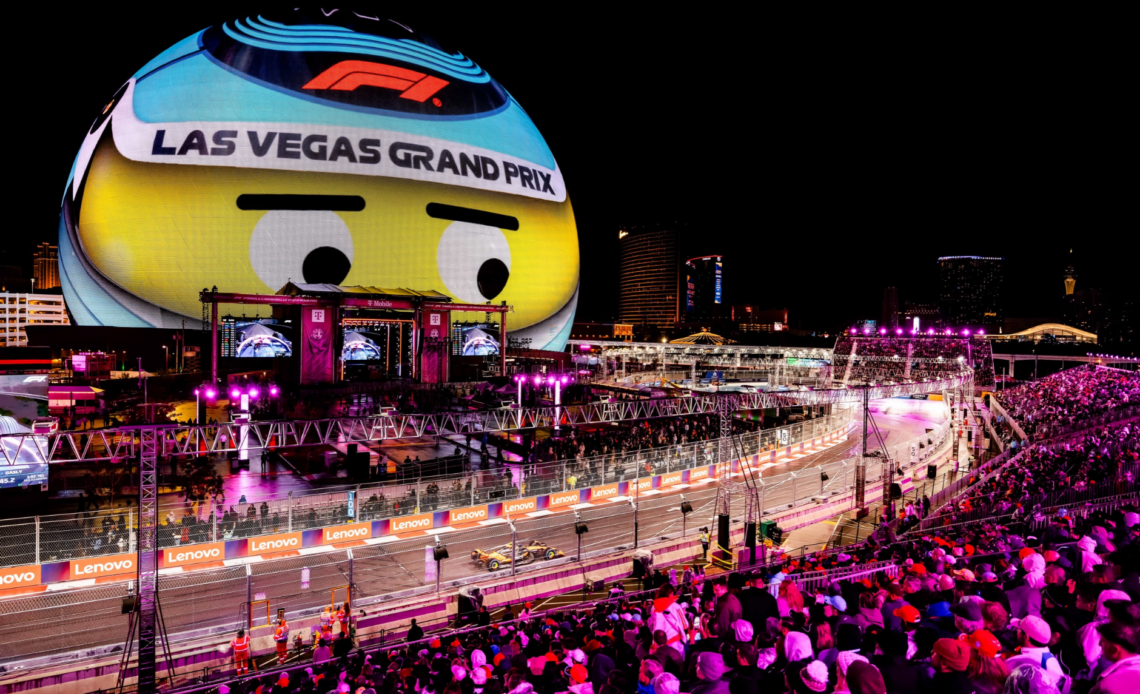
Pic Credit: Formula One World Championship Limited
Vertical: Sports and Entertainment
Application: 5G network slicing, broadcast production, real-time 3D operations monitoring, crowd density analytics, point-of-sale connectivity, mission-critical first responder communications
Ecosystem: T-Mobile, Ericsson, Formula 1, Las Vegas Grand Prix, Inc.
Private Network: 5G
| T-Mobile deployed seven separate 5G network slices at the November 2026 Las Vegas Grand Prix, connecting broadcast cameras, drones, point-of-sale terminals and a Smart Operations Command Center across one of the world’s most demanding live sporting events. The deployment marks the fourth year of an expanding partnership that now extends to the Austin circuit, demonstrating enterprise-grade private wireless at scale before a global television audience. |
T-Mobile deployed more than 20 5G-connected devices, including drones and roaming cameras, at the November 19 to 21, 2026 Formula 1 Heineken Las Vegas Grand Prix using its Advanced Network Solutions platform with 5G on Demand and network slicing technology. The network provided connectivity for more than 500 ticket scanners and point-of-sale devices, SuperMobile for Las Vegas Grand Prix staff and T-Priority for first responders.
For 2026, T-Mobile expanded its infrastructure to 152 5G radios delivering a combined 845 MHz of spectrum, including additional millimeter-wave capacity in major seating areas. This represented a significant upgrade from the 2025 race, which used 120 5G radios delivering 745 MHz of spectrum with five mobile cell sites and two temporary rooftop sites. The deployment showcased how private 5G networks enable motorsports operations that were previously impossible with traditional wireless infrastructure.
| Metric | Detail |
| Network type | 5G with network slicing and private core |
| 5G radios deployed | 152 (2026), up from 120 (2025) |
| Spectrum deployed | 845 MHz total (2026), including 2.5 GHz mid-band, 600 MHz low-band, and millimeter-wave |
| Network slices | Seven dedicated slices |
| Connected devices | 20+ broadcast devices (drones, cameras), 500+ ticket scanners and point-of-sale terminals |
| Core vendor | Ericsson (EP 5G box for 5G On Demand) |
| Operator | T-Mobile Advanced Network Solutions |
| Go-live | November 19 to 21, 2026 |
| Partnership status | Multi-year extension announced November 2025, expanding to Austin circuit in 2026 |
| Performance | Glass-to-glass latency under 100 milliseconds; 2025 race supported 233,000 peak concurrent users, 45,000 voice calls, 52 terabytes of data |
Live Event Demands Drive Multi-Year Network Evolution
The Formula 1 Heineken Las Vegas Grand Prix presents one of the most challenging live event connectivity environments in sports. The inaugural 2023 race saw users transmit 213 terabytes of data, with more than 100,000 people simultaneously on the network at its peak. Weekend attendance in 2025 exceeded 300,000 people, with the network supporting 233,000 peak concurrent users, 45,000 voice calls, and 52 terabytes of data. T-Mobile has invested in continuous infrastructure expansion to meet these demands, increasing radio count by 27 percent and spectrum deployment by 13 percent between the 2025 and 2026 races.
T-Mobile acquired significant 2.5 GHz spectrum when it bought Sprint, which provides the mid-band layer for its nationwide 5G network, with 600 MHz low-band spectrum serving as the 5G foundation. For the Las Vegas Grand Prix, T-Mobile layered in additional millimeter-wave capacity in major seating areas to provide the high throughput required for 4K video uploads and dense user concentrations. Similar network densification challenges have been addressed in other large-scale deployments, including airport private 5G networks covering thousands of acres.
Seven Network Slices Support Distinct Operational Functions
T-Mobile deployed seven network slices at the Las Vegas Grand Prix, enabling dedicated bandwidth for different use cases. Network slicing is a 5G technology that creates multiple virtual networks on a single physical infrastructure, each optimized for specific performance requirements. In 2023, 230 point-of-sale devices operated in the T-Mobile Sphere Zone on a dedicated network slice, supporting more than 50,000 transactions. For 2026, T-Mobile expanded slicing to support broadcast production, crowd management systems, ticketing operations, first responder communications, staff SuperMobile devices, and the new Smart Operations Command Center.
The 5G On Demand equipment, based around a small refrigerator-sized box weighing around 200 pounds, houses an Ericsson EP 5G box that runs as a private 5G core. This core can self-provision and attach itself to the T-Mobile macro-network in less than 48 hours. Glass-to-glass latency averaged under 100 milliseconds, with the remaining 10 percent of the 100ms latency dedicated to 5G transmission from the cameras to the operator’s private 5G core. The portable nature of the solution enables temporary deployments for events, contrasting with permanent private 5G installations at fixed industrial facilities.
| “F1 in Vegas is where performance becomes culture. Everything is happening at full speed, on and off the track, with fans tuned in from around the world. This is exactly the kind of environment where we can put our network to work at scale and see that impact carry through the entire experience, from how the race runs and how fans experience it to how we put our members inside the action.” Lucy McLellan, Executive Vice President and Chief Brand & Communications Officer, T-Mobile |
Wireless Broadcast Cameras Replace Traditional Cabling Infrastructure
Twenty wireless 5G cameras were used to film concerts and crowds in 4K, with more than 20 iPhones working as broadcast cameras around the circuit. T-Mobile’s approach to broadcast production eliminated the need for traditional cabling, which typically requires extensive setup time and limits camera mobility. Using Sony PDT-FP1 portable data transmitters combined with ultra-low latency encoders and decoders, the system delivered glass-to-glass latency of less than 100 milliseconds, meeting broadcast standards for live production.
The broadcast innovation extends T-Mobile’s work in sports production. At the 2026 PGA Championship, PGA Digital used an array of more than 60 5G-connected phones to capture footage from the T-Mobile Range, with a 5G private network connecting six cameras to PGA Production Studios in Frisco, Texas. The elimination of physical broadcast infrastructure reduces setup costs and time while enabling camera positions that would be impractical with wired connections. This approach mirrors wireless video transmission systems deployed in DTM racing, where onboard cameras transmit 4K video at 140 Mbps from moving vehicles.
Smart Operations Command Center Integrates AI-Powered Alerts
New for 2026 was the Smart Operations Command Center, a live 3D digital twin of the circuit that pulls crowd density, medical and security incidents, ticketing and network health into one view for the operations staff, with AI-powered alerts. The command center provides real-time 3D views for operational management, enabling race organizers to respond to developing situations across the venue. T-Mobile deployed the same technology at the 2026 PGA Championship, where it monitored crowd movement, entry points, concessions, and connected devices across the venue.
The Smart Operations Command Center represents an evolution from traditional two-dimensional monitoring systems to immersive 3D visualization. By aggregating data from multiple systems onto a single interface, the platform reduces the time between incident detection and operational response. The system tracks transportation, food and beverage line management, and overall venue flow. This operational intelligence approach has parallels in industrial private 5G deployments at shipyards, where real-time asset tracking and safety monitoring are critical operational requirements across large geographic areas.
| “The launch of Formula 1 in Las Vegas has defined a new era for the sport, and T-Mobile has been a valued partner from day one. Their technology, creativity and fan-first mindset continue to elevate the race week experience, and we’re thrilled to expand this partnership as we look to the future.” Emily Prazer, Chief Commercial Officer of Formula 1 and President and CEO of Las Vegas Grand Prix, Inc. |
Partnership Expands to Austin Circuit Starting in 2026
Since first announcing the partnership in 2022, T-Mobile has played a defining role in powering the Las Vegas Grand Prix, delivering 5G-connected broadcast cameras and drones, mission-critical event operations and exclusive content to fans onsite and at home. Under a multi-year extension announced in November 2025, T-Mobile will bring 5G-connected technologies supporting broadcast innovations and fan activations to the United States Grand Prix at the Circuit of the Americas in Austin, Texas, starting in 2026.
The expansion to Austin represents a geographic extension of the deployment model proven in Las Vegas. T-Mobile will deploy Club Magenta at the Austin circuit for the first time, giving T-Mobile customers exclusive, behind-the-scenes access. The partnership comes at a time when Formula 1 continues to grow in the United States, with three races now on the calendar. For T-Mobile, the deployments serve as large-scale proof points that enterprise buyers can reference, demonstrating the capabilities of private 5G at a moment when only 9 percent of enterprises have production private 5G deployments, but 21 percent are evaluating deployment within 12 months.
| “T-Mobile’s deployment at the Las Vegas Grand Prix showcases their comprehensive approach to applied 5G technology, demonstrating how modern networks can address complex, real-world challenges at scale.” Roy Chua, Founder and Principal, AvidThink |
Industry Context and Comparable Sports Venue Deployments
T-Mobile’s Las Vegas Grand Prix deployment represents one of the most extensive uses of private 5G network slicing for a live sporting event. Verizon deployed the first large-scale 5G private network to support multiple private use cases in a live setting at The Formula 1 Crypto.com Miami Grand Prix at Hard Rock Stadium, hosting nearly a quarter of a million fans over three days. By installing a 5G private network platform, Verizon enhanced venue operations, streamlining everything from efficient ticket scanning and speedy point-of-sale systems to nearly instant uploads for photographers capturing live action.
The Formula 1 Australian Grand Prix used private 5G for fast, reliable site-wide connectivity. PMY Group delivered private wireless 5G connectivity throughout the Grand Prix site, installing multiple radio units and antennas to provide a robust wireless backbone for connectivity without reliance on extensive cabling and infrastructure. Bell Canada leveraged its 5G private mobile network during the Formula 1 Canadian Grand Prix in Montreal, while Silverstone engaged neutral host and private network provider Boldyn Networks to deliver a major connectivity upgrade culminating in the construction of a new, permanent high-capacity 5G mobile network ahead of the British Grand Prix. The global proliferation of private 5G at major racing venues parallels adoption in other industries, including energy facilities using private networks for AI-driven operations.
Proof of Concept Value for Enterprise Private 5G Adoption
In our view, the deployment functions as a large-scale proof of concept that enterprise buyers can reference when evaluating private 5G business cases. The activation demonstrates enterprise-grade private wireless capabilities at a moment when private 5G adoption remains in early stages across most industries. The Las Vegas Grand Prix deployment addresses multiple use cases simultaneously, including broadcast production requiring sub-100ms latency, point-of-sale transactions requiring reliability and security, first responder communications requiring mission-critical uptime, and operational command and control requiring real-time data aggregation and visualization.
The portable nature of T-Mobile’s 5G On Demand solution, which can self-provision and attach to the macro network in less than 48 hours, addresses one of the key barriers to private 5G adoption: deployment complexity. By demonstrating that a temporary private network supporting thousands of devices and terabytes of data can be deployed and torn down within days, T-Mobile is showcasing a model that could apply to construction sites, disaster response scenarios, temporary mining operations, and other short-duration high-connectivity environments. This flexibility contrasts with permanent private LTE networks deployed at remote mine sites, which represent multi-year infrastructure investments.
| KEY INSIGHT T-Mobile’s deployment of seven network slices supporting broadcast, operations, commerce, and public safety at the Las Vegas Grand Prix demonstrates that temporary private 5G networks can deliver enterprise-grade performance for complex, high-stakes events, with sub-100ms latency and terabyte-scale data handling in a deployment that self-provisions in under 48 hours. |
Related Reading
- Private 5G Network Powers Brazilian Stock Car Championship with Real-Time Telemetry at 250 km/h
- Private 5G Network for Motorsports: DTM Deploys Riedel Easy5G Across 21 Cars for Onboard Video at 140 Mbps
- Private 5G Network for Airports: Boldyn Deploys System at Ontario International Across 1,700 Acres
- Private 5G Network for Rail Maintenance: SNCF Deploys Nokia, HPE Solution Across 19,000 m² Facility in Rennes
- Private 5G Network for Shipyards: stc Bahrain Deploys Commercial System at ASRY Covering 250,000 Square Meters
- Private 5G Network for Solar Farms: U Mobile and HLGY Energy MoU Targets AI-Driven Operations in Malaysia
- Private LTE Network for Mining: Star Solutions Deploys System at Alaska’s Red Dog Mine
Frequently Asked Questions
Q1: What is the T-Mobile 5G network deployment at the 2026 Las Vegas Grand Prix?
T-Mobile deployed 152 5G radios delivering 845 MHz of spectrum with seven network slices to support broadcast cameras, drones, ticket scanners, point-of-sale devices, first responder communications, and a Smart Operations Command Center at the November 19 to 21, 2026 Formula 1 Heineken Las Vegas Grand Prix.
Q2: How many network slices did T-Mobile deploy at the Las Vegas Grand Prix?
T-Mobile deployed seven dedicated network slices, each optimized for specific performance requirements including broadcast production, point-of-sale transactions, ticketing operations, first responder communications, staff devices, and the Smart Operations Command Center with AI-powered alerts and real-time 3D visualization.
Q3: What latency did the 5G broadcast cameras achieve at the race?
The 5G On Demand equipment delivered glass-to-glass latency under 100 milliseconds for the 20 wireless 5G cameras filming concerts and crowds in 4K, with 10 percent of that latency dedicated to 5G transmission from cameras to the private core.
Q4: What is T-Mobile’s 5G On Demand solution used at the event?
5G On Demand is a portable private 5G network solution housed in a refrigerator-sized box weighing around 200 pounds, containing an Ericsson EP 5G box that runs a private core and can self-provision and attach to the T-Mobile macro-network in under 48 hours.
Q5: How much data did the network handle during the 2025 race?
The 2025 Las Vegas Grand Prix network supported 233,000 peak concurrent users, 45,000 voice calls, and 52 terabytes of data for weekend attendance exceeding 300,000 people, with more than 100,000 people simultaneously on the network at peak in 2023.
Q6: What new technology did T-Mobile introduce at the 2026 race?
T-Mobile introduced the Smart Operations Command Center, a live 3D digital twin of the circuit that aggregates crowd density, medical and security incidents, ticketing data, and network health into one view with AI-powered alerts for real-time operational decision making.