

Vertical: Seaports
Application: Automated container handling, real-time logistics tracking, vehicle connectivity, digital twin operations
Ecosystem: Deutsche Telekom, Ericsson, Hamburger Hafen und Logistik AG (HHLA), German Federal Ministry for Digital and Transport
Private Network: 5G
| Germany advances port automation with dedicated 5G infrastructure. Container Terminal Altenwerder in Hamburg deploys Ericsson campus network to support real-time logistics and autonomous vehicle operations across one square kilometer, funded by federal digitalization initiative. |
Hamburger Hafen und Logistik AG (HHLA) has deployed a private 5G campus network at its Container Terminal Altenwerder (CTA) in Hamburg, Germany, working with Deutsche Telekom and Ericsson to build wireless infrastructure supporting one of Europe’s most automated port facilities. The deployment, covering approximately one square kilometer, forms part of the German government’s DigitTest project aimed at digitalizing critical logistics infrastructure and validating advanced automation technologies in operational environments.
The terminal handles approximately three million standard containers annually and already operates 27 automated rail-mounted gantry cranes and 14 ship-to-shore container cranes. The new 5G network provides the high-performance wireless connectivity required to expand automation, test emerging applications under realistic conditions, and integrate real-time data from vehicles, sensors, mobile devices, and IT systems across the sprawling port facility.
| Metric | Detail |
| Network type | Private 5G campus network |
| Coverage area | Approximately one square kilometer |
| Key vendor(s) | Ericsson (infrastructure), Deutsche Telekom (integration) |
| Enterprise | Hamburger Hafen und Logistik AG (HHLA), Container Terminal Altenwerder |
| Annual throughput | Three million standard containers |
| Automated equipment | 27 rail-mounted gantry cranes, 14 ship-to-shore cranes |
| Funding | German Federal Ministry for Digital and Transport (BMDV), DigitTest program |
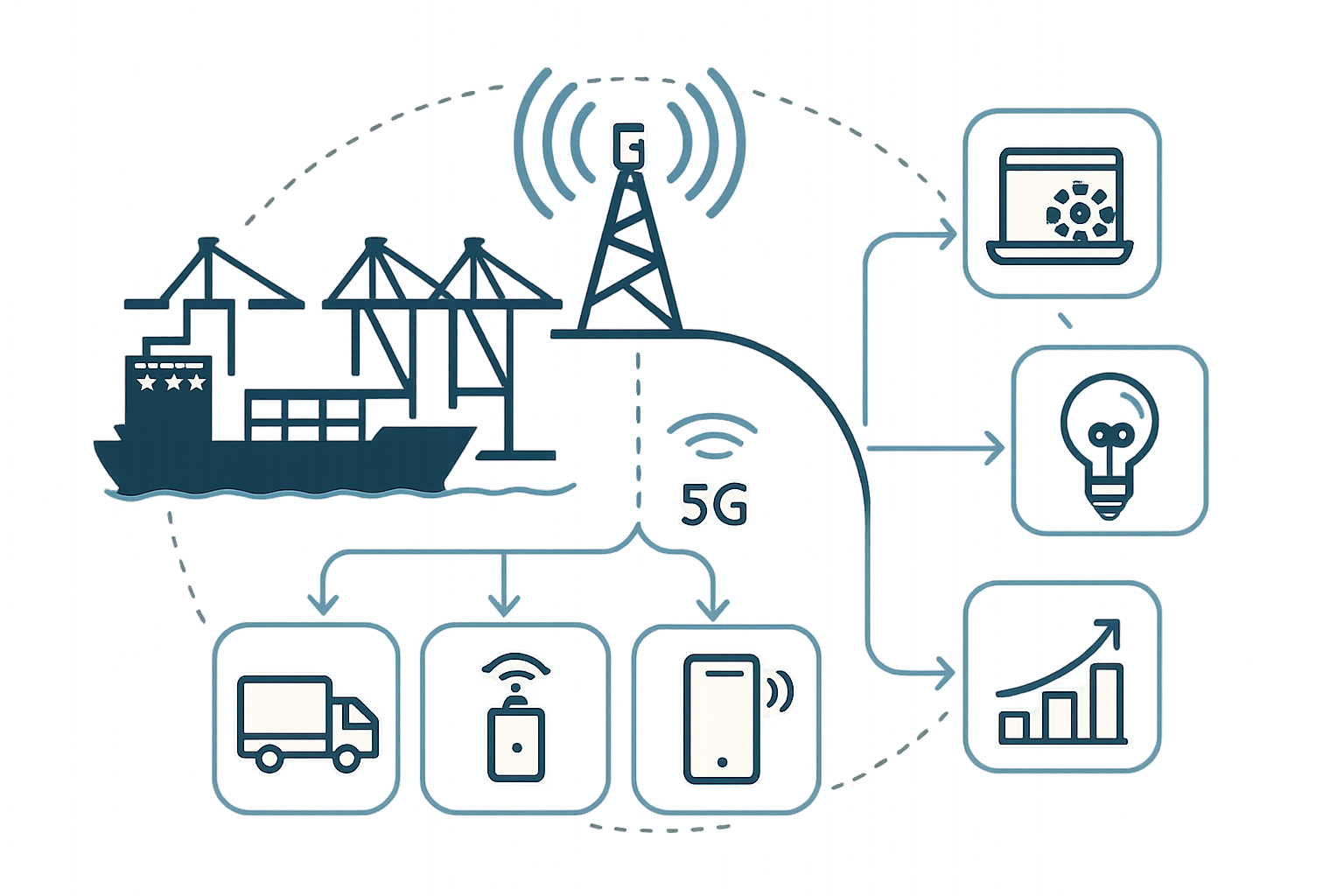
Container Terminal Altenwerder: Germany’s Automation Testbed
Container Terminal Altenwerder has served as a proving ground for port automation since it opened in 2002. Located on the southern bank of the Elbe River in Hamburg, CTA represents one of the world’s most technologically advanced container handling facilities. The terminal employs automated guided vehicles (AGVs) to transport containers between quayside cranes and storage yards, eliminating the need for human-driven trucks in much of the operation. This level of automation demands robust, low-latency wireless connectivity to coordinate movements, manage inventory, and maintain safety across a complex industrial environment.
Traditional WiFi and earlier wireless technologies have proven insufficient to support the density of connected devices and the reliability requirements of autonomous operations at modern container terminals. Similar challenges have driven private 5G deployments at major seaports worldwide, where millisecond-level latency and guaranteed bandwidth enable safe coordination of heavy machinery operating in close proximity. HHLA identified private 5G as the connectivity foundation necessary to advance automation further and test next-generation logistics applications that rely on real-time data exchange.
DigitTest Project and Government Funding
The private 5G deployment at CTA is funded predominantly by the German Federal Ministry for Digital and Transport (BMDV) through its DigitTest initiative. DigitTest represents a multi-year program designed to accelerate the digitalization of Germany’s transport and logistics infrastructure by supporting real-world trials of advanced connectivity technologies. The program prioritizes projects that test 5G applications in operational environments rather than laboratory settings, ensuring that solutions can withstand the demands of industrial use before widespread adoption.
By providing government funding for the CTA network, BMDV aims to validate 5G use cases applicable to ports, rail terminals, and logistics hubs across Germany and Europe. The project began in 2022 and is expected to run for three years, during which HHLA and its partners will test a range of applications including remote crane operation, predictive maintenance using sensor networks, and enhanced situational awareness through digital twin technologies. This approach mirrors government-supported industrial 5G programs across Europe, where public funding de-risks early deployments and generates learnings that benefit the broader industry.
Technical Architecture and Deployment Scope
Ericsson supplied the core 5G campus network infrastructure for the CTA deployment, while Deutsche Telekom managed integration and ongoing operations. The system operates on dedicated spectrum, ensuring that the terminal’s mission-critical communications do not compete with public mobile traffic. The network architecture is designed to deliver the ultra-reliable, low-latency connectivity (URLLC) characteristics essential for controlling autonomous vehicles and coordinating crane operations in real time.
The one-square-kilometer coverage footprint encompasses the terminal’s operational areas, including container stacking yards, quayside crane positions, and vehicle traffic lanes. Unlike typical enterprise WiFi deployments, which often struggle with handover reliability as devices move at speed, the 5G campus network maintains seamless connectivity as AGVs traverse the terminal at rates that can exceed 20 kilometers per hour. This continuity is critical for maintaining control signals and ensuring that vehicles respond instantly to commands from the terminal’s central control systems. The architecture shares technical similarities with Ericsson private 5G frameworks deployed in demanding operational environments requiring high availability and deterministic performance.
Use Cases and Operational Applications
The private 5G network supports a broad range of applications aimed at increasing terminal efficiency, transparency, and flexibility. Primary use cases include connecting autonomous vehicles to the terminal operating system, enabling real-time tracking of container positions, and providing wireless connectivity for mobile devices used by terminal staff. The network also serves as the foundation for testing new applications under realistic conditions, allowing HHLA and its technology partners to develop and validate innovations in a live terminal environment before committing to full-scale deployment.
Advanced applications under evaluation include remote operation of container cranes, where operators control equipment from centralized control rooms rather than crane cabs, improving safety and enabling one operator to manage multiple cranes. Predictive maintenance systems use sensor data transmitted over the 5G network to monitor equipment health and schedule interventions before failures occur, reducing downtime and maintenance costs. Digital twin applications create virtual replicas of terminal operations, allowing planners to simulate scenarios and optimize workflows. These capabilities are increasingly common in industrial private wireless deployments across sectors where operational continuity and safety are paramount.
| “With the private 5G campus network at CTA we are taking the digitalization of port logistics to the next level with HHLA. This solution demonstrates how advanced mobile communications technology can make complex processes more efficient, transparent, and flexible.” Klaus Werner, Managing Director, Business Customers, Telekom Deutschland |
| “With the 5G campus network, we now have a high-performance and reliable wireless infrastructure to test new applications under realistic conditions and deploy them directly into operations. At the same time, it allows us and our partners to develop and validate innovative solutions in a real terminal environment. This marks an important step in advancing the connectivity and automation of the CTA.” Michael Albers, IT Project Manager, HHLA |
Industry Context and Port Digitalization Trends
The CTA deployment is part of a broader wave of private 5G adoption across global port infrastructure. Major terminals in Europe, Asia, and the Americas are investing in dedicated wireless networks to support automation and digitalization strategies driven by rising cargo volumes, labor shortages, and pressure to reduce emissions. Container shipping lines increasingly demand faster turnaround times, while port operators seek to maximize throughput without expanding physical footprints, making operational efficiency gains through technology a strategic priority.
Hamburg competes with other major European gateways including Rotterdam, Antwerp, and Bremerhaven, all of which are pursuing automation and digital transformation programs. Rotterdam has conducted multiple private 5G trials across different terminal operators, while Italian ports have deployed dedicated networks to support remote crane operations and autonomous vehicle fleets. Asian terminals, particularly in Singapore and China, have moved aggressively to deploy private 5G and earlier LTE networks, often achieving higher levels of automation than European counterparts. The CTA network positions HHLA to remain competitive by validating technologies that can be scaled across Hamburg’s broader port infrastructure and potentially licensed to other operators. This competitive dynamic is evident in transport infrastructure deployments globally, where early adopters gain operational advantages and shape industry standards.
Integration with Existing Terminal Systems
A critical success factor for the CTA private 5G network is its integration with HHLA’s existing terminal operating systems (TOS) and automation platforms. The terminal already runs sophisticated software to manage container movements, optimize crane scheduling, and coordinate AGV traffic. The 5G network serves as the high-bandwidth, low-latency communication layer connecting these systems to field equipment, replacing or augmenting earlier wireless technologies that offered limited capacity and reliability.
Integration extends to safety systems that prevent collisions between autonomous vehicles, monitor personnel locations in restricted areas, and trigger emergency stops when hazards are detected. The 5G network’s ability to support massive device connectivity allows the terminal to deploy dense sensor arrays that provide continuous environmental monitoring, feeding data into centralized control systems that can respond in real time. This layered approach to connectivity and control is similar to strategies employed in industrial campus deployments where legacy systems must coexist with modern wireless infrastructure. The phased deployment approach allows HHLA to validate applications incrementally, reducing risk and building operational confidence before committing to broader rollouts across Hamburg’s port facilities.
Implications for European Logistics Infrastructure
The DigitTest project and the CTA deployment specifically generate insights applicable to logistics infrastructure beyond container ports. Germany’s transport network includes extensive rail freight operations, inland waterways, and intermodal terminals that face similar connectivity challenges. The learnings from operating a private 5G network in the harsh electromagnetic environment of a container terminal, where metal containers create signal propagation challenges, will inform deployments in other industrial settings.
European regulators and policymakers are closely watching government-funded 5G trials to shape spectrum policy, technical standards, and investment frameworks that will govern private networks across the continent. The success of projects like CTA can accelerate regulatory approvals for dedicated spectrum allocations and inform guidelines for coexistence between private and public networks. These policy dimensions are particularly relevant as European industries seek to match the pace of private 5G adoption seen in Asia and North America, where regulatory frameworks have often enabled faster deployment timelines. The intersection of policy and technology is evident in national telecommunications infrastructure programs that balance commercial and strategic objectives.
| KEY INSIGHT Government-funded trials like DigitTest de-risk enterprise private 5G adoption by validating performance in operational environments. Port operators evaluating private wireless should prioritize use cases requiring real-time coordination of autonomous assets, where 5G’s latency and reliability advantages deliver measurable operational gains over legacy technologies. |
Related Reading
- Port of Santos Private 5G Network Integrates VTMIS, Digital Twin for Smart Port Operations in Brazil
- Tampa Electric Private LTE Network Deployment with Ericsson, OneLayer, and Burns & McDonnell Secures Mission-Critical Grid Communications Across 2,000 Square Miles of Florida Territory
- Private 5G Network for Rail: Queensland Rail and Ericsson Build ETCS Infrastructure
- UK Ministry of Defence Private 5G Framework: Ericsson Wins Role in £8 Billion RM6393 Tactical Communications Upgrade Through 2034
- Costa Rica 5G Standalone Network: ICE Awards Ericsson $220 Million Contract for Nationwide Deployment
- Private 5G Network for Food Manufacturing: Inrico Upgrades Yihai Kerry’s Industrial Campus in China
Frequently Asked Questions
Q1: What is the coverage area of the private 5G network at Container Terminal Altenwerder?
The private 5G campus network deployed by Deutsche Telekom and Ericsson covers approximately one square kilometer at HHLA’s Container Terminal Altenwerder in Hamburg, encompassing operational areas including container yards, quayside crane positions, and vehicle traffic routes.
Q2: Who funded the private 5G deployment at Hamburg’s CTA terminal?
The deployment is funded predominantly by the German Federal Ministry for Digital and Transport (BMDV) through its DigitTest program, which supports real-world trials of advanced connectivity technologies in transport and logistics infrastructure across Germany.
Q3: What applications does the CTA private 5G network support?
The network enables real-time connectivity for autonomous guided vehicles, mobile devices, sensors, and IT systems. It supports testing of remote crane operation, predictive maintenance, digital twin simulations, and enhanced logistics tracking under realistic operational conditions.
Q4: How many containers does Container Terminal Altenwerder handle annually?
Container Terminal Altenwerder handles approximately three million standard containers per year, making it one of the largest and most automated container terminals in Europe. The facility operates 27 automated rail-mounted gantry cranes and 14 ship-to-shore cranes.
Q5: Which vendors provided the technology for the Hamburg port private 5G network?
Ericsson supplied the core 5G campus network infrastructure, while Deutsche Telekom served as the network integrator and operator. HHLA is the enterprise customer operating Container Terminal Altenwerder, with support from the German government’s DigitTest initiative.
Q6: What advantages does private 5G offer over WiFi for port automation?
Private 5G provides ultra-reliable, low-latency connectivity with seamless handover as vehicles move at speed, dedicated spectrum free from public network interference, support for massive device connectivity, and deterministic performance critical for controlling autonomous equipment safely in industrial environments.