
- Why Healthcare Is One of the Hardest Environments to Get Wireless Right
- What Healthcare Facilities Are Actually Deploying Private Wireless For
- How AI Is Changing What Private Wireless Can Do in Healthcare
- The Deployment Realities Nobody Puts in the Brochure
- Where Does This Leave You?
- Frequently Asked Questions
- What spectrum is best for hospital private wireless deployments in the US?
- How does private wireless differ from hospital Wi-Fi and why does it matter?
- What clinical applications benefit most from private 5G versus private LTE?
- How does AI integrate with private wireless infrastructure in a hospital setting?
- What are the biggest mistakes healthcare IT teams make when deploying private wireless?
- How does private wireless address HIPAA compliance requirements?
Quick Answer:
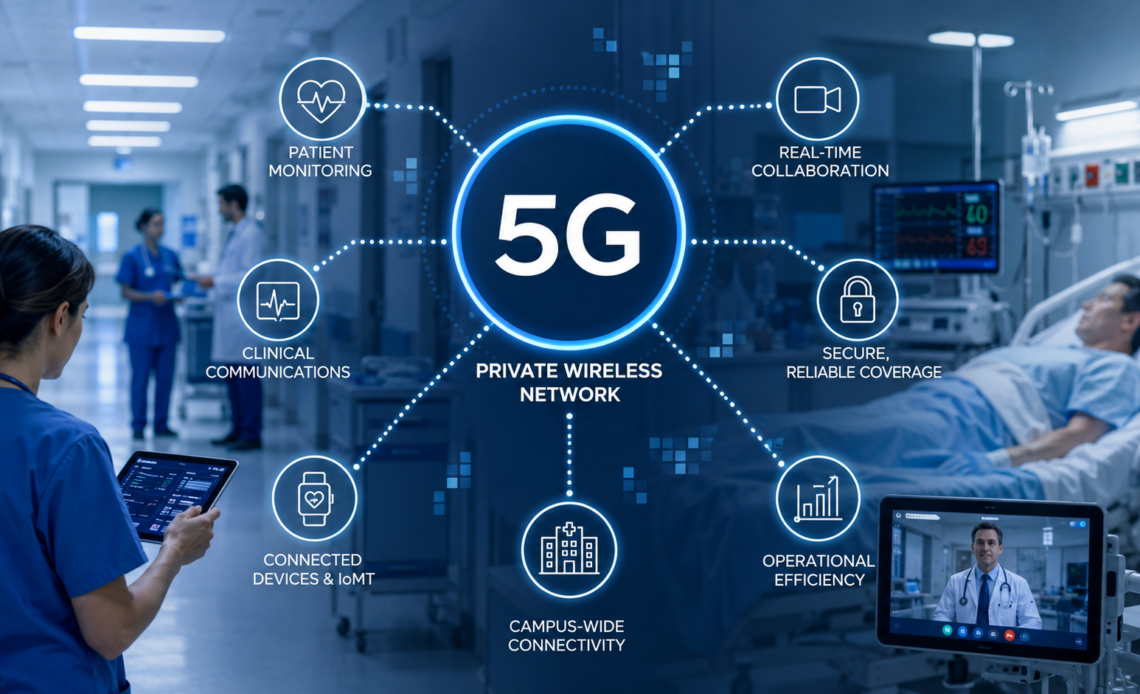
Healthcare is one of the most demanding environments for private wireless deployment. Dense building materials, strict regulatory requirements, legacy clinical systems, and zero tolerance for connectivity failure make hospital networks a different challenge entirely from any other enterprise vertical. Yet real-world deployments are proving that private LTE and 5G, when implemented correctly, deliver the reliability, data sovereignty, and low latency that clinical operations require. This article covers the use cases driving adoption across hospitals and care facilities, the deployment complexities vendors rarely advertise, how AI is expanding what private wireless infrastructure can do in clinical settings, and what healthcare IT teams need to know before committing to a deployment.
The global healthcare private 5G network market was valued at $620 million in 2025 and is projected to reach $2.86 billion by 2034, according to Grand Research Store. That number tells you exactly where the investment is heading. But market projections have a way of making complex problems look straightforward.
Walk into any large hospital today and the gap between what the brochures promise and what the infrastructure actually delivers becomes clear very quickly.
The vision is compelling: untethered patients, real-time telemetry streaming from every connected device on the ward, clinicians accessing imaging data from any terminal in the building, asset tracking systems that know where every IV pump is at any given moment. Private wireless makes all of this technically possible. The problem is that hospitals are not warehouses or factory floors. They are dense, heavily regulated, interference-sensitive environments where a connectivity failure is not an operational inconvenience but a patient safety event.
Deploying private wireless in a healthcare facility means navigating RF challenges that do not exist in most enterprise environments, integrating with legacy clinical systems that were never designed for modern wireless infrastructure, and satisfying data sovereignty requirements that rule out most public network solutions from the start. The facilities that are getting this right are doing so because they treated it as an infrastructure discipline from day one, not a technology procurement exercise.
Why Healthcare Is One of the Hardest Environments to Get Wireless Right
Most enterprise wireless deployments are complex. Healthcare wireless deployments are in a different category entirely. The combination of physical building challenges, mission-critical reliability requirements, and a regulatory framework that touches every connected device on the network means that lessons learned from manufacturing, logistics, or even education deployments transfer only partially. Healthcare IT teams need to understand what makes their environment uniquely demanding before evaluating any private wireless solution.
The RF Challenge in Clinical Settings
Hospital buildings are among the most difficult RF environments an engineer will ever work in. The physical characteristics that make hospitals function well as clinical facilities are the same characteristics that make wireless coverage unpredictable and hard to plan for.
- Concrete and lead-lined walls, common in radiology departments and operating suites, attenuate radio signals significantly more than standard commercial construction materials.
- Elevator shafts create RF dead zones and coverage gaps on every floor they serve, requiring specific engineering to maintain handoff continuity for mobile clinical devices.
- Basement facilities, including plant rooms, pharmacy storage, and morgues, often sit outside standard coverage plans but still require reliable connectivity for asset tracking and staff communications.
- Medical equipment itself generates electromagnetic interference. MRI machines in particular create significant RF interference in their immediate environment, requiring careful frequency planning and physical separation of network infrastructure.
- Patient density varies dramatically across a hospital at different times of day, creating load patterns that are harder to plan for than the relatively stable device counts in manufacturing or logistics environments.
Clinical-grade reliability requirements are stricter than any other enterprise vertical. A warehouse can tolerate a brief connectivity interruption. A patient monitor losing its network connection during a procedure cannot. The uptime expectations for private wireless in clinical settings are typically framed around five-nines availability, with latency requirements for patient-connected devices that leave no margin for interference or congestion-related degradation.
Regulatory and Compliance Pressures
The regulatory environment in US healthcare adds a layer of complexity that does not exist in most other enterprise verticals. Two regulatory frameworks in particular shape how private wireless must be designed and operated in a clinical setting.
- HIPAA requires that patient data be handled with strict controls over where it is stored, who can access it, and how it moves across networks. Data transmitted over a shared or public network creates compliance exposure that most healthcare legal and compliance teams will not accept.
- Private wireless networks keep patient data on-premise, within a controlled infrastructure that the facility owns and operates. This is the data sovereignty argument that makes private LTE and 5G directly relevant to HIPAA compliance, in a way that public 5G or shared Wi-Fi cannot match.
- The FDA oversees connected medical devices, and any wireless infrastructure supporting FDA-regulated devices must meet specific performance and security requirements. This creates procurement and validation workflows that extend deployment timelines significantly compared to standard enterprise wireless projects.
- Cybersecurity requirements in healthcare are among the most stringent of any sector. Private wireless networks, by design, are isolated from public internet infrastructure, which reduces the attack surface for connected medical devices and clinical systems.
The combined effect of these regulatory pressures is that healthcare facilities cannot treat private wireless as a commodity infrastructure decision. The network is part of the clinical environment. It has to be designed, validated, and operated accordingly.
What Healthcare Facilities Are Actually Deploying Private Wireless For
The use case list for private wireless in healthcare is long, and vendors are happy to recite all of it. The more useful question is what facilities are actually deploying today, what results they are seeing, and where the technology is genuinely earning its place versus where it remains aspirational. The answer varies by application, and understanding that distinction is what separates a realistic deployment plan from a procurement exercise built on marketing materials.
Real-Time Patient Monitoring and Connected Devices
Patient monitoring is the use case with the clearest and most immediate case for private wireless. The density of connected clinical devices in a modern hospital ward is substantial and growing. Every device that transmits data continuously over a network is a potential point of failure if the underlying connectivity is unreliable.
- IV pumps and infusion systems require continuous low-latency connectivity to transmit dosage data, alert on occlusions, and integrate with electronic health record systems in real time.
- ECG monitors and cardiac telemetry devices generate continuous data streams that cannot tolerate packet loss or latency spikes without compromising the clinical value of the monitoring.
- Wearable patient monitoring devices, including continuous glucose monitors and post-surgical vitals trackers, depend on reliable connectivity to move data from the patient to the clinical team without delay.
- Alarm fatigue is a documented patient safety problem in hospitals. A significant contributor is false alarms generated by connectivity dropouts rather than actual clinical events. Private wireless, with its dedicated spectrum and consistent performance, reduces the interference-related dropouts that generate spurious alerts.
Boston Children’s Hospital deployed a hybrid public and private 5G network in 2024, with the hospital’s CIO noting that the upgrade solved key connectivity challenges, improved clinical efficiency, and positioned the facility for next-generation innovations including AI workflows and remote patient monitoring. The deployment is notable because Boston Children’s was already a digitally advanced facility. The constraint was not ambition but infrastructure, and private wireless resolved it.
Clinical Mobility and Staff Communications
The second major deployment category is clinical mobility. Hospital staff move constantly. Nurses, physicians, technicians, and support staff cover significant distances within a single shift, often across multiple floors and building sections. The devices they carry and the systems they depend on need connectivity that follows them without interruption.
- Clinician-worn devices including smartphones, tablets, and purpose-built clinical handsets require seamless roaming across an entire facility without the dead zones that plague legacy Wi-Fi deployments in large hospital buildings.
- Real-time location systems (RTLS) for staff and asset tracking are one of the highest-ROI applications of private wireless in healthcare. Knowing where every piece of equipment is at any given moment reduces the time clinical staff spend locating devices, which in acute care environments translates directly into patient care time recovered.
- Nurse call systems, secure messaging platforms, and code response coordination all benefit from the dedicated spectrum and low interference characteristics of private LTE and 5G compared to shared Wi-Fi infrastructure.
- Asset tracking extends beyond clinical equipment to include high-value consumables, pharmaceutical carts, and patient transport equipment, all of which represent significant operational cost when lost or misplaced.
AdventHealth and Tampa General Hospital are among the healthcare providers that signed deals with Verizon Business for neutral host and private 5G network combinations in 2025, with healthcare CIOs citing growing device density and diversifying user groups as the primary drivers. The neutral host plus private 5G model is increasingly common in large health systems where both clinical and visitor connectivity need to be managed on a single infrastructure.
Imaging, Diagnostics, and High-Bandwidth Applications
The highest-bandwidth use cases in healthcare are in imaging and diagnostics. This is where the limitations of Wi-Fi become most apparent and where the performance characteristics of private 5G are most directly relevant.
- MRI, CT, and ultrasound systems generate large imaging files that need to move quickly from the imaging suite to radiologists, referring physicians, and integrated diagnostic platforms. Over Wi-Fi, this transfer competes with every other device on the network. Over dedicated private wireless, the bandwidth is reserved.
- Operating suites require interference-free connectivity for surgical navigation systems, intraoperative imaging equipment, and the growing category of robotically assisted surgical tools. The RF environment inside an operating room is managed extremely carefully, and any wireless infrastructure operating in that space must be validated against existing equipment.
- Telehealth and remote consultation applications require reliable, high-quality video connectivity. Over shared Wi-Fi in a busy hospital environment, video quality is unpredictable. Over private wireless with dedicated spectrum, it is consistent and manageable.
Wi-Fi alone cannot reliably meet these requirements at scale. The fundamental issue is not speed but consistency. Wi-Fi networks in hospital environments frequently experience traffic congestion and interference from a sudden influx of people and devices competing for bandwidth, directly impacting staff communication, patient monitoring, and other critical applications. Private wireless solves this by removing the shared spectrum problem entirely.
| Use Case | Technology Fit | Primary Benefit | Maturity |
| Patient monitoring and telemetry | Private LTE or 5G | Low latency, dedicated spectrum, reduced false alarms | Actively deployed |
| RTLS for staff and asset tracking | Private LTE | Facility-wide coverage, seamless roaming | Actively deployed |
| Clinical staff mobility and communications | Private LTE or 5G | Seamless handoff, secure dedicated network | Actively deployed |
| Large imaging file transport | Private 5G | High bandwidth, consistent throughput | Actively deployed |
| OR suite connectivity | Private 5G | Interference management, reliability | Early deployments |
| Robotically assisted surgery | Private 5G | Ultra-low latency, dedicated capacity | Pilot stage |
| Telehealth and remote consultation | Private 5G | Consistent video quality, secure data path | Growing adoption |
How AI Is Changing What Private Wireless Can Do in Healthcare
Private wireless infrastructure gives healthcare facilities the connectivity foundation they need. AI is what turns that foundation into an intelligent, responsive system. The two technologies are increasingly inseparable in serious healthcare deployments. A private 5G network without AI integration is a significant infrastructure investment. A private 5G network with AI integration is an operational platform that learns, adapts, and delivers value that a static network cannot. Understanding how AI fits into the picture is now a prerequisite for any healthcare IT team evaluating private wireless seriously.
AI-Powered Network Management in Clinical Environments
Managing wireless infrastructure in a hospital is operationally demanding. Device counts are high, interference sources are numerous, and the tolerance for degraded performance is effectively zero. Most hospital IT teams are not large enough to monitor and optimize a complex private wireless deployment manually at the level of granularity clinical operations require. AI-powered network management changes that equation.
- Self-optimizing networks use machine learning to monitor spectrum conditions, device load, and interference patterns in real time, adjusting radio parameters automatically to maintain performance without requiring manual intervention from IT staff.
- In clinical environments where interference sources shift constantly, including as medical equipment is moved between rooms and patient census changes by floor and shift, this dynamic adjustment capability is not a convenience feature. It is an operational necessity.
- Predictive maintenance applies AI to network telemetry data to identify degradation patterns before they result in connectivity failures. In a hospital context, a connectivity failure affecting patient monitoring equipment is a patient safety event. Predicting and resolving infrastructure issues before they surface is materially different from responding to them after the fact.
- AI-driven anomaly detection identifies unusual traffic patterns or device behavior on the private network, flagging potential cybersecurity incidents or device malfunctions that would otherwise require manual investigation to surface.
- For lean hospital IT teams managing complex clinical environments, AI reduces the operational burden of private wireless significantly. The network manages itself within defined parameters, escalating only the issues that genuinely require human judgment.
Healthcare companies spent $6.5 billion on AI in 2024, with costs expected to reach $30.9 billion by 2029, according to GlobalData, reflecting widespread deployment across hospitals as AI moves from experimental pilots to enterprise-scale integration. A growing portion of that investment is going into the network layer, not just clinical applications, because healthcare organizations are recognizing that AI-managed infrastructure is the prerequisite for AI-powered care delivery.
AI at the Clinical Edge
The second and more clinically significant dimension of AI in private wireless healthcare is edge AI. Rather than sending data to a central cloud or data center for processing, edge AI runs inference and analytics on infrastructure located within the facility itself, on servers connected directly to the private wireless network. This architecture has specific advantages in healthcare that go beyond performance.
- Real-time patient monitoring analytics can run on edge infrastructure connected to the private wireless network, processing telemetry data from connected devices and generating clinical alerts in milliseconds rather than the seconds or minutes that round-trip cloud processing would require.
- AI-assisted diagnostic tools, including imaging analysis applications that flag anomalies in radiology scans or flag deteriorating patient vitals patterns, can be delivered to clinical devices over private 5G with the low latency and consistent bandwidth that cloud-dependent delivery cannot guarantee in a busy hospital environment.
- Surgical navigation systems and intraoperative imaging analysis applications require processing speeds that only local edge infrastructure can reliably provide. Private wireless is the connectivity layer that makes those edge compute resources accessible to mobile clinical devices anywhere in the facility.
- The privacy architecture of edge AI on private wireless is a significant advantage for HIPAA compliance. Patient data is processed locally, on infrastructure the facility controls, and never transmitted to external cloud environments for inference. The data sovereignty argument that makes private wireless attractive from a compliance perspective extends directly into the AI layer when edge deployment is chosen over cloud-dependent AI architectures.
- As AI workflows become more embedded in clinical operations, the underlying network infrastructure needs to support them reliably. Private wireless is increasingly specified as the connectivity layer for AI-dependent clinical applications precisely because it provides the dedicated, managed spectrum that shared Wi-Fi cannot guarantee.
PRO TIP: Evaluate the AI Layer Before You Commit to the Network
Before selecting a private wireless vendor for a healthcare deployment, ask specifically how their platform supports AI integration at the network management layer and at the clinical edge. Request documented examples of self-optimizing network behavior in clinical environments and ask whether their infrastructure has been validated for edge AI workloads. A private wireless platform that cannot clearly articulate its AI roadmap in 2026 is likely to require costly upgrades within two to three years as AI-dependent clinical applications become standard rather than exceptional.
The Deployment Realities Nobody Puts in the Brochure
Every private wireless vendor will show you the use case slide deck. Connected patients, seamless clinical mobility, real-time asset tracking, edge AI delivering insights at the point of care. The slide deck is not wrong. The technology delivers on those promises when it is implemented correctly. What the slide deck does not cover is what correct implementation actually involves in a hospital environment. The gap between a successful private wireless deployment and a costly, delayed one almost always comes down to the same two factors: legacy system integration and spectrum strategy. Both deserve more honest treatment than they typically receive in vendor conversations.
Integration with Legacy Clinical Systems
Healthcare IT environments are layered in a way that most other enterprise verticals are not. A large hospital system typically operates electronic medical record platforms, biomedical device management systems, nurse call infrastructure, building management systems, and clinical communication platforms that were each procured and deployed at different points over a decade or more. Very few of these systems were designed with modern private wireless integration in mind.
- Legacy EMR platforms including older deployments of Epic, Cerner, and Meditech have integration architectures built around wired network assumptions. Connecting private wireless infrastructure to these systems requires middleware, API work, and in some cases custom integration development that adds both time and cost to the deployment.
- Biomedical devices present a specific challenge. Many FDA-cleared clinical devices have fixed wireless configurations, operate on specific frequency bands, and cannot be updated to support new network infrastructure without going through a regulatory revalidation process. This means the private wireless network often has to accommodate the device, not the other way around.
- Building management systems, elevator controls, and physical security infrastructure are increasingly network-connected in modern hospitals, but on architectures that were not designed to coexist with private LTE or 5G spectrum. Interference mapping and coexistence planning need to account for all of these systems, not just the clinical devices.
- A realistic integration roadmap for a large hospital private wireless deployment typically spans 12 to 18 months from initial site survey to full clinical validation. Facilities that plan for six months and budget accordingly run into cost overruns and delayed go-lives that damage internal confidence in the technology and in the teams that championed it.
- The most underestimated cost in healthcare private wireless is not the radio access network or the spectrum licensing. It is the systems integration work required to connect the network to the clinical environment it is supposed to serve.
The facilities that navigate this successfully approach integration planning before vendor selection, not after. Understanding your existing system architecture and its integration constraints shapes which private wireless platforms are viable for your environment. Treating integration as a post-procurement problem is the single most reliable way to turn a promising deployment into an expensive delay.
CBRS as the Spectrum of Choice for US Healthcare Facilities
For US healthcare facilities evaluating private wireless, spectrum strategy is not a peripheral technical decision. It shapes cost, deployment timeline, and long-term operational flexibility. The dominant spectrum choice for US hospital private wireless deployments is CBRS, and the reasons are practical rather than theoretical.
- CBRS operates in the 3.5 GHz band and is available to healthcare facilities without the licensing costs and regulatory timelines associated with traditional licensed spectrum. A hospital can access CBRS spectrum through a Spectrum Access System without acquiring a dedicated license, which significantly reduces the barrier to deployment.
- The propagation characteristics of the 3.5 GHz band are well suited to the indoor hospital environment. The frequency penetrates building materials effectively enough to provide coverage across floors and through walls without requiring the extreme small cell density that mmWave deployments demand.
- Licensed mmWave spectrum offers higher peak throughput but requires dense infrastructure deployment to achieve coverage in a complex indoor environment like a hospital. For most healthcare use cases, the throughput available through CBRS is sufficient, and the cost and complexity difference is substantial.
- The CBRS ecosystem has matured significantly. Multiple vendors offer CBRS-compatible private wireless platforms validated for enterprise deployment, and the supply chain for CBRS-capable devices including clinical handsets, tablets, and IoT modules is established and growing.
- Facilities already operating Citizens Broadband Radio Service infrastructure for other applications can extend and integrate their existing deployment rather than building a parallel network for healthcare use cases, which reduces both capital expenditure and operational complexity.
For a deeper understanding of how CBRS works and why it has become the foundation of enterprise private wireless in the United States, the platform’s dedicated CBRS section covers the technology, the regulatory framework, and the deployment considerations in full.
Where Does This Leave You?
If you are a systems integrator or technology vendor building solutions for the healthcare vertical, the message from real deployments is clear: clinical environments will expose every weakness in your integration approach, your RF planning methodology, and your understanding of regulatory requirements. The facilities seeing results are working with partners who did the hard work of understanding the clinical environment before proposing a solution. That means investment in healthcare-specific competency, in clinical workflow knowledge, and in the ability to navigate biomedical device coexistence and HIPAA compliance requirements as part of your core delivery capability, not as an afterthought. The healthcare vertical rewards specialists. A generic enterprise wireless approach positioned toward hospital procurement teams will not hold up under scrutiny from clinical IT and biomedical engineering.
If you are an enterprise IT director or healthcare technology lead evaluating private wireless, the most important thing you can do before issuing an RFP is to map your existing clinical system architecture honestly. Understand which devices are on which networks, which systems have integration constraints, and where your current wireless infrastructure is creating operational problems that private wireless is actually positioned to solve. The technology works. The deployments proving it are real. But the facilities getting the most value are the ones that treated this as a multi-year infrastructure program requiring clinical, IT, and compliance stakeholders aligned from the start, not a network upgrade managed by IT alone. Start with a pilot in a defined clinical area, validate the integration, and build from a foundation of demonstrated results.
To explore how private wireless can work in your healthcare environment, visit the platform’s partner section to connect with vendors and solution providers who specialize in clinical deployments, or reach out directly through the contact page to discuss your specific requirements with the PrivateLTEand5G team.
Frequently Asked Questions
What spectrum is best for hospital private wireless deployments in the US?
For most US hospital deployments, CBRS in the 3.5 GHz band is the practical starting point. It is available without traditional spectrum licensing costs, the propagation characteristics work well in complex indoor environments, and the vendor ecosystem supporting CBRS-compatible clinical devices is mature enough to support serious deployments today. Facilities with very high bandwidth requirements in specific areas, such as imaging suites handling large radiology file transfers, may evaluate licensed mid-band spectrum for those zones. mmWave is technically capable but requires dense infrastructure to achieve indoor coverage in a hospital building, which makes it cost-prohibitive for most healthcare organizations outside of highly specific, contained use cases.
How does private wireless differ from hospital Wi-Fi and why does it matter?
The fundamental difference is spectrum control. Wi-Fi operates in unlicensed spectrum shared with every other device in range, including visitor smartphones, personal laptops, and consumer electronics brought into the facility. In a dense hospital environment with high device counts and unpredictable occupancy patterns, that shared spectrum creates congestion and interference that degrades performance in ways that are difficult to predict and hard to resolve. Private wireless operates on dedicated spectrum that the facility controls. No external devices compete for bandwidth, coverage can be engineered to clinical reliability standards, and the network can be configured to prioritize patient-connected devices over lower-priority traffic. For clinical applications where connectivity failure has patient safety implications, that distinction is not a technical preference. It is a fundamental requirement.
What clinical applications benefit most from private 5G versus private LTE?
Private LTE is well suited to the applications that have driven healthcare private wireless adoption to date: asset tracking, clinical staff mobility, patient monitoring telemetry, and secure communications. These applications do not require the peak throughput that 5G delivers, and private LTE infrastructure is more cost-effective for wide-area coverage across a large hospital campus. Private 5G becomes the stronger choice when the application requires high bandwidth, ultra-low latency, or both simultaneously. Large imaging file transport, intraoperative navigation systems, robotically assisted surgical tools, and edge AI workloads that require fast data transfer between clinical devices and edge compute infrastructure are the use cases where 5G performance characteristics are genuinely necessary rather than aspirational. Many facilities will run both technologies in parallel, with private LTE providing broad coverage and private 5G deployed in specific high-demand clinical zones.
How does AI integrate with private wireless infrastructure in a hospital setting?
AI integrates at two distinct layers. At the network management layer, AI monitors spectrum conditions, device load, and interference patterns continuously, adjusting radio parameters in real time to maintain performance without manual IT intervention. This is particularly valuable in clinical environments where interference sources shift constantly and the cost of manual network management at the required level of granularity would be prohibitive for most hospital IT teams. At the clinical application layer, AI runs on edge compute infrastructure connected to the private wireless network, processing data from patient monitoring devices, imaging systems, and clinical sensors locally within the facility. This edge architecture keeps patient data on-premise for HIPAA compliance purposes while delivering the low-latency inference that cloud-dependent AI processing cannot reliably provide in a busy clinical environment. The two layers are complementary: AI manages the network that delivers AI-powered clinical applications.
What are the biggest mistakes healthcare IT teams make when deploying private wireless?
The most consistent mistake is underestimating integration complexity. Healthcare IT teams often scope a private wireless deployment primarily around the radio access network and spectrum strategy, and treat integration with existing EMR platforms, biomedical device management systems, and clinical communication infrastructure as a secondary workstream. In practice, integration is where deployments stall, budgets overrun, and go-live dates slip. The second most common mistake is insufficient RF planning for the specific clinical environment. A site survey methodology that works in a warehouse or office building does not account for lead-lined radiology walls, MRI interference zones, elevator shaft coverage gaps, or the RF complexity of an operating suite. The third mistake is failing to involve biomedical engineering and clinical compliance stakeholders early enough. Decisions made by IT without clinical and regulatory input often have to be revisited after procurement, which is an expensive place to discover constraints that were present from the start.
How does private wireless address HIPAA compliance requirements?
Private wireless supports HIPAA compliance through several architectural characteristics that public and shared network alternatives cannot match. Because the network operates on dedicated spectrum with infrastructure owned and operated by the healthcare facility, patient data transmitted over the network stays within a controlled environment the facility governs. There is no shared carrier infrastructure through which patient data passes, eliminating a category of third-party data handling risk that HIPAA compliance programs have to account for when public networks are used. When combined with edge AI architecture, patient data is also processed locally rather than transmitted to external cloud environments for analysis, which further reduces data residency exposure. Private wireless does not replace the full HIPAA compliance program that healthcare facilities are required to maintain, but it resolves the data sovereignty and network control requirements that make public and shared wireless infrastructure difficult to justify for sensitive clinical applications.