
- The Challenge
- The Solution
- Results
- How Murray’s Approach Compares to Other K–12 CBRS Deployments
- Conclusion
- Frequently Asked Questions
- Why did Murray School District choose CBRS instead of relying on commercial carriers or expanding Wi-Fi?
- How did the district fund the CBRS deployment, and how can other K–12 districts do the same?
- What is a neutral host deployment, and why is it significant for public institutions like schools?
- Can this model work for districts in rural areas or with limited technical staff?
- Where can I go deeper on CBRS deployments in education and public institutions?
| QUICK ANSWER Murray School District in Salt Lake City, Utah, deployed one of the most comprehensive CBRS private LTE networks in K–12 education — triggered by a single squirrel chewing through a fiber run. Using Citizens Broadband Radio Service spectrum, the district bridged the homework gap for students without home internet during COVID-19, improved indoor 911 location accuracy, and built a replicable model that 16 Utah school districts adopted. No spectrum license. No carrier dependency. Full community control — funded through state grants and federal ESSER relief funds. |
| 16 of 40 Utah school districts adopted Murray’s CBRS model during COVID-19 closures — scaling a single district’s innovation statewide. |
When a rogue squirrel knocked out a redundant fiber link, leaving a Utah school district without backup connectivity, it set in motion one of the most comprehensive CBRS private LTE deployments in K–12 education. Murray School District in Salt Lake City turned that outage — and the looming challenge of pandemic-era remote learning — into an opportunity to build carrier-grade wireless infrastructure on Citizens Broadband Radio Service spectrum. The result: reliable internet for students who had none, improved 911 accuracy for first responders, and a replicable model that 16 Utah school districts would follow.
CBRS enabled the district to deploy carrier-grade private LTE without purchasing spectrum licenses or relying on commercial carriers, putting reliable connectivity directly in students’ hands.
Network architects and technology coordinators at Murray School District, working alongside state partners and the Utah Education Network (UEN), deployed CBRS radios across school rooftops and extended coverage deep into surrounding neighborhoods. The network supported student broadband during COVID-19 closures, served as a neutral host for multiple commercial carriers, and pioneered indoor public safety use cases — all using unlicensed CBRS spectrum.
The Challenge
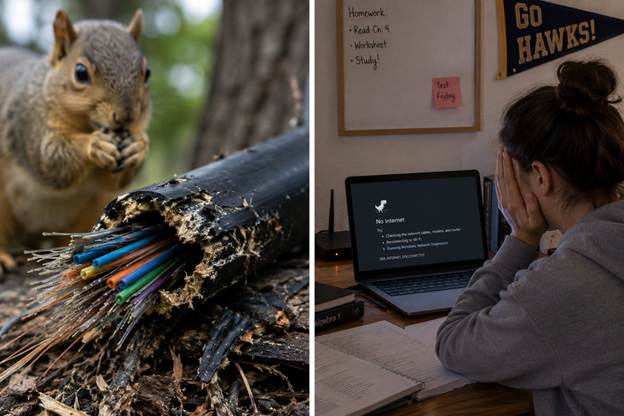
Murray School District faced a constellation of connectivity challenges that exposed both operational vulnerability and deep inequity in student access to learning.
Fragile Backhaul and No True Redundancy
The district’s network relied on fiber links that, despite paper redundancy, shared a physical vulnerability. A single incident — a squirrel damaging a fiber run — caused a widespread outage with no viable failover. The district needed wireless backhaul and redundancy that could survive unpredictable physical events.
The Homework Gap During COVID-19
When schools shifted to remote learning in 2020, connectivity inequity became a crisis. Students in lower-income households had no home broadband, making digital learning impossible. The district used geocoding and socioeconomic data to map exactly where connectivity gaps were most severe — and found significant overlap with its own coverage footprint. Murray’s situation wasn’t unique: Lynchburg City Schools, Campbell Union School District, and Tukwila, Washington faced identical homework-gap crises and reached for CBRS as the solution.
Dead Zones Inside School Buildings
Traditional Wi-Fi and commercial carrier signals degraded sharply inside school facilities. Public safety personnel relying on commercial LTE for 911 communications experienced inconsistent indoor coverage, leading to reduced location accuracy during emergency dispatch. Coordinating operations across a distributed campus environment was equally difficult for staff.
No Off-the-Shelf Playbook
When the district began planning, the technology was newly authorized and equipment was scarce. There was no established model for deploying private LTE at the K–12 level. The team would have to build the playbook as they went — and what they built became the template for the state.
The Solution
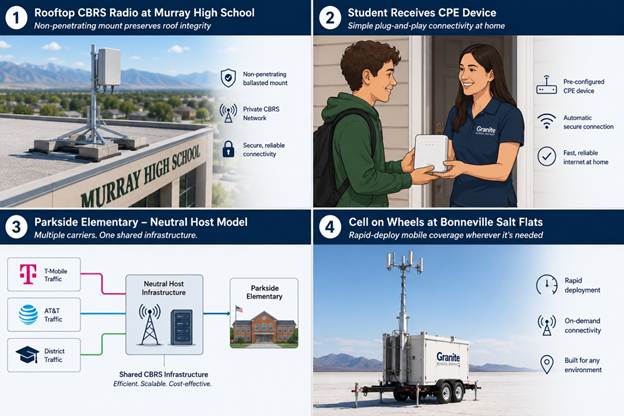
CBRS provided the breakthrough. By deploying private LTE on Citizens Broadband Radio Service spectrum, Murray School District built a dedicated network with carrier-grade performance — no spectrum license required, no carrier dependency, and full control over prioritization and coverage design.
1. Rapid Rooftop Deployment with Non-Penetrating Mounts
The district deployed CBRS radios on non-penetrating roof mounts, enabling fast rollout across multiple school sites without structural modifications. The first installation at Murray High School went live in April 2019. Installation teams iterated quickly, and the network scaled as equipment availability and ESSER pandemic relief funding allowed.
2. Student Connectivity at Home
Using geocoded student data overlaid with socioeconomic indicators, the district prioritized CBRS coverage in neighborhoods where students lacked home internet. CPE devices from Cradlepoint, Multitech, and other vendors were distributed to students, connecting them to the private LTE network and restoring access to remote learning during school closures. State grants and federal ESSER funds covered device procurement at scale. For other districts exploring similar paths, current federal and state broadband funding mechanisms include BEAD and successor programs that build on what ESSER started.
3. Neutral Host for Public Safety and Commercial Carriers
Parkside Elementary became a showcase neutral host deployment. Ten Airspan access points provided private LTE coverage while simultaneously supporting T-Mobile and AT&T traffic through shared infrastructure. First responders gained improved indoor 911 location accuracy — a measurable public safety benefit delivered through the same CBRS network built for students. This model mirrors approaches taken by Chesapeake’s city-wide private wireless deployment and the neutral host experience at Duke University: one infrastructure investment, multiple simultaneous beneficiaries.
4. Mobile Demonstration and Emergency Deployment
The district developed a mobile Cell on Wheels (COW) that could be repositioned for demonstrations, community outreach, and emergency coverage needs. Testing at the Bonneville Salt Flats validated range and performance in extreme open environments, informing RF planning decisions for future deployments across Utah’s varied terrain.
5. Statewide Collaboration
Murray’s work became a template. Working with UEN, state agencies, and private sector partners, the district shared its approach with school districts across Utah. During the pandemic, 16 of Utah’s 40 school districts participated in the CBRS initiative. The neighboring Beaver School District deployed Band 41 LTE-connected Chromebooks and extended rural builds for both safety and agricultural research applications.
| ⚡ PRO TIP: Start with One Site, Build the Blueprint Murray’s statewide impact started with a single rooftop at Murray High School in April 2019. The lesson for other K–12 districts and municipalities: • Begin with your highest-need coverage area and one clean deployment • Document everything — your RF planning, mount approach, CPE selection, and funding sources • That documentation becomes your grant application and your replication playbook Sixteen districts didn’t reinvent the wheel. They used Murray’s. |
Results
| 16 School Districts Connected Utah districts adopted the CBRS model during COVID-19 closures, scaling statewide from Murray’s original deployment | 7+ Years Continuous Operation Surveillance camera use case at Murray High School has run reliably since the first CBRS installation in April 2019 | 911 Indoor Location Improved Neutral host at Parkside Elementary enhanced first responder indoor positioning for emergency dispatch |
What the numbers represent in practice:
- Zero spectrum license cost — CBRS shared spectrum eliminated the single largest barrier to entry for a public school district
- Carrier-grade reach into homes — rooftop radios pushed coverage into surrounding neighborhoods where students lived, reaching families that Wi-Fi cannot
- Multi-use infrastructure — the same investment served student connectivity, commercial carrier coverage, emergency services, and surveillance cameras simultaneously
- Replicable model — Murray’s documentation and statewide collaboration meant 16 districts didn’t start from scratch
How Murray’s Approach Compares to Other K–12 CBRS Deployments
Murray is not alone. A growing cluster of school districts have reached for CBRS to close the homework gap:
| District | State | Primary Use Case | Key Approach |
| Murray School District | Utah | Homework gap + public safety + neutral host | Rooftop CBRS, statewide replication, COW deployment |
| Lynchburg City Schools | Virginia | Homework gap (CBRS) | Student CPE distribution, community coverage |
| Campbell Union School District | California | Digital divide bridging | CBRS private network, low-income neighborhood focus |
| Tukwila School District | Washington | Student home connectivity | Federated Wireless CBRS, CPE to households |
| Ft. Worth ISD | Texas | District-wide CBRS network | Large-scale district deployment |
| Dos Palos Oro Loma USD | California | Homework divide | CBRS for rural student access |
| Alef / Jackson Public Schools | Mississippi | Digital divide (private mobile) | Private mobile network for school neighborhoods |
Conclusion
Murray School District’s CBRS journey demonstrates that private cellular networks built on Citizens Broadband Radio Service spectrum can solve real, urgent problems — not just for enterprises, but for communities. Where commercial carriers left coverage gaps and Wi-Fi fell short indoors, CBRS delivered carrier-grade connectivity that kept students learning, improved emergency response, and gave the district control over its own network destiny.
With just rooftop radios and distributed CPE devices, the district reached students who had no other path to remote learning. Neutral host deployments improved public safety outcomes without building separate infrastructure. With a mobile COW and statewide partnerships, it turned a local innovation into a replicable model for K–12 districts facing similar connectivity challenges nationwide.
For school districts, municipalities, and public institutions wrestling with coverage gaps, equity gaps, and outdated wireless infrastructure, Murray School District’s experience offers a clear blueprint: CBRS doesn’t just solve connectivity problems — it puts institutions back in control of their own wireless future. And as CBRS continues to mature and new federal broadband funding mechanisms come online, the conditions that made Murray’s model possible are only improving.
Frequently Asked Questions
Why did Murray School District choose CBRS instead of relying on commercial carriers or expanding Wi-Fi?
Murray needed a solution that gave it full control over network prioritization and coverage design — something commercial carriers could not offer. CBRS spectrum required no spectrum license purchase and no carrier dependency, while delivering carrier-grade performance. Wi-Fi, by contrast, degraded significantly indoors and could not reach students’ homes in the surrounding neighborhoods. CBRS allowed the district to place radios on school rooftops and push coverage directly into the community areas where students lived — a reach Wi-Fi simply cannot match.
How did the district fund the CBRS deployment, and how can other K–12 districts do the same?
Murray leveraged state grants and federal ESSER pandemic relief funds to procure CPE devices at scale and expand the network. The Utah Education Network (UEN) played a key role as a state partner. For other districts, funding broadband in underserved areas is an active area with multiple mechanisms available — ESSER has wound down, but BEAD and successor federal broadband programs continue the mission. Murray’s experience shows that beginning with a small initial deployment and scaling incrementally as funding becomes available is a proven approach.
What is a neutral host deployment, and why is it significant for public institutions like schools?
A neutral host network is a single shared wireless infrastructure that supports multiple carriers and users simultaneously. At Parkside Elementary, Murray’s CBRS deployment served as a neutral host for T-Mobile and AT&T traffic while also serving students and staff. For public institutions, this is especially significant: the school gained a measurable public safety benefit — improved indoor 911 location accuracy — without funding or building separate infrastructure for that purpose. The same investment served education, commercial carrier coverage, and emergency services simultaneously. For a broader look at how this model is evolving, see Reflections on CBRS and Neutral Host Networks.
Can this model work for districts in rural areas or with limited technical staff?
Yes — and Beaver School District’s deployment is the proof point within the same Utah initiative. Beaver extended rural builds for both public safety and agricultural research using Band 41 LTE-connected Chromebooks, operating in terrain and staffing conditions far from a metro school district. The non-penetrating mount approach minimizes installation complexity, and the statewide collaboration model means districts don’t need in-house RF expertise to get started. Murray’s documentation and UEN partnership provided the template. Districts like Dos Palos Oro Loma in rural California have replicated similar approaches in comparable environments.
Where can I go deeper on CBRS deployments in education and public institutions?
The PrivateLTEand5G.com Connected AI Edge Virtual Bootcamp Series runs May through December 2026 — nine focused sessions for enterprise IT/OT leaders, systems integrators, and public-sector technology teams. Sessions cover private 5G and CBRS architecture, IT/OT convergence, and vertical-specific deployments including education and government. Sessions are recorded and available on-demand to registered attendees. For additional context on how CBRS is being applied beyond manufacturing, see 5G on Campus: Bridging the Wireless Gap in Higher Ed and the CBRS landing page.
Subscribe Now to Get More Insights → PrivateLTEand5G.com