

- Why the Old Wiring Is Running Out of Road
- Private 5G: Wireless That Earns a Seat at the OT Table
- What the Market Is Doing Right Now
- What You Should Do Next
- Frequently Asked Questions
- What is Time-Sensitive Networking (TSN) and why does it matter for factories?
- How does private 5G integrate with TSN on the factory floor?
- What is URLLC and what performance does it deliver?
- Is TSN over private 5G ready to deploy today?
- What has changed with the 3GPP release roadmap since this article was first written?
- What should a manufacturing IT team do first when planning a TSN migration?
- Where can I go deeper on private wireless, AI edge, and enterprise connectivity?
| QUICK ANSWER The factory floor connectivity problem isn’t speed – it’s determinism. A robotic arm running a 250-microsecond control cycle needs a guarantee that its packet will arrive within a known, bounded window every single time. TSN (IEEE 802.1 sub-standards) and private 5G URLLC are now converging to deliver wireless determinism at industrial scale. IEC/IEEE 60802, the industrial automation profile enabling certified multi-vendor interoperability, was published as a ratified standard in 2025. 3GPP Release 19 completed in December 2025, further advancing 5G-Advanced industrial capabilities. The stack is deployable today for well-defined use cases – the integration challenge is the bottleneck, not the technology. |
| 1,900+ Private 5G installations deployed worldwide by February 2026, with 370 in manufacturing alone |
If a robotic arm on your assembly line misses its control signal by just a few milliseconds, what happens? A jitter spike, a stalled cycle, a cascade. The factory connectivity conversation has long been dominated by speed – raw throughput, more bandwidth, faster wireless. That framing misses the point entirely.
The real requirement on the factory floor is not speed. It is determinism – guaranteeing that a packet arrives within a known, bounded window every single time. That is what separates a production network from a regular IT network. And right now, two standards-based technologies are converging to deliver it wirelessly, at scale, for the first time: Time-Sensitive Networking (TSN) and private 5G. For context on how these fit into the broader shift in enterprise wireless infrastructure, the direction of travel is consistent: the old architecture is running out of road.
Why the Old Wiring Is Running Out of Road
Industrial Ethernet has served factories well for decades. But standards like PROFINET, EtherCAT, and EtherNet/IP each require dedicated cabling, switches, and configuration tooling. A single factory floor might run four or five simultaneously in isolated silos, with zero interoperability between them.
TSN changes the equation. Built as a set of IEEE 802.1 sub-standards, it adds deterministic behavior to standard Ethernet, letting time-critical OT traffic and ordinary IT data share the same physical network.
The performance gap is not incremental – it’s categorical:
- TSN synchronization accuracy: below 1 microsecond across a properly configured TSN domain
- Standard NTP: 1 to 10 milliseconds – four orders of magnitude slower
- Robotic motion controller cycle time: 250 microseconds – where that gap is the difference between reliable automation and production stoppages
Private 5G: Wireless That Earns a Seat at the OT Table
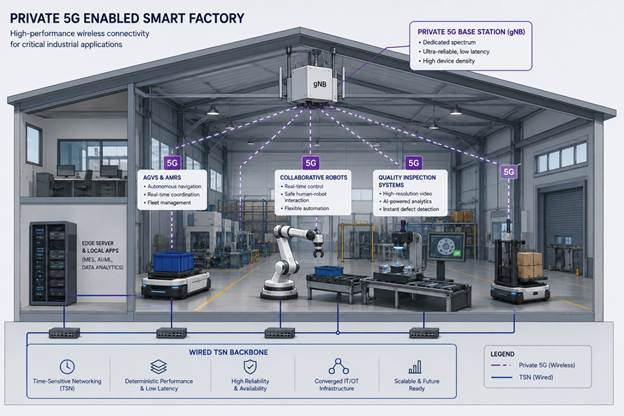
Wi-Fi is fine for laptops and handheld scanners, but its listen-before-talk channel access introduces unpredictability. When 200 IoT devices contend for airtime in a metal-rich factory, jitter is a physics problem, not a configuration one.
Private 5G is built differently. The URLLC capability in 3GPP Release 16 delivers one-way latency of around one millisecond with reliability up to 99.999% under controlled factory conditions – close enough to wireline performance to run real-time control applications. The market reflects this: the global private 5G network market was valued at $3.7 billion in 2024, growing at around 40% CAGR through 2034, with manufacturing the single largest vertical.
From our Private Mobile Networks Deployments Report published in February 2026, more than 1,900 private 5G installations had been deployed worldwide, with 370 in manufacturing. Real deployments – not pilots. Hitachi Rail ran autonomous quality inspections using Boston Dynamics’ Spot robots over a private 5G network at its Hagerstown, Maryland, facility in 2024. That is what industrial deployment looks like today.
How TSN and Private 5G Actually Fit Together
TSN operates at Layers 1 and 2 of the OSI model. Private 5G operates at Layer 3. The 3GPP standard bridges them by having the 5G System act as a virtual TSN bridge – appearing to the TSN management layer as just another set of IEEE-compliant Ethernet switches. TSN translators sit at both ends of the wireless hop, handling the clock domain handover between the TSN precision timing protocol and the 5G air interface. When it works, the 5G link is transparent to the TSN scheduler. When it does not, accumulated jitter breaks the determinism guarantee.
Releases 16 and 17 formalized the integration hooks. Release 18 – finalized in mid-2024 – further extended URLLC and TSN support. The rise of agentic AI and programmable 5G networks adds another dimension: as AI inference moves into the network fabric itself, deterministic data delivery becomes the prerequisite for autonomous machine control, not just a network specification.
What the Market Is Doing Right Now
The vendor ecosystem has moved fast. Nokia, Ericsson, and Cisco are shipping or demonstrating private 5G solutions with TSN integration. Moxa earned the world’s first TSN component certification from the Avnu Alliance in September 2024. Nokia and Telefónica launched a three-year collaboration in July 2024 to deploy 100 private wireless and edge solutions across Spanish manufacturing, ports, and logistics sites. The 2026 enterprise wireless playbook reflects this vendor consolidation: the leading players are no longer just selling connectivity – they are selling integrated OT outcomes.
3GPP release stack for TSN-over-5G: where each release sits today
| 3GPP Release | Key TSN / Industrial Capability | Status (June 2026) |
| Release 16 | TSN integration hooks; URLLC at 1ms / 99.999%; virtual TSN bridge architecture | Finalized 2020 – shipping in hardware |
| Release 17 | TSN enhancements; IIoT/URLLC improvements; NPN support | Finalized 2022 – shipping in hardware |
| Release 18 (5G-Advanced) | Further URLLC + TSN extension; AI-native network features; RedCap IoT | Finalized mid-2024 – hardware reaching market |
| Release 19 (5G-Advanced) | Consolidates Rel-18; further industrial IoT and URLLC refinements; sets 6G baseline | Frozen December 2025 – hardware 2026–2027 |
| Release 20 | 5G-Advanced commercial enhancements + first 6G studies | Underway 2026 – Stage 1 frozen June 2025 |
That said, the integration is not plug-and-play yet. Native 5G endpoint devices with built-in TSN support remain scarce. Dynamic reconfiguration – handling AGVs and moving machinery while preserving deterministic guarantees – is still an active engineering problem. Migrating a factory with legacy PROFINET, EtherNet/IP, and older fieldbus nodes to a TSN-capable infrastructure is a multi-year roadmap, not a single project. The questions enterprises and SIs can’t afford to leave unanswered about the AI edge apply here with equal force: the harder challenge is always integration, not connectivity.
What You Should Do Next

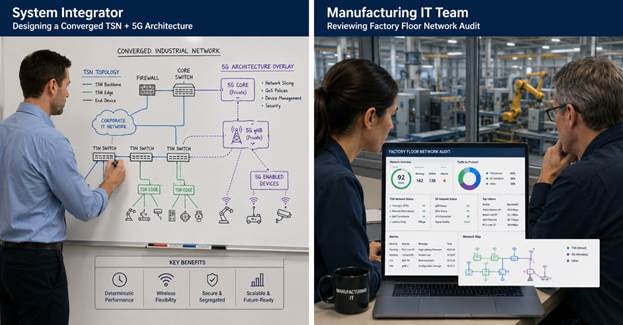
If You’re a System Integrator
The TSN-over-private-5G stack deserves your investment now. IEC/IEEE Std 60802-2025 is published – certified products are following quickly, and the early-mover advantage shrinks with every quarter.
- Get fluent in 3GPP Releases 16–19 and the IEC/IEEE 60802 profile – this is the relevant deployment stack
- Stand up a lab with off-the-shelf TSN switches (Cisco IE3400, Moxa TSN-G5008, or similar) alongside a private 5G testbed to understand synchronization boundary behavior before you put it in front of a client
- The system integrator’s expanding role now runs straight through OT determinism – integrators who can speak to both TSN architecture and 5G network design will be writing the SOWs, not responding to them
- The skills gap in enterprise networking is real – the people who can bridge RF engineering, TSN standards, and OT protocols in a single conversation are rare, and the market rewards them accordingly
If You’re in IT or Network Architecture at a Manufacturing Company
Start with a topology audit. Map your fieldbus protocols, identify proprietary industrial Ethernet dependencies, and flag where AGVs, collaborative robots, or mobile workstations require wireless connectivity.
- Identify every non-TSN switch in your signal path – each one is a synchronization break point
- Flag AGVs, collaborative robots, mobile workstations, and quality inspection systems as first wireless candidates
- Private 5G can start as a wireless extension of a wired TSN backbone and expand from there – the phased approach also builds your investment case stage by stage
- That audit is your business case for a phased TSN migration – see Presenting Private Network ROI to the C-Suite for how to frame each phase
Frequently Asked Questions
What is Time-Sensitive Networking (TSN) and why does it matter for factories?
TSN is a set of IEEE 802.1 sub-standards that adds deterministic, time-synchronized behavior to standard Ethernet. Unlike regular IT networking, where packets are delivered on a best-effort basis, TSN guarantees that time-critical traffic – motor control commands, safety signals, robot synchronization data – arrives within a precisely bounded time window. Synchronization accuracy across a TSN domain is below 1 microsecond, compared with the 1-to-10 milliseconds of standard NTP. For a robotic arm running at a 250-microsecond cycle time, that four orders-of-magnitude improvement is the difference between reliable automation and production stoppages.
How does private 5G integrate with TSN on the factory floor?
The 3GPP standard (formalized in Releases 16 and 17, extended through Release 19) bridges the two technologies by having the 5G System act as a virtual TSN bridge – it appears to the TSN management layer as a standard set of IEEE-compliant Ethernet switches. TSN translators sit at each end of the wireless hop, handling the clock domain handover between the TSN precision timing protocol and the 5G air interface. When configured correctly, the 5G wireless link is completely transparent to the TSN scheduler. The most common failure point is accumulated jitter from a non-TSN-capable switch anywhere in the signal path – which is why a full path audit before hardware procurement is essential.
What is URLLC and what performance does it deliver?
URLLC stands for Ultra-Reliable Low-Latency Communications – the 3GPP capability within 5G NR specifically designed for industrial and mission-critical applications. Under controlled factory conditions, URLLC delivers one-way latency of approximately one millisecond with reliability of up to 99.999%. That is close enough to wireline performance to support real-time control applications that previously required dedicated industrial Ethernet cabling. Wi-Fi cannot match these figures because its listen-before-talk channel access mechanism introduces unpredictable jitter when large numbers of IoT devices simultaneously contend for airtime.
Is TSN over private 5G ready to deploy today?
Yes, for well-defined use cases – with important caveats. Vendors including Nokia, Ericsson, and Cisco are shipping or demonstrating TSN-integrated private 5G solutions. Moxa earned the world’s first TSN component certification from the Avnu Alliance in September 2024. IEC/IEEE Std 60802-2025 – the industrial automation profile enabling certified multi-vendor interoperability – was published in 2025 and is now the active standard. However, native 5G endpoint devices with built-in TSN support remain scarce, and dynamic reconfiguration for moving machinery is still an active engineering challenge. Our PCN deployments report gives a current picture of where real manufacturing deployments stand.
What has changed with the 3GPP release roadmap since this article was first written?
3GPP Release 19, the second 5G-Advanced release, was fully frozen in December 2025. It consolidates and extends the industrial IoT and URLLC capabilities of Releases 16–18. Release 20 is now underway in 2026, addressing commercial 5G-Advanced enhancements while beginning the first formal 6G technical studies. For TSN-over-5G deployments, the relevant spec stack runs from Release 16 (foundational TSN integration) through Release 19, with Release 19-capable hardware expected to reach the market through 2026–2027.
What should a manufacturing IT team do first when planning a TSN migration?
Start with a topology audit. Map every fieldbus protocol running on your current factory floor – PROFINET, EtherCAT, EtherNet/IP, legacy fieldbus variants – and identify which switches, PLCs, and controllers are TSN-capable and which are not. A single non-TSN switch anywhere in the synchronization domain breaks the determinism guarantee across the entire ring. Then flag the use cases that most require wireless connectivity: AGVs, collaborative robots, mobile workstations, and quality inspection systems are typically the first candidates. Private 5G can be introduced as a wireless extension of a wired TSN backbone, adding mobility without disrupting the deterministic core. That phased approach also gives you the business case for presenting the investment to the C-suite – each phase delivers measurable operational value before the next commitment is required.
Where can I go deeper on private wireless, AI edge, and enterprise connectivity?
The PrivateLTEand5G.com Connected AI Edge Virtual Bootcamp Series runs from May through December 2026 – nine focused sessions designed specifically for enterprise IT/OT leaders, systems integrators, and MSPs navigating exactly these decisions. Sessions cover private 5G architecture, IT/OT convergence, AIoT device ecosystems, programmable networks, and vertical-specific deployments across manufacturing, logistics, agriculture, and higher education. Every bootcamp ends with a Pro Tips segment – practitioner-sourced, immediately actionable, and compiled into a downloadable reference card after each session. Sessions are recorded and available on-demand to registered attendees.
Subscribe Now to Get More Insights → PrivateLTEand5G.com