

Insights from the June 2026 “Wireless Beyond Wi-Fi” Virtual Bootcamp – featuring practitioners & experts from Cal Poly, Murray School District, Graybar, OnGo Alliance, and KAIROS Pulse.
| QUICK ANSWER The private wireless debate has moved past Wi-Fi vs. cellular. Practitioners from manufacturing, education, and distribution confirm that enterprise connectivity is now a portfolio decision – Wi-Fi, shared spectrum (CBRS), and private LTE/5G each serve distinct roles. The real barriers to adoption are not a lack of use cases but limited in-house RF expertise, perceived risk, and awareness gaps. Spectrum strategy has become a boardroom issue: enterprises that do not control the airwaves above their facilities risk ceding their operational destiny to hyperscalers and carriers. A simple wireless self-audit is the recommended first step before any technology investment. |
| $1 Trillion Projected global AI CapEx spend in 2026 – three times the entire annual telco CapEx combined. |
For years, the conversation around private 5G was framed as a choice: Wi-Fi or private cellular? That framing misses the point. The real world – and the practitioners operating in it – has already moved past either/or thinking. During the June 2026 “Wireless Beyond Wi-Fi” virtual bootcamp ,hosted by Ashish Jain, CEO of KAIROS Pulse & Co-Founder of PrivateLTEand5G, a panel of enterprise IT leaders, academics, and integrators made one thing clear: the future of enterprise connectivity is plural. It is Wi-Fi and private cellular using variety of spectrum – unlicensed, shared, and licensed, all working together. The question is not which one wins. It is how you orchestrate them.
The Convergence Is Already Happening
Jonathan Polly, who set up Cal Poly’s 5G innovation lab four years ago after a career deploying advanced wireless in oil and gas at Chevron, opened the session with a deliberate reframe of the IT-OT convergence conversation. Rather than focusing on the technical challenges of connecting IT and operational technology (OT) systems, he shifted the lens to market opportunity. The OT market – manufacturing, utilities, transportation, ports, airports – is vast. But getting into that room and being taken seriously requires understanding real operational problems, not just technology capabilities.
What emerged from the discussion is that there is no single connectivity solution that solves everything. A modern industrial facility typically needs:
- Low-latency, high-reliability links for critical control systems and autonomous mobile robots (AMRs)
- Broad-area coverage for asset tracking across large campuses or yards
- Wi-Fi for administrative and general IT workloads
- Robust cybersecurity across all of the above, managed from a single policy layer
Practitioners on the call – including Jason Eyre from Murray School District in Utah and Eric Toenjes from Graybar – confirmed this from the field. They are not replacing Wi-Fi. They are adding to it. And they are doing so because their operational requirements have expanded beyond what a single radio technology can support.
The Real Barriers Are Not What You Think
A question near the end of the session cut to the heart of a common assumption: is private wireless adoption constrained by a shortage of relevant use cases? The panelists were unanimous. “If anybody is telling me they don’t know what use cases to sell, you haven’t really studied the business problems yet,” said Ashish Jain, founder of PrivateLTEand5G.com. The constraint is not use cases – it is awareness and expertise.
Eric Toenjes drew a clear parallel to Wi-Fi 25 years ago. Enterprises did not have RF expertise then either. Most IT teams still have limited knowledge of wireless networks. That knowledge gap creates perceived risk, and perceived risk slows adoption. But it is not permanent – it is the natural friction of any maturing technology. Costs have dropped significantly as competition has increased, and the learning curve shortens quickly with hands-on experience.
Jason Eyre’s perspective from K-12 education was refreshingly pragmatic. His team installed their first radio completely upside down – and learned more from that experience than any whitepaper could provide. For lower-latency-tolerance use cases, 4G LTE may be cheaper and fully sufficient compared to a full 5G deployment, with a larger device ecosystem and a viable used-equipment market.
IT-OT Convergence: Getting Wireless Past the “Kiddies’ Table”
Jonathan Polly framed a critical challenge the industry has not fully solved: wireless is still treated as a secondary system in most OT environments. “Wireless is still kind of at the kiddies’ table in those conversations,” he said. “The opportunity is to make it a first-class citizen.”
The barrier is partly a vocabulary gap. OT professionals and wireless engineers speak entirely different languages:
| Concept | OT / IEC 62443 Language | 3GPP / Private 5G Equivalent |
| Protected area | Security Zone | Network Slice |
| Guarded boundary | Conduit | Slice boundary / VRF |
| Isolated network | Air-gapped segment | Private 5G Standalone (SA) core |
| Device layer | Level 0 (sensors, breakers) | Radio Unit (RU) / embedded SIM |
| Supervisory | Level 2 (SCADA) | Near-RT RIC / xApps |
Building this common vocabulary is essential for wireless vendors to earn a seat at critical infrastructure decisions. As Polly noted, O-RAN’s disaggregated architecture is actually an advantage in OT environments – splitting the CU, DU, and core maps naturally to the network segmentation requirements of industrial control systems. Learn more about private cellular networks in utility sectors.
The Utility Sector: A Proving Ground
Polly cited a landmark GSMA case study from China, where a single province deployed 30,000 base stations in approximately two years to connect an entire utility grid – generation, transmission, transformation, distribution, and consumption. The architecture used 3GPP and O-RAN standards across multiple spectrum bands (Band 48 at distribution substations, Band N26 at transmission substations, Band N106 for remote wildfire risk zones). Explore the growing case for private wireless in critical grid infrastructure.
In the U.S., regulatory pressure is building from a different direction. The 2018 PG&E Camp Fire – which resulted in 85 deaths, widespread property destruction, and a $14 billion bankruptcy for Pacific Gas and Electric – illustrated what happens when critical infrastructure monitoring fails. Fault location, isolation, and service restoration (FLISR) capabilities that can operate in sub-100-millisecond windows exist today. Building the resilient private wireless networks to support them – capable of local breakout and autonomous operation even when the WAN goes down – remains an unsolved challenge across most U.S. utilities.
Spectrum Strategy: If You’re Not at the Table, You’re on the Menu
Kishore Raja, recently appointed CTO of the OnGo Alliance, brought one of the session’s most provocative arguments. As wireless becomes critical infrastructure, the choice of spectrum is not just a procurement decision. It is a strategic one with compounding downstream consequences. “It is a domino effect,” Raja explained. “The choice you make here – it’s the first domino, and that effect will dictate your coverage model, interference risk, device ecosystem, quality of service guarantees, security boundary, investment horizon, and who controls the network.”
Spectrum is to physical AI what GPUs were to generative AI. Raja’s analogy was pointed: companies that controlled GPU compute early defined the terms of the generative AI era. The same dynamic is now playing out in physical-world connectivity. NVIDIA’s compute infrastructure is valued at over $5 trillion. Hyperscalers including AWS and Azure, satellite operators including SpaceX (valued near $2 trillion), and AI platform companies are all racing to control connectivity and compute infrastructure. The projected global AI CapEx spend in 2026 – $1 trillion – is three times the entire annual telco CapEx combined. Read more about what AI connectivity really means for enterprises.
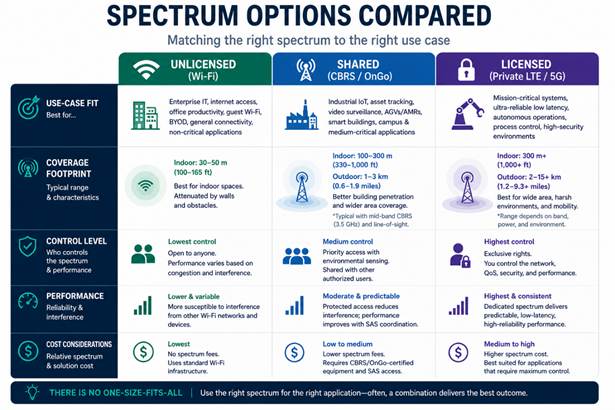
The spectrum landscape for enterprises today spans three distinct tiers:
| Spectrum Type | Examples | Best For | Cost | Control Level |
| Unlicensed | Wi-Fi (2.4/5/6 GHz) | Broadband access, general IT | Free | Low – shared, best effort |
| Shared / Coordinated | CBRS (3.5 GHz), OnGo | Industrial IoT, robotics, deterministic links | Free – Low | Medium – SAS-managed, 3GPP QoS |
| Licensed | N53, 900 MHz, 2500 MHz, 450 MHz, and licensed spectrum from operators and different organizations | Outdoor, wide coverage, exclusive use | Medium – How | High – operator-grade, auctioned |
| Industrial Dedicated | 3.8-4.2 GHz and other bands (28+ countries) | Multinational enterprise private 5G | Low – Medium | Full – enterprise-owned spectrum |
For multinational enterprises, spectrum fragmentation remains a genuine obstacle. The U.S. uses CBRS (3.5 GHz), while over 28 countries have allocated dedicated industrial spectrum (typically 3.8-4.2 GHz) that enterprises can license for under $1,000. The device ecosystem challenge is real: no single radio chipset works across all bands globally. Raja sees AI-driven spectrum management and the OnGo Alliance’s expanded mission as key to solving this. Explore the case for CBRS in American manufacturing and the broader OnGo Alliance evolution.
How AI Is Reshaping Spectrum Utilization
Traditional spectrum optimization is designed for asymmetric, human-driven traffic: roughly 80-85% downlink, 15% uplink. AI changes that model entirely. As Raja explained, AI agents – whether in industrial sensors, AR glasses, or autonomous machines – are constantly streaming uplink data to understand and respond to their environment. Connectivity infrastructure built for human browsing will not perform adequately for machine intelligence. The industry needs to redesign for dynamic, bidirectional traffic patterns. CBRS, as the designated innovation band, is well-positioned to trial these AI-native connectivity models first.
The Framework Question: Start With a Wireless Audit
Ashish Jain introduced a self-assessment framework for organizations trying to determine whether private 5G even makes sense for them. The premise is simple but often skipped: most enterprises have never done a formal wireless audit. Networks get installed, performance degrades over time as use cases multiply, and teams quietly adapt with workarounds – without ever questioning whether the underlying connectivity is fit for purpose.
The wireless self-audit framework asks five categories of questions:
- Reliability: Do you experience dropped connections, dead zones, or intermittent signal loss that disrupts operations? How critical is that impact?
- Device and equipment coverage: Do you have devices that cannot maintain a reliable connection? Does one application’s traffic degrade another’s?
- Coverage and mobility: Are there locations or movement patterns where connectivity fails?
- Security and control: Do you have visibility into what is on your wireless network and the ability to enforce policy?
- Operational impact: Have wireless failures caused work stoppages, slowed throughput, or forced manual workarounds?
Jain noted that in over 50 conversations with logistics companies the previous year, nearly every AMR and AGV vendor reported that their devices were not working reliably on customer-provided Wi-Fi. Most were simply accepting the problem as a given, either unaware of better options or lacking in-house expertise to pursue them. Access the Wireless Self-Audit tool to benchmark your organization’s current connectivity readiness.
The framework is deliberately technology-agnostic. The goal is not to sell private 5G – it is to diagnose whether any gap exists and then match the right solution to the identified need. As Jain put it to system integrators and MSPs: “If you start by pitching private 5G as a panacea, you’ve already lost the deal.” Be the trusted advisor who helps the enterprise understand the gap first.
For system integrators looking to position this service offering, see The System Integrator’s Expanding Role in Private Network Deployments and Building the Enterprise Case: Presenting Private Network ROI to the C-Suite.
What Comes Next
The closing thoughts from the virtual bootcamp panelists were optimistic. Jonathan Polly highlighted the next generation of engineers – computer scientists and electrical engineers combining RF, propagation, and software skills – who are moving faster than any previous cohort. At Cal Poly, students went from zero experience to deploying their own private 5G networks in approximately one week. That velocity points toward a near-term shift in the talent pipeline that will accelerate enterprise adoption. The skills gap in enterprise networking remains real today, but the trajectory is improving.
The practical takeaways from the panel for IT and OT leaders evaluating wireless strategy:
- Do not assume you need the latest technology: 4G LTE may be cheaper and sufficient if your latency tolerance allows it
- Match your management model to the technology: if you run Wi-Fi yourself, you can likely run private cellular yourself; if you outsource, consider a managed cellular service
- Start with operations, not products: map where connectivity actually fails before selecting a solution
- Plan for AI-native traffic patterns: uplink-heavy, continuous-streaming AI agents require different network design assumptions than human browsing
- Get hands-on: experience accelerates understanding faster than any whitepaper; even a home lab with used equipment is a worthwhile investment
The wireless landscape is more complex than it was five years ago – but also more flexible. The organizations that win will be those that treat wireless not as a binary choice between technologies, but as a portfolio strategy: picking the right tool for each job and integrating them seamlessly. Explore how the enterprise LAN is evolving in 2026 with Wi-Fi 7 and private 5G convergence, and read the 2026 enterprise wireless playbook for a broader strategic overview.
Frequently Asked Questions
Is private 5G adoption limited by a shortage of use cases?
No. Every panelist agreed the bottleneck is awareness and in-house expertise, not the number of applicable use cases. The OT sector alone – manufacturing, utilities, transportation, healthcare, and defense – contains enormous untapped demand. The challenge is getting wireless expertise into the room where operational decisions are made.
Should enterprises own their wireless infrastructure or outsource it?
It depends on in-house capability. If you manage your own Wi-Fi, you likely have the skills to manage private cellular. If you outsource Wi-Fi to an MSP, the same managed-service model applies to cellular. The important point: connectivity you do not control is a dependency, not an asset. Enterprises that own their physical sites should have a clear strategy for also controlling the airwaves above those sites.
What is CBRS, and why does it matter for enterprises?
CBRS (Citizens Broadband Radio Service) is the 3.5 GHz shared spectrum band in the U.S., managed through a Spectrum Access System (SAS) that coordinates interference between users. It provides enterprise-grade, 3GPP-based connectivity with SIM-level security and deterministic QoS – suitable for industrial IoT, robotics, and machine control – without requiring a spectrum license or carrier relationship. The OnGo Alliance is now expanding CBRS principles to additional spectrum bands and international markets.
When should an enterprise consider 4G LTE instead of 5G?
If your use cases tolerate latency above 10ms, your device ecosystem requirements favor mature 4G chipsets, or budget is a primary constraint, 4G LTE is often the right choice. The EPC core used for 4G is compatible with 5G NR upgrades, so starting with 4G does not foreclose a future 5G path. A used-equipment market also exists for 4G that significantly lowers proof-of-concept costs.
How is AI changing enterprise wireless requirements?
AI agents – in industrial machines, AR wearables, edge inference devices, and autonomous robots – generate continuous uplink traffic as they stream sensor data for real-time analysis. Traditional network designs that optimize for 80-85% downlink are not suited for this pattern. AI-native connectivity requires symmetric or uplink-biased network planning, plus low-latency local breakout to avoid round-tripping inference requests to the cloud. Read more about what AI connectivity really means for enterprises and the questions enterprises and SIs cannot afford to leave unanswered.
| Explore More Private Wireless Insights Visit PrivateLTEand5G.com for deployment case studies, expert analysis, and practical tools for enterprise wireless decision-makers. |