
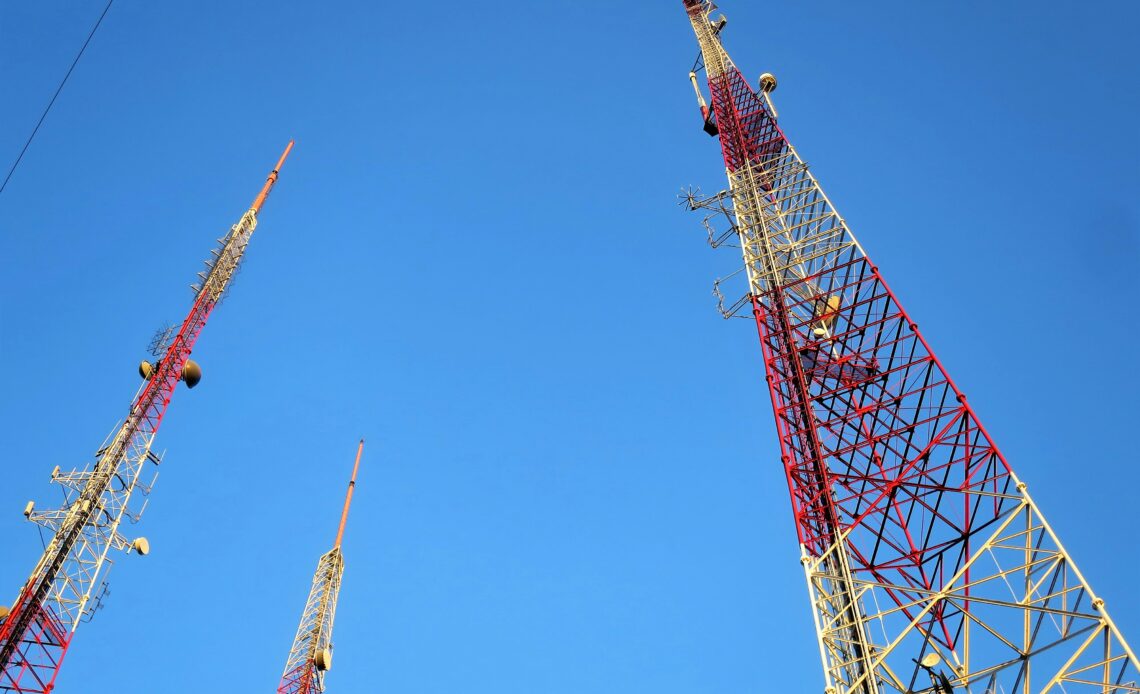
Vertical: Telecommunications
Application: VoLTE, Wi-Fi calling, LTE, 5G, fiber, Sky-Fi wireless
Ecosystem: Vertiv, ISF ICT Infrastructure, Paratus Na
Private Network: LTE/5G
| 2nd Private Cellular Network Now Operating in Namibia Joining the private LTE network at the Rossing uranium mine – two distinct deployment models taking hold in the same market. |
Sub-Saharan Africa’s private network story is being written faster than most industry observers predicted. At one end of the spectrum, mining and energy operators are deploying industrial private LTE to serve autonomous equipment and remote sensor networks. At the other end, telecom operators are building their own mobile cores rather than leasing capacity from incumbents. Paratus Namibia’s launch is a clear example of the second model – and its significance extends beyond the technology to what it signals about the pace of digital infrastructure investment across the continent.
From Regional Provider to Full-Service Mobile Operator
Based in Windhoek, Paratus Namibia is part of the Paratus Group, which describes itself as the largest privately owned pan-African network operator. The company’s trajectory – from regional connectivity provider to full-service mobile operator building its own infrastructure – follows a pattern now visible across multiple African markets, where connectivity gaps, incumbent limitations, and falling equipment costs are combining to make self-built infrastructure economically viable for the first time.
This launch completes that transition. Paratus now controls its own LTE and 5G core, data center, power, and cooling infrastructure, rather than being a tenant on someone else’s network. That distinction matters both commercially, in terms of margin and service control, and strategically, as a foundation for the company’s broader regional ambitions.
| Deployment Detail | Paratus Namibia Launch |
| Operator | Paratus Namibia (Paratus Group – largest privately owned pan-African network operator) |
| Location | Windhoek, Namibia |
| Network type | LTE and 5G |
| Services supported | VoLTE, Wi-Fi calling, LTE, 5G, fiber, Sky-Fi wireless |
| Market served | Residential, business, and mobile customers |
| Data center approach | Converted former storage space at Windhoek facility |
| Infrastructure partners | Vertiv (power and cooling); ISF ICT Infrastructure (commissioning) |
| Key challenge | Global lithium battery shortage – resolved via interim backup battery workaround |
| Significance | Namibia’s first private LTE/5G mobile network; second private cellular deployment in the country |
Turning Storage Space Into a Telecom Data Center
The rollout required converting a previously underused storage area at the Windhoek site into a functioning telecom data center capable of housing racks, power, and cooling equipment at the redundancy levels a live mobile network demands. Paratus was working against strict delivery timelines to get its mobile services live, leaving little room to rework the design once construction began.
Vertiv and its local partner, ISF ICT Infrastructure, handled the build-out, layout, and commissioning of the facility. The conversion approach – repurposing existing space rather than commissioning a new-build data center – is increasingly common in markets where speed to market is a competitive variable and construction timelines for purpose-built facilities are measured in years. For Paratus, it was also a pragmatic response to the specific constraints of the Windhoek site.
Power and Cooling: Built for Redundancy and Scale
Vertiv’s equipment selection was designed for a facility that needed to scale with demand while keeping power and cooling redundant enough to avoid service interruptions in a live mobile network environment. The infrastructure spans both indoor and outdoor deployment:
| Equipment | Role in the Deployment |
| Liebert PDX cooling units | Direct-expansion cooling with variable-speed compressors – adapts cooling output to real-time heat load, reducing energy consumption at partial utilization |
| Liebert APM Plus UPS | Modular uninterruptible power supply on lithium-ion batteries – provides power continuity and supports incremental capacity expansion without full system replacement |
| PowerIT rack PDUs | Rack-level power distribution, enabling per-outlet monitoring and remote management across the data center |
| NetSure 7100 system | Combined AC inverter and DC rectifier in a single unit – supplies both AC and DC power to radio equipment across multiple sites, reducing the number of separate power conversion systems required |
The modular architecture of the Liebert APM Plus UPS is particularly relevant for a deployment expected to grow with the operator’s subscriber base – modules can be added incrementally as load increases, avoiding the over-provisioning cost common in fixed-capacity UPS installations. For a new mobile operator building its first own infrastructure in a market where capital efficiency matters, that flexibility has real financial value.
Working Around a Global Battery Shortage
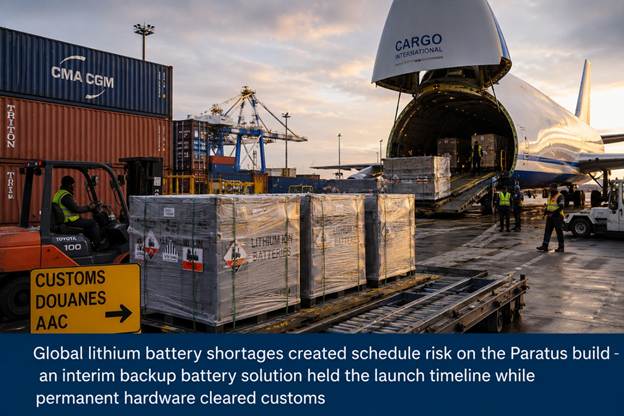
The project’s biggest complication was not the design – it was the supply chain. Lithium battery availability was constrained globally during the build-out period, and Namibia’s geographic position at the end of long supply chains added lead time that could not be compressed. Rather than delay the launch, the team used interim backup batteries to maintain the schedule while permanent lithium-ion shipments arrived in Windhoek.
That kind of hardware substitution workaround is becoming more common on private network builds globally, where equipment lead times – for batteries, semiconductors, and specialized radio components – do not always align with a customer’s target launch date. The lesson from Paratus’s approach is a practical one: identify the long-lead items at the start of the project, build interim solutions into the schedule before they become crises, and treat the supply chain as a design constraint, not a procurement function.
| KEY INSIGHT Battery lead times were the critical path item on this project – not the radio equipment, not the data center conversion. On any private network build with a firm launch date, map your long-lead components in the first week of planning. Lithium-ion batteries, specialized RF components, and certain UPS modules have been running 16-26 week lead times in some markets. An interim solution is always available; discovering you need one at Week 14 is not. |
What the Network Delivers
The finished network gives Paratus Namibia a single infrastructure base to serve residential, business, and mobile customers – without dependency on a third-party carrier’s infrastructure for any of those segments. The service portfolio:
- VoLTE (Voice over LTE): HD voice calling over the LTE data network, eliminating legacy circuit-switched voice infrastructure and enabling simultaneous voice and high-speed data on a single connection
- Wi-Fi calling: Voice calls routed over Wi-Fi connections, extending coverage for subscribers in areas where LTE signal is limited – particularly relevant in Namibia’s mix of urban and remote terrain
- LTE and 5G connectivity: Mobile broadband for consumer and business customers, with 5G capacity positioned for future demand growth as device adoption increases
- Fiber access: Fixed broadband for business and residential customers in Windhoek and connected areas
- Sky-Fi wireless: Wireless fixed broadband access extending connectivity beyond the fiber footprint
The combination of mobile and fixed infrastructure under a single operator-owned core is what distinguishes this deployment from a managed service arrangement. Paratus has direct control over network slicing, service prioritization, and capacity planning – capabilities that matter competitively in a market where incumbent carriers have had limited incentive to invest in underserved segments.
| “Our vision has always been to build our own infrastructure as the foundation for long-term growth. With Vertiv and ISF ICT Infrastructure, organisations where we have long-standing trust, we were able to overcome space constraints, aggressive timelines, and complex technical requirements to roll out scalable, redundant, market-leading solutions, backed with added technical capabilities.” – Gert Duvenhage, Group Chief Technical Officer, Paratus Group |
A Broader Signal for Africa’s Digital Infrastructure
Namibia now has two distinct private cellular deployments operating simultaneously: the Paratus mobile operator build, and the private LTE network at the Rossing uranium mine serving industrial operations. Those two deployments represent the two ends of the private network spectrum – a full-service mobile operator building its own core, and an enterprise deploying private LTE for a specific operational use case. Both are now operating in the same small market.
Across the region, the pattern is accelerating. The Beira Port private mobile network in Mozambique, Vodacom’s private network at the Sasol Secunda facility in South Africa, Airtel’s private telecom network for oil operations in Congo Brazzaville, and MTN, Huawei, and China Telecom’s private network for mining in South Africa all point in the same direction: private cellular infrastructure is no longer a solution reserved for markets with mature public networks – it is becoming a first-choice option in markets where public infrastructure has not kept pace with demand.
| Deployment | Country | Model | Vertical |
| Paratus Namibia | Namibia | Operator-built mobile core | Telecommunications |
| Rossing Mine – MTC | Namibia | Enterprise private LTE | Mining |
| Beira Port – Sedna Africa | Mozambique | Port private mobile network | Logistics / ports |
| Sasol Secunda – Vodacom | South Africa | Operator-managed private network | Energy / petrochemical |
| Airtel Congo – Oil operations | Congo Brazzaville | Private telecom for enterprise | Oil and gas |
| MTN / Huawei / China Telecom | South Africa | Mining private network | Mining |
| KEY INSIGHT The African private network story is not a single deployment model. It spans operator-built mobile cores, enterprise industrial deployments, port logistics networks, and energy sector private wireless – all driven by the same underlying reality: public infrastructure investment has not kept pace with connectivity demand, and the equipment cost curve has now made self-built infrastructure viable. |
Related Reading
- Paratus Disrupts Namibian Mobile Market with First Private Network Launch
- Connected Underground – MTC’s Private LTE at Rossing Mine, Namibia
- Private Cellular Networks Are Transforming Industries in the World’s Most Isolated Places
- Beira Port Partners with Sedna Africa to Deploy Private Mobile Network
- Vodacom Business Deploys Private Mobile Network at Sasol Secunda Facility
- Airtel Congo Deploys First Private Telecom Network for Oil Operations
- Telecom Operators and Their Strategy for Private Networks and Security
- Private Networks and Supply Chain – Coping with Shocks with Data
Frequently Asked Questions
Q1: What makes this a ‘private’ network if Paratus is operating it as a public mobile service?
The term ‘private’ in this context refers to the ownership and control model rather than the subscriber base. Paratus Namibia built and operates the underlying data center, power, cooling, and LTE/5G core infrastructure itself, rather than leasing capacity from an existing national carrier or building on a third party’s infrastructure. That gives Paratus direct control over network architecture, service quality, capacity planning, and commercial terms for everything running on it – including the mobile services offered to residential and business customers. It is the same logic that drives enterprises to deploy their own private LTE rather than use a carrier’s shared network: control, security, and long-term cost structure. In Paratus’s case, the business case was about building a competitive foundation as a full-service operator, not just reducing operational dependency on an incumbent.
Q2: Why did the data center go into a former storage space rather than a purpose-built facility?
Speed was the primary driver. A purpose-built data center at a new location would have extended the project timeline significantly – construction, permitting, and fit-out for a new facility in Windhoek would likely have added 12-18 months to the schedule. Repurposing existing storage space at the Paratus site allowed the team to work within a fixed footprint with known infrastructure constraints, focus the design work on power and cooling redundancy rather than site selection and civil works, and meet Paratus’s target launch timeline. The trade-off is a facility that was designed around the constraints of an existing space rather than optimized from a blank canvas – but for a first deployment under time pressure, it was the right call. The modular nature of the Vertiv equipment means the data center can be expanded incrementally as capacity requirements grow, without a full redesign.
Q3: How did the team handle the global lithium battery shortage without delaying the launch?
The team identified early that lithium-ion battery availability was the critical path item on the project, not the radio equipment or the data center conversion work. Rather than hold the entire launch pending battery delivery, they specified interim backup batteries that could be sourced locally or on shorter lead times, providing the UPS systems with sufficient backup capacity to support a live network during the gap. Once the permanent lithium-ion shipments arrived and cleared customs, the interim batteries were swapped out. This kind of staged hardware approach is increasingly common on private network builds where launch dates are commercially fixed. The key is identifying the long-lead item early enough that an interim solution can be designed into the project schedule – not discovered when the equipment has not arrived two weeks before go-live. For a broader context on supply chain risk management in private network deployments, Paratus’s pattern is becoming a standard design consideration.
Q4: What does this deployment tell us about the trajectory of private networks across Sub-Saharan Africa?
It tells us that both deployment models are now viable and operating simultaneously in the same market. Namibia has a full-service mobile operator that built its own LTE/5G core – and a mining operation running private LTE for industrial automation underground. Those are fundamentally different use cases, but the same underlying dynamic drives both: public infrastructure investment has not kept pace with demand, and equipment costs have fallen to the point where building your own is commercially viable. The same pattern is now visible at the Beira Port in Mozambique, Sasol Secunda in South Africa, and oil operations in Congo Brazzaville. Private cellular networks are becoming a first-choice option in markets historically underserved by public infrastructure – not a fallback for markets that cannot afford something better.